

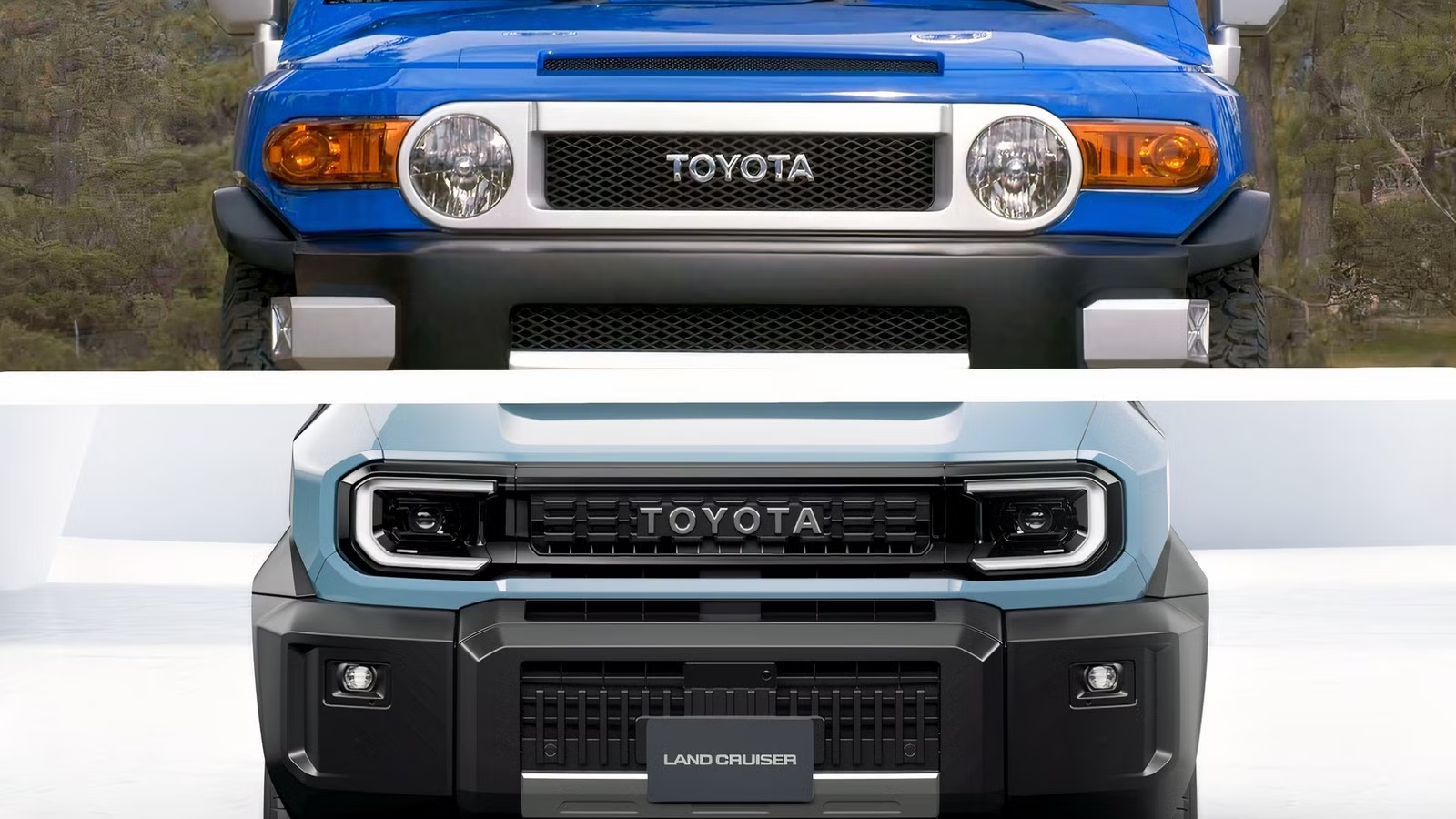
While both bear the iconic “FJ” badge, the Toyota FJ Cruiser and the classic FJ Land Cruiser serve completely different generations of off-roaders. The legendary FJ Land Cruiser—specifically the iconic FJ40—built Toyota’s reputation for bulletproof, go-anywhere durability starting in the 1960s. Decades later, the 2000s FJ Cruiser arrived as a retro-styled homage, combining modern comfort and mechanical reliability with distinct design cues. Here is how these two legendarily rugged 4x4s stack up side-by-side.
The Target Market
Different Strokes For Different Folks
A front three-quarter shot of a 2007-2014 Toyota FJ Cruiser off-roading Toyota
In the early 2000s, Toyota Motor Corporation’s product development team was apparently convinced the company was not catering sufficiently for young male customers. Specifically, North American, young male customers. They believed these potential customers had an adventurous spirit and wanted to explore the great outdoors in a rugged, cool vehicle that not only looked the trendy part, but could also go the whole nine yards on a tough off-road track. The so-called Rugged Youth Utility (RYU) program was born.
The retro-styled 4WD was comprehensively tested in demanding North American locations like Moab and the Mojave Desert. The new FJ went on sale in 2006, attracting — mostly, but not exclusively — young, male adventure seekers who also wanted to tick the ‘cool car’ box.
The new Toyota Land Cruiser FJ going the off-road mile.Toyota
Fast-forward to today. The new FJ makes its debut, almost breaking the internet. Still retro-styled, still cool, and packing serious 4WD hardware, the latest FJ seems to tick all the North American boxes the first-generation vehicle did. Except the new FJ is not aimed at the US or Canadian markets at all. Instead, it will be sold in markets around the world — everywhere except Canada and the USA. The new FJ was designed to appeal to the broader international market, with no gender-specific elements: a more universally minded take on the FJ formula, if you like.
Doorway To Heaven?
Rear-Hinged Doors Versus Front-Hinged Doors
2015 Toyota FJ Cruiser, with cool but rather impractical rear-hinged rear doors.Bring A Trailer
In an effort to stand out from the crowd and make the four-door FJ Cruiser look like a two-door, the designers gave the previous-generation Cruiser rear-hinged rear doors. At first glance, this was super cool. But actually living with the feature on a day-to-day basis was less rosy.
Rear-seat passengers can’t exit the vehicle if the front doors are closed. So you’d open the front door, open the rear door, slide the front seat forward, and only then could rear passengers clamber out. Very cool when there are just two of you, but far less practical for families.
The new Toyota FJ Cruiser has four conventional doors.Toyota
The all-new FJ Cruiser comes with four conventional doors, no longer pretending to be a two-door. And it still manages to look pretty cool too.
Four Versus Six
Four-Cylinder Engine Versus V6
The original Toyota FJ Cruiser came with a four-liter V6 engine.Bring A Trailer
The 2006 Toyota FJ Cruiser is powered by the brand’s well-proven 1GR-FE V6 engine. The four-liter unit has been around since 2002, earning a solid reputation for reliability and plenty of never-say-die grunt. But the engine is now a quarter of a century old, and hails from an era when big-capacity engines were the preferred option, with far less emphasis on emissions or fuel economy.
The V6 received power upgrades over the years, yet still managed only around 18 MPG on average.
The new FJ Cruiser is powered by Toyota’s equally well-proven 2TR-FE 2.7-liter four-cylinder engine. It won’t be keeping pace with a Toyota Prius at the pump, but it will represent a meaningful improvement over the thirsty V6.
Power Play
272 HP Versus 160 HP
2014 Toyota FJ Cruiser, a power player.Bring A Trailer
Engine
4.0-liter V6
Horsepower
272 hp
Torque
278 lb-ft
0-60
7.4 seconds
You could have the older FJ Cruiser with any engine you liked, as long as it was Toyota’s four-liter 1GR-FE V6 gasoline mill, delivering 272 hp. The never-say-die V6 was paired with either a six-speed manual gearbox or a five-speed automatic. Old-school cool, and with 272 hp on tap, it was a genuinely powerful thing.
Even though the FJ Cruiser could sprint to 60 mph in less than eight seconds, its higher emissions are said to have played a significant role in its eventual discontinuation, compounded by heavy fuel consumption at a time when gas prices surged. Sales eventually slowed to a trickle.
2025 Toyota FJ Cruiser, with the rest of the Land Cruiser family.Toyota
Engine
2.7-liter Inline-4
Horsepower
160 hp
Torque
181 lb-ft
0-60
9 seconds (estimated)
The new FJ Cruiser’s 2.7-liter four-cylinder engine produces 160 hp, along with a handy 181 lb-ft of torque. This should allow the new FJ to reach 60 mph in under 10 seconds — so no, the new FJ Cruiser is no traffic-light racer. But it will drink considerably less fuel than its V6-powered predecessor, and still deliver plenty of poke around town. With 181 lb-ft of torque, it should also prove capable on a tough 4WD track. More on that shortly.
A Platform Of Change
Climbing The Ladder (Frame) To Success
Toyota FJ Cruiser, at rest.Bring A Trailer
The original Toyota FJ Cruiser is based on the Toyota Land Cruiser Prado J150 platform. Ironically, the Prado is sometimes described as a ‘light-duty’ Land Cruiser when compared to its more hardcore 4WD cousins like the 70 Series. The biggest difference between the FJ Cruiser and the 70 Series setup is the Prado’s front independent suspension, versus the Cruiser 70’s live axle layout. The result is a 4WD that is far more comfortable on the road, but ultimately more compromised in a truly demanding off-road environment.
2025 Toyota FJ Cruiser, side view.Toyota
The all-new FJ Cruiser shares its Innovative International Multi-purpose Vehicle (IMV) platform with a raft of well-proven Toyota products, including the tough-as-nails Hilux truck, the Fortuner SUV, the Champ pick-up, and the Innova MPV. This is not just good news — it is great news. Toyota could have gone the unibody route, as with the popular RAV4, which would have meant the new FJ Cruiser looked cool and offered a car-like ride, but was limited to gravel tracks and pavement.
4WD To The Max?
‘Light Duty 4WD’ Versus ‘Even Lighter Duty 4WD’?
The 2014 Toyota FJ Cruiser has some real 4WD skills.Bring A Trailer
As mentioned, the first-generation FJ Cruiser has a tough ladder-frame chassis, with an independent front end providing on-road comfort alongside genuinely capable off-road performance. Hailing from a time before terrain-response systems became the norm, the FJ got a comprehensive array of electronic off-road aids, including a newly developed A-TRAC setup. This system brakes wheels that have lost traction, diverting power to those that still have grip. It was no gimmick either — even without a dedicated differential lock, A-TRAC allowed the FJ to clamber over some seriously challenging terrain.
A transfer case, all the grunt from the V6 engine, and useful approach, departure, and breakover angles also played their part in ensuring the FJ Cruiser could go the whole nine yards off the beaten track. Aftermarket companies developed a wide range of off-road accessories for the FJ, boosting its 4WD credentials even further.
The new FJ Cruiser comes with some real 4WD credentials.Toyota
Toyota could so easily have fallen into the trap of simply giving the world a retro-styled, cool-looking little SUV on a unibody platform. Instead, they went all in on the new FJ Cruiser’s 4WD capability. Although specific details about its 4WD systems are still emerging, here’s what we know so far. Built on the IMV ladder-frame platform with an independent front suspension setup, the new FJ is said to offer the same levels of wheel articulation as the brand’s hardcore Cruiser 70. It gets a transfer case and, by all indications, a rear differential lock, with electronic off-road aids expected as well.
The smaller dimensions, aided by genuinely short overhangs, further confirm that this FJ is no pavement special — it is the real 4WD deal. Heck yeah for that.
Cabin Fever?
Retro Cool Versus Modern Cool
2014 Toyota FJ Cruiser interior. Retro cool.Bring A Trailer
The 2006 FJ Cruiser came with a retro-styled cabin that was undeniably cool for its time. It offered all the basic kit you’d expect from a higher-end 4WD of that era. By modern standards, though, it is decidedly dated.
The new 2025 Toyota FJ Cruiser’s cabin is a modern, up-to-date business.Toyota
The new FJ Cruiser’s cabin retains some retro elements — the air vents, for instance, hark back to the old-school items found on the 70 Series. But otherwise, it is a thoroughly modern setup, featuring all the creature comforts and amenities today’s buyers expect, including the large infotainment screen that has become standard fare in any contemporary SUV.
Neat detailed touches include a grab handle for the driver — an obvious omission in many modern 4WDs, which tend to cater only for passengers. It may not seem like a big deal, but it makes a lot of sense when you need to get in and out of a 4WD parked at an awkward angle on an off-road track.
Less Is More?
Less Size, More Practicality?
2025 Toyota FJ Cruiser front viewToyota
2025 Toyota FJ Cruiser
2006 Toyota FJ Cruiser
Length
180.1 inches
183.9 inches
Width
73 inches
75 inches
Height
77.1 inches
72.4 inches
Wheelbase
101.5 inches
105.9 inches
The 2006 Toyota FJ Cruiser is longer and wider than the new FJ Cruiser. Most notably, the new FJ’s wheelbase is a substantial 4.4 inches shorter than its predecessor. But even more interestingly, the new FJ is also a considerable 4.7 inches taller than the original.
This bodes particularly well for interior space, reinforcing the impression that the newer version is a considerably more practical offering than the original.
Saving The Planet, One FJ At A Time
Less Environmental Impact, Easier On The Pocket
The new Toyota FJ Cruiser features a modular design, with a myriad of customization options.Toyota
Fewer cylinders. Less engine capacity. A smaller body. Less weight (presumably). An updated version of Toyota’s well-proven 2.7-liter gasoline engine. It all adds up to lower emissions, reduced fuel consumption, and likely lower taxes in the markets where it will be sold.
A New Modular Age
Customization Options Galore
The new Toyota FJ Cruiser will come with a host of custom body parts that customers can choose from. This includes headlights, bumpers and more.Toyota
The new FJ Cruiser builds on the modular philosophy of its cousin, the Toyota Champ pick-up, which launched internationally in 2023. Designed with extensive customization in mind, components like the segmented bumpers can be swapped out in sections — handy for replacing damaged parts without replacing the whole assembly.
Toyota will also offer a host of factory options, including heritage-style headlights, roof racks, snorkels, bash plates, and more. In short, customers will be able to tailor their FJ into a unique, retro-styled 4WD that is distinctly their own.
Sources: Toyota
