

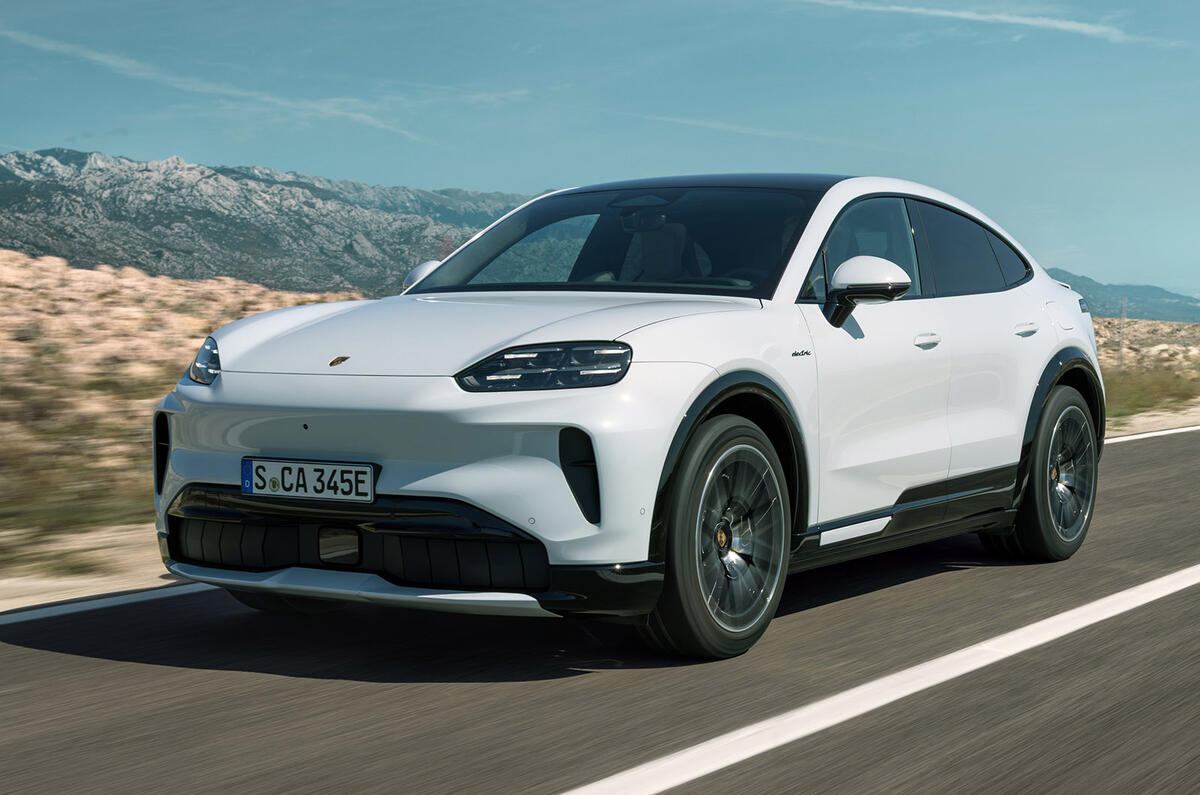
We’ll start in the obvious place here. What does 1140bhp and 1106lb ft feel like, out on the road, in an electric SUV from one of the world’s most prestigious performance brands?
Well, if you just get in and drive it about in Comfort or Normal mode, it feels incredibly civilised. Almost zen-like, actually. There’s tyre noise from the enormous 22in Michelin tyres but almost no motor whine; wind noise is subdued; and you breeze along, trying not to be tempted by the ‘push to pass’ button.
Activate launch control, mash the brake pedal and then mat the accelerator, and the launch control mode activates in a delightfully understated Porsche manner. Given the madness you’re about to unleash, it feels there should be sirens and flashing lights and big warning triangles – but the Cayenne just shrugs and gives a deliciously nonchalant mode warning on the driver’s display before, well, accelerating really fast.
I remember when I first drove the Nissan GT-R and did a full launch, it felt like the world detonated. Big noise, big vibrations, big drama. Huge, memorable, laugh-out-loud moments, even as you prayed that the grinding noises from the gearbox were supposed to be happening.
Oddly enough, the actual power delivery of the Cayenne Turbo reminds me of the GT-R’s. It’s a touch more subdued than the Taycan, and feels as if it has been tuned to be a bit gentler and more linear, to suit the car’s posh family runabout nature, so there’s a bit more nuance to it. But predictably, the Cayenne just feels uncomfortably rapid. Not undramatic – but it’s so easy that it’s almost underwhelming, even as you try to persuade your stomach to unclench itself from your spine.
In more normal modes, the Cayenne’s throttle response is pleasantly responsive yet easy to modulate, and while the Taycan has more feelsome brake response, the Cayenne’s (whether you’ve added optional ceramics or not) are still some of the best brakes of any performance EV.
And what of the mid-range S model? Well, a 657bhp electric Porsche Cayenne is not, it turns out, in want of urgency, either. It doesn’t quite rocket off the line like the Turbo; but still, any car this size that can hit 62mph from rest in less than four seconds has to be considered a very serious performance prospect indeed. The S feels like the rubicon beyond which Cayenne Electric performance extends into the realm of the gratuitous; or, to put it another way, it’s all the Cayenne Electric any really needs.
Porsche meters the car’s accelerator and brake pedal progression in suitably linear fashion, so the car only ever responds to either how you expect it to. Unlike in the Taycan, no gearshift is necessary in order for the car to keep piling on the pace, which it’ll do urgently all the way up to fast autobahn speeds. Regen, meanwhile, is controlled either through a handy shortcut ‘button’ on the central touchscreen, or via the selected drive mode dialled in via the steering-mounted rotary knob (if you want it off entirely, you can have that).
After all that, the standard Cayenne Electric’s 436bhp and 0-62mph time of 4.8sec sounds almost weedy, but in practice it’s a muscular and serene thing to drive that offers 90% of what even the Turbo can do for a lot less.
