

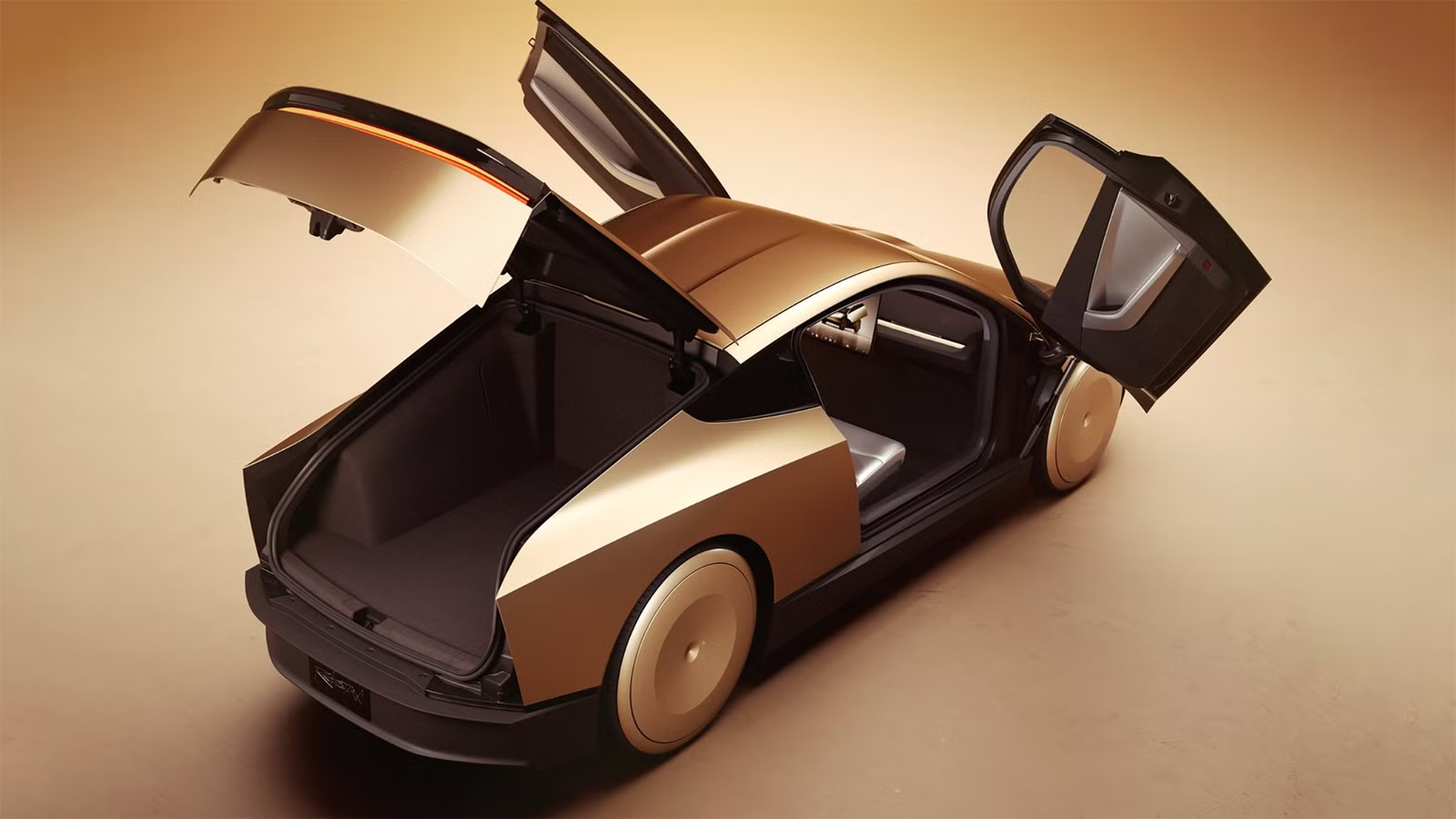
It might seem strange to declare that a taxi service controlled by autonomous driving technology is a “big win” for driving enthusiasts, because at first, such services might seem the exact opposite. However, we’re not placing said enthusiasts within the taxis; instead, we’re placing everyone else who simply isn’t interested in driving within them, and that changes the picture somewhat.
How Autonomous Driving Services Could Improve Life On The Road For Us All
Gold Tesla Robotaxi rear on roadTesla
It’s not just Tesla’s Robotaxi we’re discussing here, but any autonomous service, such as Waymo, and the Rimac-developed Verne Robotaxi alternative too. The thought here is that super convenient and cost-effective autonomous driving solutions could develop into the perfect commuting solution for those who simply don’t enjoy driving.
Consider the sort of driver who might be tempted to zone out during a dull commute, flick through their WhatsApp notifications, or sneak in a quick scroll of their social feeds while trudging along in slow-moving traffic. Our own Gerhard Horn noticed exactly this while zipping around the tight city streets of Tokyo in an autonomous Nissan Ariya:
“I used to be under the impression that fully autonomous driving would not be a reality in my lifetime. That was until I completed a journey in the Nissan Ariya ProPilot Prototype in Tokyo, one of the most populated cities in the world, in peak hour traffic. It was a drama-free experience, and I’m surprised at how comfortable I was without a driver.
It also made me wonder whether I’d rather share the road with an autonomous car that knows what it’s doing, or a completely indifferent human who is only on the road because they have no alternative. The kind of person who would rather scroll through TikTok than pay attention to the road ahead” — Gerhard Horn, Senior Editor, CarBuzz
Those of us who actually enjoy the act of driving, and can happily go 30 minutes without having to check in on their social accounts, flick through podcast or playlist options, or just generally avoid any sort of obvious distraction, can then go about their business more confidently and comfortably, knowing those who aren’t interested in driving anymore aren’t. In theory, at least, but at the end of the day, every time an uninterested driver chooses an autonomous taxi over driving themselves is surely a small win for the rest of us motorists.
We’re Not Exaggerating The Problem
Texting While Driving IIHS TestIIHS
There is plenty of solid evidence to suggest there are thousands of motorists out there who seem to think the act of driving need not be their primary concern when at the helm of a car. The NHTSA tells us that distracted driving claimed 3,208 lives in 2024 alone, while 315,167 were injured as a result of associated bad habits. While distracted driving covers everything from talking on the phone to eating and drinking, it’s texting that’s the real concern – a car will travel the entire length of a football field while you send a quick five-second text at 55 mph.
And in some cases, that’s not even illegal. Missouri finally passed a statewide ban in late 2023 on texting while driving, but still no such ban exists in Montana, meaning it’s perfectly legal to message your friends while darting down the highway, commuting through a city center, or indeed zipping along through a residential street.
According to the IIHS, over 20% of drivers engage in at least one smartphone-based distraction on most or all of their trips, be that a text, video call, social media check, or anything else. And that’s only the reported figures; the reality could potentially be a lot worse. Surely, the rest of us would indeed classify these motorists moving into an autonomous vehicle as a big win?
Autonomous Driving Tech Takes Convenience A Step Further
What? No steering wheel, or pedals? Although the concept is cool, the current format, without the option for a driver to take over the controls in case of an emergency, won’t fly with the NHTSA.Tesla
There is plenty to attract folk to services like Tesla’s Robotaxi, too. For starters, these are fully autonomous solutions, not just partially autonomous, so occupants can text, video call, and scroll mindlessly to their heart’s content, safe in the knowledge that the taxi won’t ever ask them to step up and take control. The Robotaxi concept didn’t even have a steering wheel or pedals, clearly demonstrating the lack of involvement required by those inside.
Now, there are similar solutions out there already, like buses, or just regular taxis, so why haven’t old-world solutions like this eradicated our roads of uninterested drivers? Well, while buses and trains are typically far cheaper than taxi services, they aren’t as convenient, requiring occupants to travel to stops and stations, share the space with others, and avoid direct routes. While a traditional taxi service comes close, with the Robotaxi and its rivals there will be lower operational costs, no space for human error – both behind the wheel and in terms of timing or fatigue – and an autonomous taxi offers enhanced levels of security and privacy, too.
Surely, the ultimate answer would come in the form of private autonomous vehicle ownership. While the initial outlay will obviously be a lot more than just hailing a taxi, it would likely be easy to justify, as it’s simply buying a car, and private car ownership is certainly nothing new. So, yes, as the technology develops and becomes more mainstream, it’s easy to see how and why those who genuinely don’t enjoy or care for the act of driving would lean toward autonomous solutions. And if doing so helps us to reduce those aforementioned statistics, then it’s absolutely both a win worth celebrating and a reality worth chasing.
The Tech Isn’t Quite There Yet
Tesla Model Y RobotaxiTesla
We need not get too excited, though, as judging by the state of Tesla’s recent Robotaxi performances, there is still a while to wait before the world’s more distracted drivers find their way into autonomous cabins. In fact, the service appears to be falling flat on its face, with trials in Texas proving there is much still for the automaker to learn. To be specific, it was arriving late, refusing to take left turns, and dropping occupants off in the wrong location.
Other limitations of such services include an inability to read deteriorated or vandalized road signs, or indeed navigating cul-de-sacs, but automakers keep persevering, so it’s surely only a matter of time before services like this transition from novelty into the mainstream.
Driving Will Become A Choice Instead Of A Chore
2026 Honda Civic Si driving front 3/4 angleHonda
When all is said and done, if Waymo, Robotaxi, Verne, and any other fully autonomous taxi services finally figure out how to read and navigate the road efficiently enough to become a widespread solution to the troubles of motoring, what we’ll end up with is the act of driving itself becoming a choice, rather than a necessity.
Be it for picking the kids up from school, grabbing the groceries, or commuting to work, the roads would be lined with robots that are programmed to pay attention, rather than bored drivers who would rather be checking in with their partners on what’s for dinner, or sending an ETA to the group chat. So there you have it, autonomous driving services could actually prove to be a huge win for proper enthusiasts, once the creases are ironed out, making the roads a far safer place for us to head out and enjoy, whether that be on the morning commute or on a weekend cruise.
Sources: Tesla, NHTSA, IIHS.
