

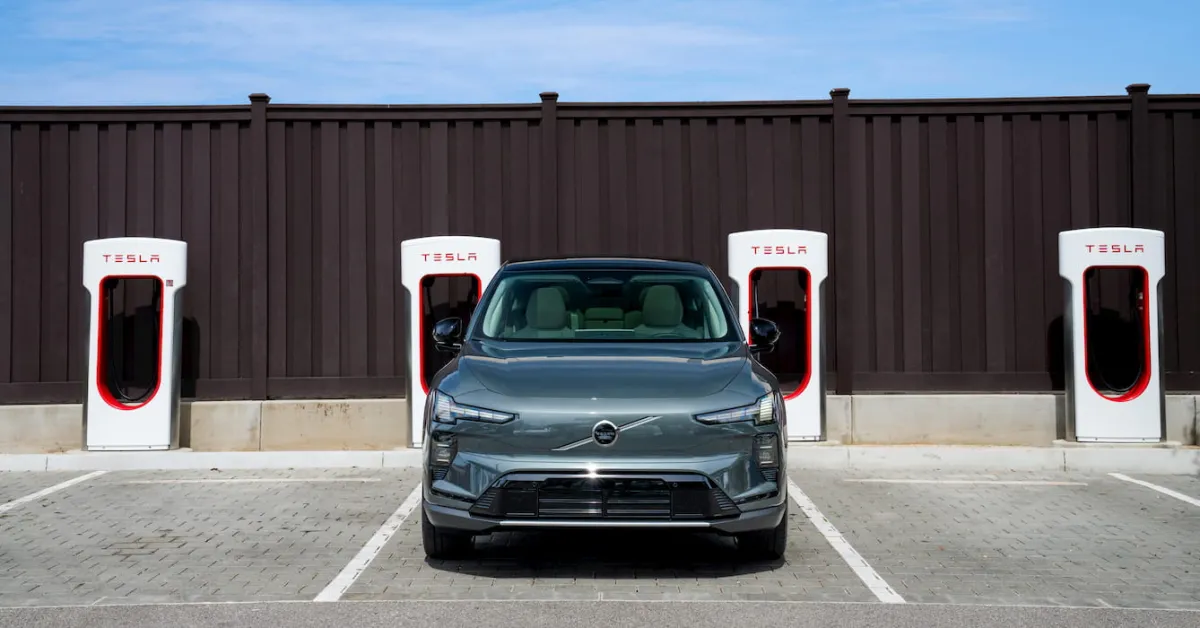
Volvo EX60 at a Tesla Supercharger (Source: Volvo)
The US has passed 80,000 public EV fast-charging ports, and new charging stops are getting bigger and packing more power. That’s good news for drivers looking for an open stall. The price story is more mixed: Most networks are holding steady, but Tesla Supercharger costs have gone up.
EV charging data platform Paren’s Q3 2026 State of the US Fast EV Charging Industry report finds that operators added 4,106 fast-charging ports at 664 stations from July through September. That brings the US total to 80,964 ports across 14,614 locations.
The rollout slowed compared to Q2, when 4,618 ports opened. Through September, operators added about 9% fewer ports and opened about 20% fewer stations than in the same period last year.
But the stations that are opening have more places to plug in. New non-Tesla sites averaged five ports, up from 4.1 a year earlier. Locations with just one or two ports made up less than a third of new non-Tesla stops, down from nearly half.
For drivers, a bigger site means more chances to grab a charger when they arrive.
IONNA and Walmart pick up speed
Tesla still added more ports than any other network: 1,287 during Q3, plus another 124 through its Supercharger for Business program.
IONNA took second place with 378 ports, more than double its Q2 additions. Walmart came in third with 344.
Much of IONNA’s jump came from converting former Circle K charging locations, including 44 stations during the quarter. There’s a counting detail to note here: Paren treats replacement chargers as new infrastructure when another operator takes over and replaces the equipment.
Tesla’s new stations averaged 13.1 ports. It opened 11 locations with at least 24 stalls, the largest of which was a 48-stall site in Fort Lauderdale, Florida.
And the new equipment is getting more powerful. Across all networks, 73% of new ports were rated at least 250 kilowatts (kW), up from 60% a year earlier. Outside Tesla’s network, ports rated at 400 kW or more accounted for 35% of additions, compared with just 10% a year ago.
More chargers, more charging
Drivers are putting the growing network to use. Paren tracked 50.4 million fast-charging sessions in Q3, up 26% year over year. July set a monthly record with 17.6 million sessions.
National utilization barely moved, reaching 15.9%, compared with 15.8% in Q2. That’s the share of monitored time a port spends charging a vehicle, including unsuccessful attempts.
That national average hides some big differences. Ports in the 30 largest charging markets averaged 21.1% utilization, compared with 11% elsewhere. Los Angeles led those metros at 31.8% – twice the national average.
Reliability held steady, too, with a national score of 93.9. Paren’s index accounts for successful sessions, retries, failed attempts, and downtime, so it isn’t simply a charger uptime percentage.
Fifty of the 52 states and territories assessed scored at least 90, up from 46 a year earlier. Only Oklahoma and Vermont remained below that mark.
Tesla charging gets pricier
Drivers who use Superchargers may have noticed a bigger dent in their wallets.
In Q3, the national average fast-charging price reached 54 cents per kilowatt-hour, up 2.7% year over year. Paren attributes that increase to Tesla.
Tesla’s average non-member Supercharger price rose 15% over the year to 56.9 cents per kWh. Its member price increased 9% to 39.6 cents.
Meanwhile, the average across non-Tesla networks stayed near 53.3 cents per kWh for the fifth consecutive quarter.
When you plug in can make a difference, too. At stations with time-of-use pricing, average peak rates reached 63.7 cents per kWh, while off-peak rates held at 43.8 cents. That’s nearly a 20-cent gap for the same amount of electricity.
Where the next chargers go also matters. Urban markets received 90% of Q3’s new stations, while rural markets got 68 of the 664 additions. Larger charging stops are welcome, but drivers beyond those urban areas still need more places to stop.
Read more: US EV fast charging has entered ‘Charging 2.0’ – here’s what that means
If you’ve ever considered going solar, make it easy by finding a trusted, reliable solar installer near you that offers competitive pricing by checking out EnergySage. It has hundreds of pre-vetted solar installers competing for your business, ensuring you get high-quality solutions and save 20-30% compared to going it alone. Plus, it’s free to use, and you won’t get sales calls until you select an installer and share your phone number with them.
Your personalized solar quotes are easy to compare online, and you’ll get access to unbiased Energy Advisors to help you every step of the way. Get started here.
FTC: We use income earning auto affiliate links. More.
