

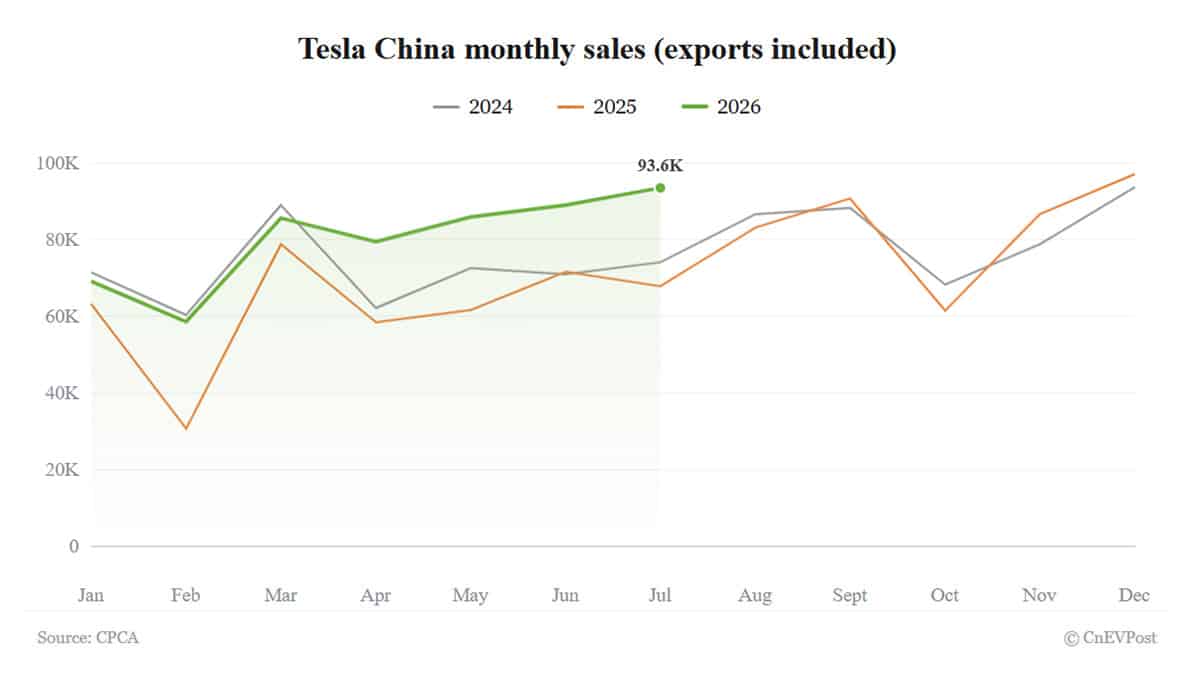
Tesla China Monthly Sales (Exports Included) 2024-2026
Month
2024
2025
2026
January
71,447
63,238
69,129
February
60,365
30,688
58,599
March
89,064
78,828
85,670
April
62,167
58,459
79,478
May
72,573
61,662
85,982
June
71,007
71,599
89,091
July
74,117
67,886
93,579
August
86,697
83,192
September
88,321
90,812
October
68,280
61,497
November
78,856
86,700
December
93,766
97,171
Tesla China monthly sales (exports included)
2024
2025
2026
- Tesla China’s July wholesale sales rose 37.85% year-on-year, marking the ninth consecutive month of year-on-year growth.
- It was also Tesla China’s strongest July ever.
Tesla (NASDAQ: TSLA) China saw its wholesale sales rise nearly 38% year-on-year in July, the ninth consecutive month of year-on-year growth.
Tesla China’s wholesale sales were 93,579 units in July, up 37.85% from 67,886 units in the same month last year, according to data released Tuesday by the China Passenger Car Association (CPCA).
That was the highest figure so far this year, up 5.04% from 89,091 units in June, and also Tesla China’s strongest July ever.
Over the past five years, July has typically been a slow month for Tesla, as the Shanghai plant often carries out production line upgrades during the period. That seasonal effect was much less pronounced this year.
In absolute monthly terms, this was Tesla China’s highest level since the 97,171 units in December 2025.
In the first seven months of the year, Tesla China’s cumulative wholesale sales reached 561,528 units, up 29.88% year-on-year.
Wholesale sales include deliveries in China as well as exports from the Shanghai plant. The July breakdown is expected to become available in several days.
Exports have been the main engine of growth this year. In June, the Shanghai plant exported 36,171 units, up 257.60% year-on-year, accounting for 40.60% of that month’s wholesale sales.
In the second quarter, the Shanghai plant exported 128,394 vehicles, exceeding its deliveries in China of 126,157 units in a single quarter for the first time ever.
Local demand remains under pressure. Tesla’s deliveries in China fell 2.05% year-on-year in the second quarter, the fifth consecutive quarterly decline, and its share of the company’s global deliveries fell to 26.28 percent, the first time below 30% since the fourth quarter of 2020.
The divergence is also clear at the model level. In the first half, Model Y deliveries in China were 172,513 units, essentially flat, while the Model 3 saw 66,442 units, down 27.72% year-on-year.
To boost local demand, Tesla in May rolled out a car purchase financing program called Easy Loan, aiming to attract price-sensitive consumers with lower down payment thresholds.
Local competition continues to intensify. Leapmotor (HKEX: 9863) delivered 101,267 vehicles in July, topping 100,000 units for the first time and beating Tesla China for the second consecutive month.
BYD (HKEX: 1211) sold 419,211 new energy vehicles (NEVs) at wholesale in July, up 21.76% year-on-year and its highest monthly level so far in 2026.
Zeekr delivered 35,837 vehicles in July, a record for the brand. Nio Inc (NYSE: NIO), Xpeng (NYSE: XPEV) and Li Auto (NASDAQ: LI) all saw month-on-month declines.
The Shanghai plant is Tesla’s largest and most highly utilized production base globally, with annual capacity of about 1 million vehicles.
Last week, the Wall Street Journal reported that Tesla was weighing a separation of its China business, but CEO Elon Musk subsequently denied it, saying the matter “has never even come up in a discussion ever.”
Nio, Xpeng and Li Auto all posted sequential declines, while Leapmotor and Zeekr reached new highs.
