

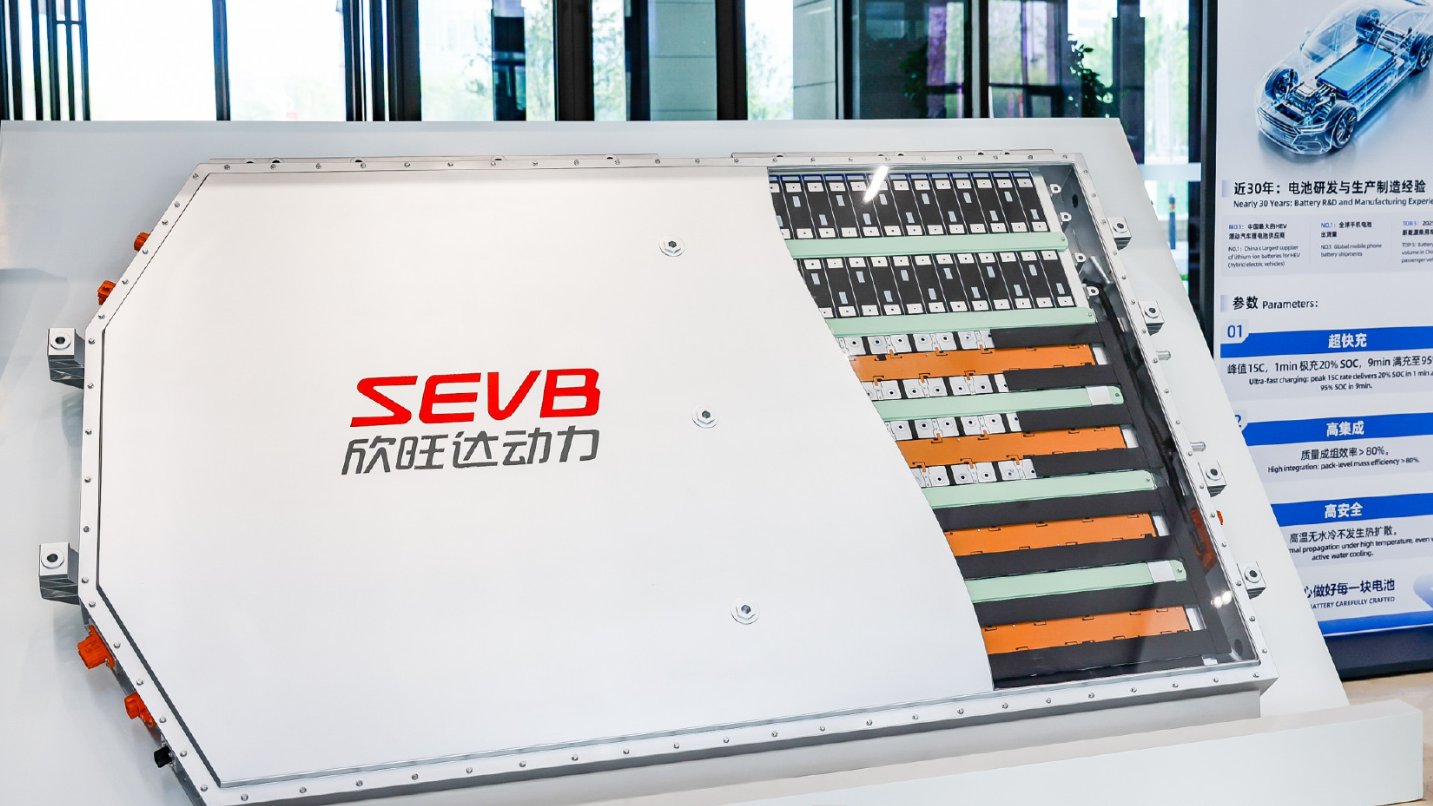
A Sunwoda EVB battery pack on display in a file photo. Credit: Sunwoda
- Sunwoda said its new system can charge from 10% to 70% in just 5 minutes at room temperature.
- Sunwoda expects its flash charging ecosystem to include 10,000 megawatt charging stations by the end of 2027.
Sunwoda Electric Vehicle Battery Co Ltd (Sunwoda EVB) has unveiled a 15C smart flash charging battery system and aims for 10,000 megawatt charging stations by the end of 2027, joining China’s intensifying race in ultrafast charging.
The Chinese battery maker announced the plan on September 17. The system debuted at a battery industry conference held September 16-17 in Zaozhuang, Shandong province.
The launch comes as Chinese automakers and battery makers step up their push into flash charging. After BYD (HKEX: 1211) introduced its second-generation Blade Battery and new flash chargers in March, Hongqi, Dongfeng and Xpeng (NYSE: XPEV) announced advances in batteries or ultrafast charging infrastructure.
Data Sunwoda presented at the conference showed that the new battery system can charge from 10% to 70% in 5 minutes and from 10% to 97% in 9 minutes at room temperature. A 1-minute charge can add 100 kilometers of range.
The charging times for both intervals match the room-temperature figures BYD announced when it unveiled its second-generation Blade Battery in March.
At minus 20°C, Sunwoda’s new system takes 15 minutes to charge from 10% to 97%. The company said the system can support a driving range of more than 700 kilometers.
Sunwoda also said the system can meet warranty requirements of 10 years or 300,000 kilometers, with no limit on ultrafast charging sessions for vehicles not used commercially, seeking to address concerns that high-rate charging could shorten battery life.
Beyond charging speed, Sunwoda made smart monitoring a focus of the upgrade. The system integrates smart battery cells 3.0, an energy domain controller and an AI cloud-control platform to improve battery monitoring and early fault detection.
The system can provide warnings for more than 20 types of faults 2 to 10 days in advance, with an accuracy rate of 99.77%, the company said in the statement.
An open ecosystem platform combining solar power, energy storage and flash charging, unveiled alongside the battery system, extends the company’s offering into charging infrastructure.
The platform integrates flash charging EV batteries, energy storage systems, megawatt charging units, high-power liquid-cooled charging terminals and an AI cloud-control platform. It supports vehicles from multiple brands and different partnership models.
Sunwoda expects its flash charging ecosystem to include 10,000 megawatt charging stations by the end of 2027. The statement did not disclose station locations, investment plans, the first vehicle models to use the new battery or a mass-production timetable.
Competition in China’s flash charging market has moved from technology launches to network expansion. BYD announced the completion of its 10,000th flash charging station in China on August 28, reiterating its target of 20,000 stations by the end of 2026.
Other domestic automakers are also advancing the technology. Test results Hongqi released in July showed that a battery jointly developed with China Automotive New Energy Battery Technology (CNET) could charge from 10% to 70% in 3 minutes and 41 seconds at 25°C. The brand did not disclose a mass-production timetable at the time.
Dongfeng rolled out a prototype of its independently developed ultrafast charger on July 29. Its peak output of 1,500 kW per charging connector matches that of BYD’s new flash charger unveiled in March.
Xpeng announced on September 15 that its first X-Energy megawatt charging station had begun operating in Hong Kong. Jointly built with local charging provider Halo, the station is open to drivers of all vehicle brands.
The station has a peak output of 1 megawatt and is equipped with 400 kWh of energy storage. That figure represents the station’s output capacity; actual vehicle charging power still depends on the vehicle’s battery and charging capabilities.
“We did a massive amount of cycle and reliability testing before turning it into a technology that can be installed in vehicles on a large scale.”
