

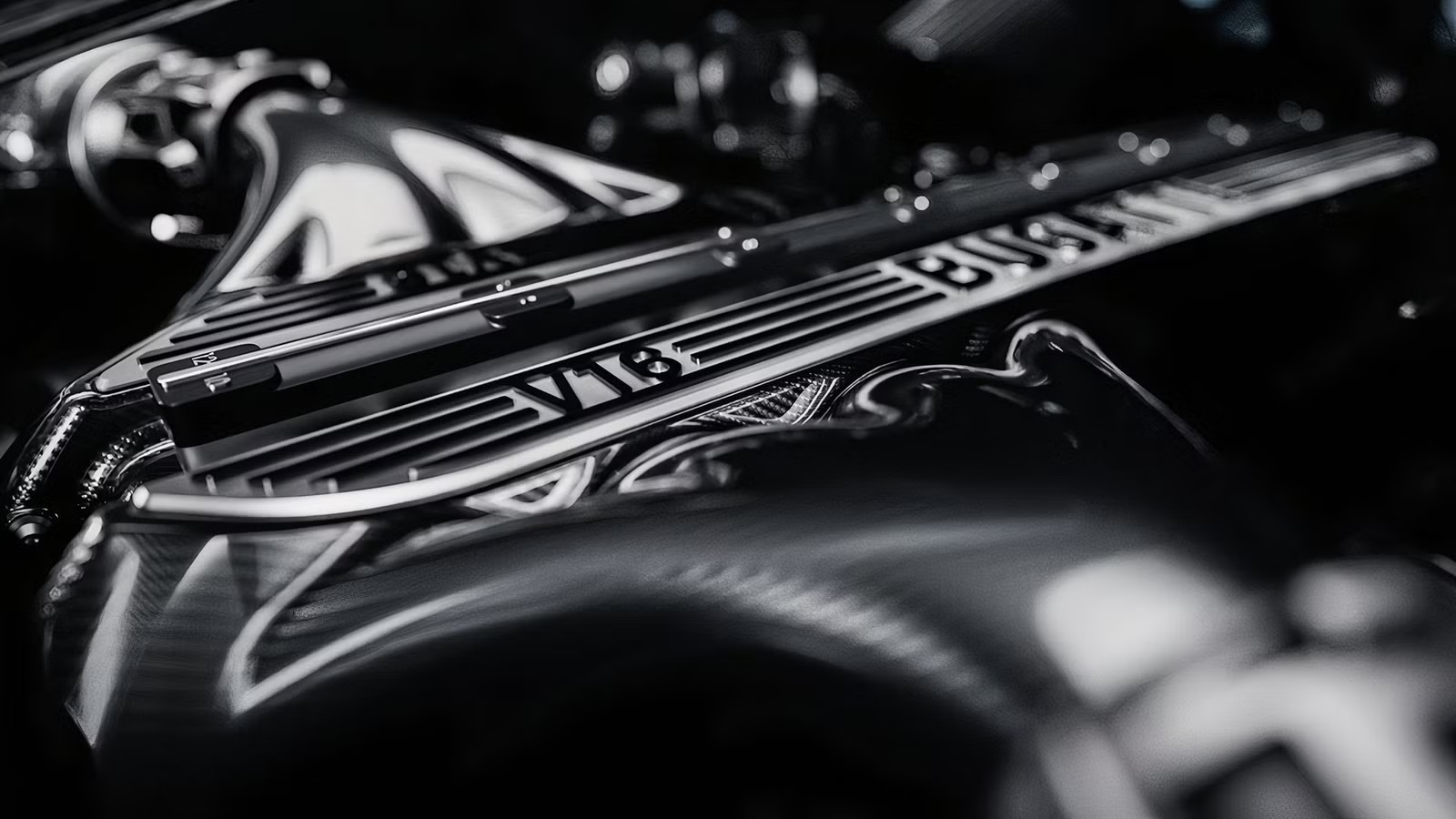
From a 75 horsepower sub-1,000cc four-cylinder to a 986-hp, 8.3-liter V16 and nearly everything in between, one company may have built a wider range of powerplants than any other. But what’s next? Are there any other wild engine designs that could turn Cosworth’s crank? What about no cylinders at all?
Cosworth is one of the legends in the world of combustion engines, and at Goodwood this year, CarBuzz spoke with Chris Willoughby, commercial director at the legendary British engine builder. Among the topics of discussion was perhaps the most important for fans of combustion power: what comes next? Here’s what Cosworth had to say.
After Nearly 70 Years Of Building Engines, Is There Anything New To Try?
The T.50 is legendary designer Gordon Murray’s modern take on his classic McLaren F1, long considered to be the greatest car on the planet. The T.50’s Cosworth V12 revs to more than 12,000 rpm.Gordon Murray Automotive
Cosworth’s first engines were built in 1959 and were tiny four-cylinder engines for open-wheel cars. Over time, it moved upmarket, with efforts including the DFV V8 that won 167 F1 races over 20 years, the engine in the Ford Escort RS Cosworth, and a V12 for Gordon Murray’s latest projects.
Its most ambitious project yet might be the 8.3-liter V16 that it is developing for Bugatti to go in the Tourbillon hypercar. Does the brand want to go even further to develop something unusual or strange or amazing? “It’s hard to think of any sensible ones beyond the V16,” Willoughby said, adding that more pistons is often an exercise of ego not power, since that equals more friction and complexity.
He did suggest an H-configuration, which is where two flat engines are attached and power a shared input shaft. But, as that description suggests, Willoughby described H configurations as “not particularly practical.”
What about a rotary engine, Mazda style? “We’ve got a lot of people with a lot of skills around piston engines, and we’ve got a lot of machinery to make piston engines, so I think that’s where our focus is,” Willoughby said. But there are reasons for Cosworth to keep pushing in that direction beyond it being in the comfort zone.
Piston Engines Are ‘Hard To Beat’
Cosworth V8Cosworth
“We’re involved in a huge range of automotive projects,” Willoughby said, “but we’re also involved with aviation piston engines as well.” He added that the company wasn’t looking to change on either side, saying, “If you want high efficiency and a pretty high power density, it’s still a hard thing to beat as an engine configuration. That’s really where our focus is, you know, for now and and really the foreseeable future.”
Cosworth is already involved with modern engine technology and ways to make vehicles cleaner-running, Willoughby said. The engine design firm has been using sustainable fuels for some time, along with hydrogen combustion.
Last year, Willoughby spoke with CarBuzz about synthetic fuels. He said that Cosworth had been using them for at least five years, and that “the chemists say it’s exactly the same as gasoline.” Whatever the chemists say, it’s what the engine builders believe, and Willoughby said, “when we put it in an engine, we can’t tell the difference.” Hydrogen, though, depends on infrastructure and supply, both far out of the scope of a company like Cosworth.
Whatever the world moves to, Cosworth expects piston engines to remain relevant for a long time to come. “We’re looking at future technologies,” Willoughby said. “And the piston engine still plays a part in those future technologies.”
