

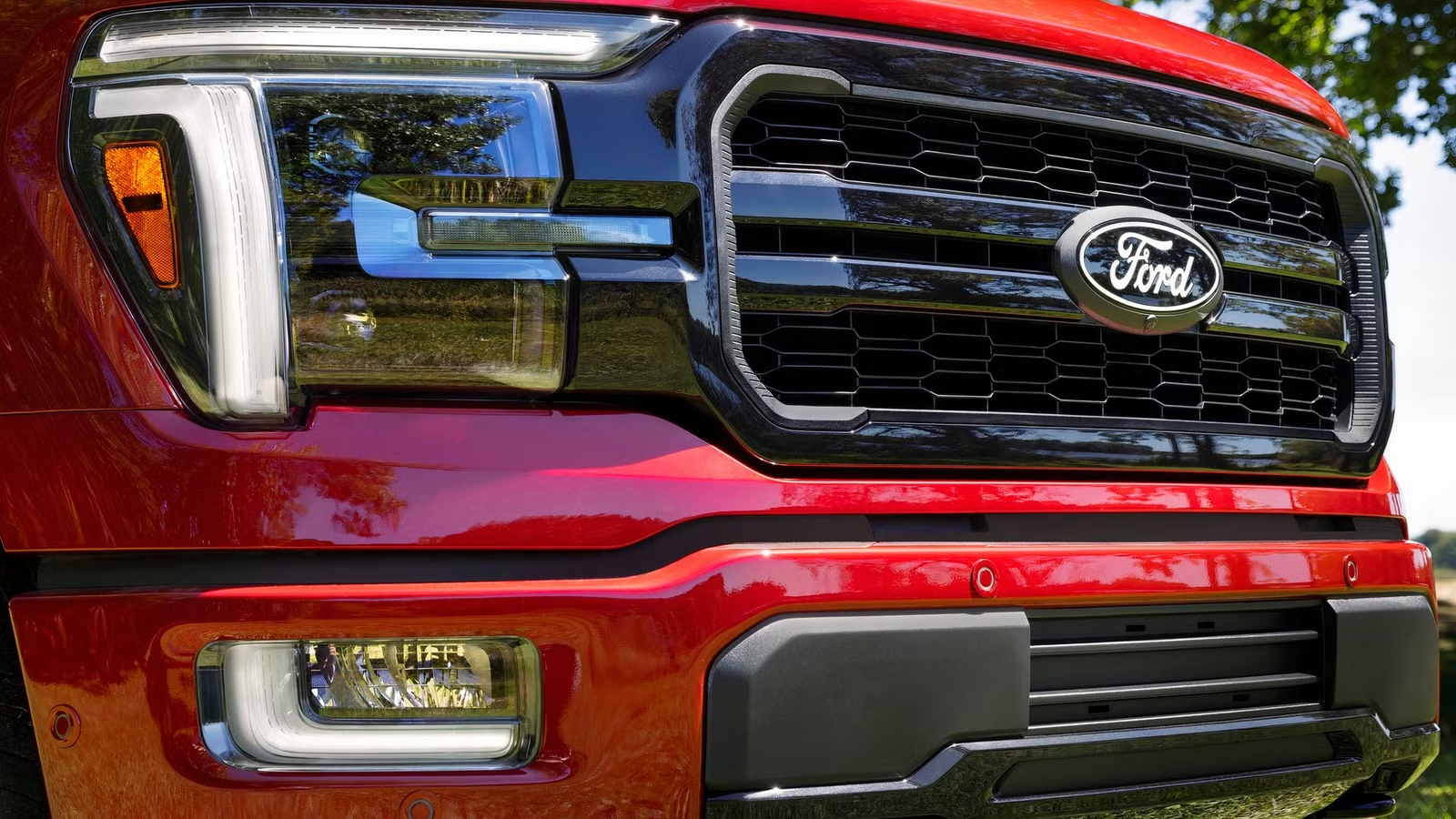
Some shoppers prefer the twin-turbocharged torque of the Ford F-150’s EcoBoost V6 engines; others prefer the sound and feel of the Coyote 5-liter V8. With the V8 positioned as an added-cost option for numerous F-150 trim grades, you might be wondering exactly how it compares to its alternatives, what it costs to move from V6 to V8 power, and what you’ll gain (and lose) by doing so. If you’re considering a Ford F-150 in 2026 and wondering whether six or eight cylinders are best, you’re in the right place.
The Coyote Is A Potentially Pricey Option
2026 Ford F-150 Lariat SuperCrew PowerBoost Hybrid Rear 3/4 ViewFord
Between these options, we know that the 3.5-liter EcoBoost V6 delivers more torque for your fuel dollars, and that the 3.5-liter EcoBoost V6 out-torques and out-tows both the 5.0-liter Coyote V8 and base 2.7-liter EcoBoost V6, which are nearly matched on torque output and fuel economy themselves. Still, within this mix, a large share of F-150 shoppers still opt for the V8, especially in XLT and Lariat trim grades.
2026 Ford F-150 Lariat SuperCrew PowerBoost Hybrid Front 3/4 ViewFord
On lower-end F-150 models (XL and XLT), the 2.7L EcoBoost V6 recently became the new base engine, outdoing an earlier naturally aspirated V6 in favor of twin-turbocharged power. That gives the F-150’s 2.7-liter twin-turbo V6 base engine 325 horsepower and 400 pound-feet of torque, output figures in the same universe as Chevrolet’s latest Silverado base engine, the four-cylinder TurboMax of the same displacement.
On models where the 2.7-liter V6 engine is standard, you need a considerable $2,595 to take advantage of the 5-liter V8 upgrade where it’s available. In higher-end models like the Lariat and Tremor where the larger 3.5-liter EcoBoost V6 becomes the base engine, the V8 engine remains an extra-cost upgrade, though the price drops to just $375.
Some shoppers consider the V8 a downgrade from the larger EcoBoost V6, while others consider it an upgrade.
2026 Ford F-150 Lariat SuperCrew PowerBoost Hybrid Interior ViewFord
By the way, in the F-150’s flagship models (King Ranch and Platinum), the V8 isn’t offered at all, signaling the intention of that shopper to experience the latest and most powerful engine tech.
Related
Ford Just Made The F-150’s V8 More Expensive Than Its Twin-Turbo V6
Just when Ford works out the kinks, it pulls the Coyote from the premium trims.
The EcoBoost Versus Coyote Conundrum
2025 Ford F-150 XL Rolling Chassis with 5.0L Coyote V8 PowertrainFord
Let’s illustrate your choices here with a few examples that should help you decide between six- and eight-cylinder power for your new F-150. For the purposes of this article, we’re focusing mostly on the mainstream F-150 powertrain lineup, not the pricier hybrid models. By the way, every F-150 on your page runs a 10-speed automatic and regular-grade gas.
Twin Turbo 2.7-Liter V6 EcoBoost
2025 Ford F-150 2.7L V6 engineFord
Starting with the 2.7-liter engine as the base unit at 325 hp, shoppers get 400 lb-ft of torque, a combined EPA fuel economy of 20 MPG on 4×4 models, and a maximum available towing capacity of 8,400 lbs.
The great thing about the 2.7-liter EcoBoost is that it’s quiet and smooth, relatively easy on fuel, and has enough pulling power to satisfy most pickup truck drivers in most situations, most of the time. If you’re not towing a trailer, it’s hard to tell this engine apart from its larger 3.5-liter brother unless you’re at full throttle.
5.0-Liter Coyote V8
2025 Ford F-150 5.0L Coyote V8 EngineFord
If you prefer a little more drama and noise to your power delivery, the 5‑liter V8 probably has your attention with its $2,595 add‑on price. For that investment, maximum available towing goes from 8,400 lbs to 13,000 lbs, an increase of 55 percent. Horsepower is up by 75 to 400, an increase of 23 percent. Torque rises slightly from 400 to 410 lb-ft, but peak torque arrives higher up the rev-range, which should leave most drivers finding the 2.7-liter engine more responsive at lower revs.
The 5-liter V8 is no slug at low revs either; its trick cam timing system delivers a hearty punch that builds beautifully with more throttle. The soundtrack of the 5-liter V8 is rich and hearty, and enthusiast drivers will appreciate the way this quad-cam engine breathes across its entire rev range, and especially when spinning fast.
2025 Ford F-150 double cab front 3/4 parked on gravelFord
Within a 5-liter, four-wheel drive configuration, you’ll do 19 MPG, according to EPA data. That’s just 1 MPG less than the 2.7-liter V6, an annual fuel cost difference of just $150 extra to feed the Coyote.
In this way, the $2,595 V8 add-on comes with both the unique character that shoppers love about the five-liter, as well as meaningful improvements to capability with a marginal effect on your gas bill that rounds out to less than 13 bucks a month.
3.5-LiterEcoBoost V6
2025 Ford F-150 front 3/4Ford
Then, there’s the 3.5-liter EcoBoost V6, delivering 382 hp for 2026, backed by 500 lb-ft of torque and a maximum available towing capacity of 12,800 lbs. Like the Coyote V8, this engine was originally introduced 15 years ago, and has undergone several major revisions since.
2025 Ford F-150 SuperCrew STX 4×2 front 3/4Ford
From behind the wheel, the larger of the EcoBoost V6s feels like the premium experience. Torque output is generous from low revs, and response is pleasingly punchy from an engine that feels and sounds so effortless at low revs.
If you’re a fan of smooth and quiet torque available in big quantities at a moment’s notice, this is probably the engine for you. The 3.5‑liter EcoBoost is stronger in torque, towing, and real‑world responsiveness so buyers often see little reason to spend extra for the V8.
But the V8 appeals to a different kind of owner who values mechanical simplicity, a naturally aspirated powerband, and the unmistakable soundtrack that the V6 can’t match. For these shoppers, the modest horsepower bump and richer driving character justify the upgrade, especially since the price premium shrinks on higher trims.
Base Trim Engine
2.7L EcoBoost V6 ICE
Base Trim Transmission
10-speed automatic
Base Trim Drivetrain
Rear-Wheel Drive
Base Trim Horsepower
325 HP @5000 RPM
Base Trim Torque
400 lb.-ft. @ 3500 RPM
Base Trim Fuel Economy (city/highway/combined)
17/25/20 MPG
Infotainment & Features
8 /10
Within the marketplace, the EcoBoost is primarily known for its mighty torque output relative to its gas bill, though some owners prefer to steer clear of twin turbocharging to keep complexity and potential problems to a minimum. For those shoppers, outing the 3.5-liter engine for the 5-liter V8 is a $375 ordeal. That spend gets you 12 more horsepower than the EcoBoost, but you’ll sacrifice 90 lb-ft of torque and up to 700 lbs of towing capacity while using the same amount of gas dollars, according to EPA data.
2026 Model Year Ford F-150 Gas Engines: Selected Specifications
Specification
5.0-Liter
Coyote V8
(F-150 4×4)
3.5-Liter
EcoBoost V6
(F-150 4×4)
2.7-Liter
EcoBoost V6
(F-150 4×4)
3.5-Liter
PowerBoost Hybrid
(F-150 4×4)
Engine Family Launch Year
2011
2011
2015
2021
Current Generation (F-150)
Gen 4 Coyote
(2024+)
Second major
revision (2021+)
Second major
revision (2021+)
First generation
PowerBoost (2021+)
Power (F-150)
400 hp
@ 6,100 rpm
382 hp
@ 5,250 rpm
325 hp
@ 5,500 rpm
420 hp
@ 5,250 rpm
Torque (F-150)
410 lb-ft
@ 4,250 rpm
500 lb-ft
@ 3,500 rpm
400 lb-ft
@ 3,500 rpm
570 lb-ft
@ 3,500 rpm
Transmission Pairing
10-speed auto
10-speed auto
10-speed auto
10-speed auto
(hybrid)
EPA Fuel Economy (2026 4×4)
City, Highway, Combined
16, 24, 19 MPG
17, 23, 19 MPG
18, 24, 20 MPG
23, 24, 23 MPG
Total Driving Range (2026 4×4)
437 miles
684 miles
500 miles
700 miles
Annual Fuel Cost (2026 4×4)
$3,300
$3,300
$3,150
$2,900
Available Max Towing
12,800 lbs
13,500 lbs
8,400 lbs
12,400 lbs
Available Max Payload
2,235 lbs
2,440 lbs
1,775 lbs
1,740 lbs
Making Your Decision
2026 Ford F-150 Lariat SuperCrew PowerBoost Hybrid Side ViewFord
Note the fuel economy and annual fuel cost implications across this engine lineup. Excluding the hybrid-assisted PowerBoost V6, the F-150’s two EcoBoost V6s and single 5-liter V8 option are within just $150 per year of each other. Your results will vary, but the takeaway is that there’s no significant fuel savings to be had by choosing one engine of the trio over the rest. Output and capability may vary significantly between your engine choices, but fuel economy doesn’t. In this way, Ford’s pricing structure doesn’t just separate engines by output; it separates them by identity, giving buyers a clear choice between modern turbocharged performance and traditional V8 feel.
Related
Best V6 Trucks Of 2026
Do you really need that V8? These are the best V6-powered trucks on sale in 2026.
The best F‑150 engine for you comes down to how you use your truck and what you value most. The 2.7‑liter EcoBoost is the quiet, efficient all‑rounder that delivers plenty of torque for everyday driving and light towing while keeping fuel costs down.
The 5.0‑liter Coyote V8 trades a bit of low‑end response for a richer soundtrack, higher towing limits, and a mechanical simplicity some owners prefer, though it comes with a meaningful price premium on lower trims.
The 3.5‑liter EcoBoost remains the heavy‑hitter: the strongest tow ratings, the most torque, and the most effortless real‑world performance, especially when loaded up with your family and trailer.
Sources: Ford 2026 Towing Guide, Ford, EPA
