

The biggest car news and reviews, no BS
Our free daily newsletter sends the stories that really matter directly to you, every weekday.
Whether it’s the folksy “win on Sunday, sell on Monday” or its anodyne MBA-speak replacement “road relevance,” the connection between road cars and race cars is one of the fundamental forces of the motorsports universe. It usually takes the form of actual cars, either showroom models prepped for the track or homologation specials built purely to make a race team’s machinations legal. But 40 years ago, BFGoodrich did the same thing with tires.
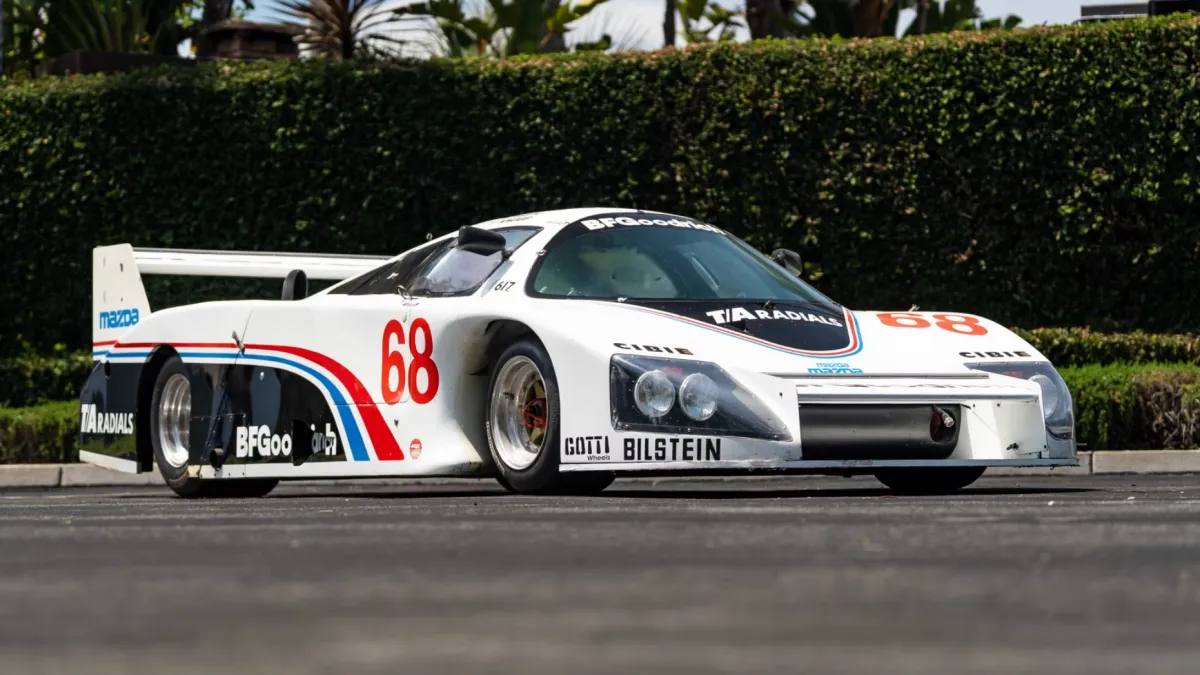
In 1984, looking to promote its T/A radial tires, the company put together a two-car team and went endurance racing in both the IMSA GT Championship and the FIA World Endurance Championship (WEC), including the 24 Hours of Le Mans, where chassis HU-2 scored a class win on the street tires the team was created to promote. HU-2 will be among the featured lots at Mecum’s 2026 Monterey Car Week auction, alongside its sibling car, chassis HU-3. It’s expected to sell for around $300,000—about $100,000 more than its sibling.
Tires are arguably the most important part of any car, and a lot of engineering goes into making them work. Unfortunately, even most diehard car enthusiasts don’t care. In the early 1980s, BFG tires and a Mazda RX-7 chassis proved to be a winning combination in the IMSA GTU class, but those wins weren’t getting enough attention. So the tire company decided to up the ante.
Mecum Auctions
Mecum Auctions
Mecum Auctions
Mecum Auctions
“The problem was, nobody really cared about any RX-7 doing well,” Chuck Patrick, then a BFG tire engineer, said in a 2005 Vintage Motorsport article on the project. “So the guys in marketing asked, ‘How do we demonstrate that we are really making a fine product?’”
The solution was to step up to the FIA C2 class, then the second-tier class for prototypes in endurance racing. BFG contracted with racing driver Jim Busby to run the team, and he selected the then-new Lola T616 chassis, which would be paired with the 1.3-liter 13B rotary engine from the RX-7. And while the all-important street tires retained the same overall design as the retail versions, they had to be reshaped for the 13×11-inch front and 13×14-inch rear wheels demanded by the regulations. A 3,000-mile testing program ensured they were ready.
Both cars ran the major IMSA races in 1984, including Sebring and Daytona (they’re claimed to be the first cars to run street tires on that track’s high banking), and chassis HU-3 won its class at that year’s Monza 1,000-kilometer race. But the crown jewel was Le Mans, where John Morton, John O’Steen, and Yoshimi Katayama nabbed the C2-class win and 10th overall. The second car, driven by Busby, Rick Knoop, and Boy Hayje, came home third in class and 12th overall.
Mecum Auctions
Mecum Auctions
Mecum Auctions
Mecum Auction
According to drivers quoted in that Vintage Motorsport article, the tires were less of a factor than the engine, which was both less powerful and less fuel-efficient than most of the competition (with the exception of the factory Mazda 727Cs also running that year). The T616 had to be driven fairly conservatively to save fuel, and the chassis was designed for a heavier, more powerful engine, both of which might have helped mask any differences in performance between its street tires and the purpose-built racing rubber on other cars.
Team BFG’s class win was also the second in a row for a Mazda rotary-powered car, helping to build momentum for the Japanese manufacturer’s overall Le Mans win with the 787B in 1991. It’s hard to say if the win actually sold any tires, but it certainly makes for an interesting story, one that won’t be repeated in today’s more restrictive environment.
It’s also surprising that both cars still exist to tell that tale. They’re not exactly as well known as period Group C cars like the Porsche 956, after all. Thankfully, Busby and Knoop acquired and restored the pair in the early 2000s. They’ve been making regular appearances in vintage racing ever since, a testament to an unlikely marketing gambit that produced an unlikely win.
Stephen has always been passionate about cars, and managed to turn that passion into a career as a freelance automotive journalist. When he’s not handling weekend coverage for The Drive, you can find him looking for a new book to read.
