

The biggest car news and reviews, no BS
Our free daily newsletter sends the stories that really matter directly to you, every weekday.
It was only last December that Ram CEO Tim Kuniskis was called out of retirement to right Mopar’s sinking pickup brand. The “Father of Hemis” came back with a pretty simple simple mission: Give the customers what they want. And Ram customers? They want V8s—even if they don’t actually end up buying them. Don’t try to parse it, but if you somehow still needed evidence that cars are highly emotional purchases, look no further.
Fortunately for Ram, the company was still building some Hemis to supply its heavy-duty truck line, so bringing production back online was more a matter of scaling back up than rebuilding the whole thing from scratch. Still, the fact that Ram managed to get the Hemi Ram back into production inside a year is pretty impressive. It’s even more impressive that we’re here, at roughly the 18-month mark, and now we’re talking about not one engine, but four: the mild-hybrid 5.7-liter, the 6.4-liter 392, the 6.2-liter Hellcat, and now the de-hybridized 5.7 (returning for both the Rumble Bee and the standard 1500).
It helps that Ram had a head start on the de-regulatory push. Several months ago, when asked during a media event whether presidential politics played into the V8 revival, Kuniskis said it was the changes in leadership within Stellantis, rather than in America, that made all the difference. Trump’s election and subsequent gutting of CAFE regulations certainly softened the landing, but when asked whether it was the deciding factor, Kuniskis responded stoically and succinctly:
“I was gonna do it anyway.”
The 2027 Ram 1500 TRX SRT. Byron Hurd
That didn’t make the job itself any easier, of course, but at least Ram hit the ground running. When the newly reconstituted SRT was given the go-ahead to bring TRX back, the team knew it had to be more than a simple continuation of the old truck, especially since Ford snatched the most-powerful-gas-truck title with its updated Raptor R. So, the number had to be higher than 720. That meant SRT’s engineers needed to scare up at least 19 horsepower. After a sticking their arms shoulder-deep in the parts bin, they came back with 75.
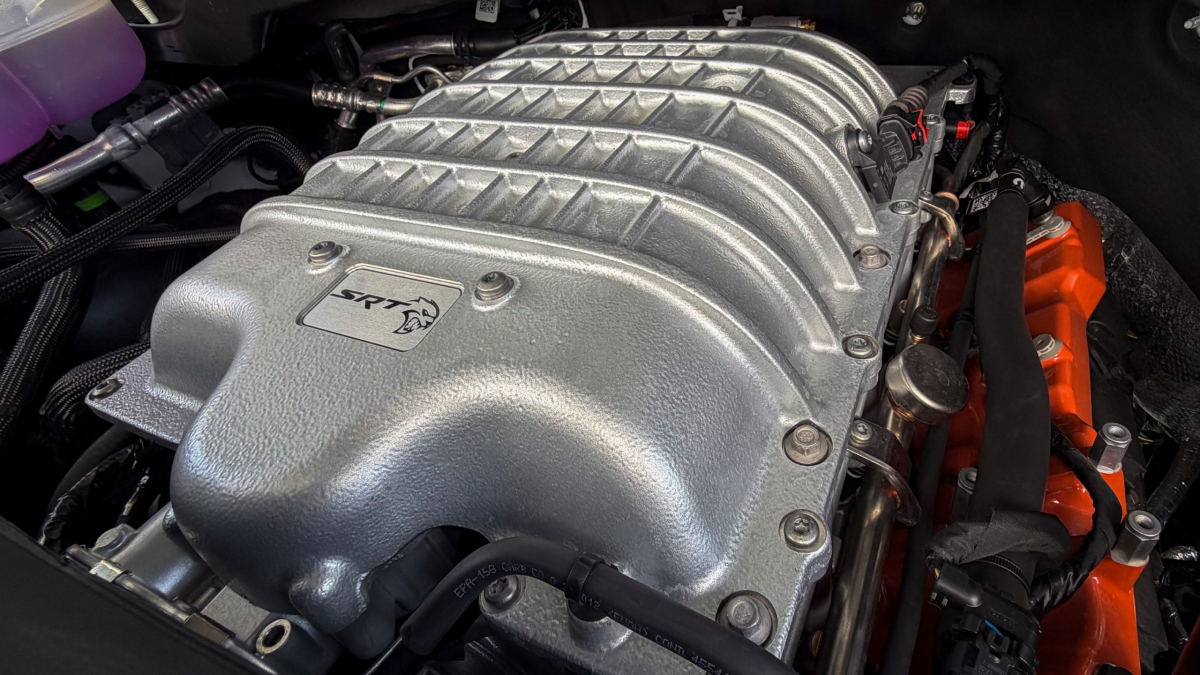
And since the TRX is a pretty old-school truck, it probably won’t surprise you that they found that power the old-fashioned way: throwing more air and fuel at it, and then spinning it a little faster. That’s where the Redeye comes in. The old TRX’s power curve was quite pretty, and its top end was limited only by its ability to breathe. By swapping in the valvetrain from the Redeye, SRT freed the Hellcat to rev a little higher—just 300 RPM—and keep riding that curve upward.
The 2.4-liter, twin-screw supercharger was massaged and fitted with a slightly smaller pulley (3.17 inches; down from 3.43 on the previous TRX), and the whole works is fed by a new cold-air intake system. A new fueling setup increased pressure from 5 bar to 7 bar to keep the 6.2-liter well-fed.
The result is 777 horsepower. And yep, it’s quite a giggle.
Got a news tip? Let us know at tips@thedrive.com!
Byron is an editor at The Drive with a keen eye for infrastructure, sales and regulatory stories.
