

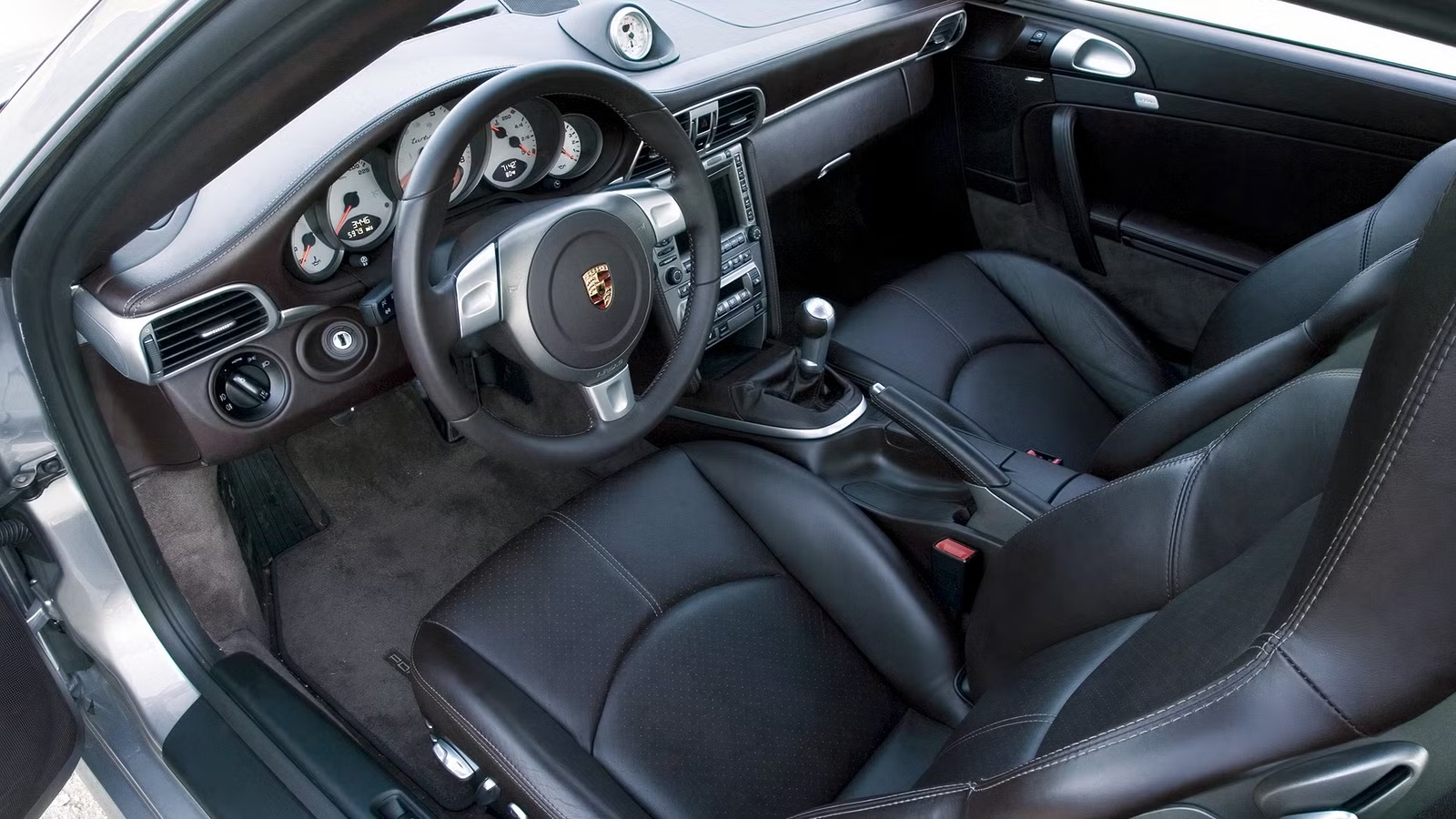
While automakers race to pack more screens into every new car, a growing group of buyers is doing something unexpected – paying a premium to own cars with less technology, not more. And the used car market is rewarding them for it.
Analog driver’s cars, such as the Porsche 911, hold on much tighter to their resale values, and touchscreens seem to have something to do with it. In big luxury barges like the BMW X7, tech is everywhere, but the Porsche 911 tries to keep its electronic reliance to a minimum. Because of this, the 911 – along with other analog models like the Mazda MX-5 Miata – sticks to its original value like glue. Not to mention, the 911 has a timeless enthusiast appeal to it. The high-tech X7? Not so much.
Luxury SUVs Are Depreciating Faster Than Buyers Expected
2026 BMW X7 xDrive40i front 3/4BMW
Bad news for high-end SUV lovers: the full-size luxury SUV is currently experiencing a major slump in resale value. According to most reports, the segment is prone to a large amount of depreciation. Some may even call the huge rate alarming, with models like the Mercedes-Benz GLS-Class losing nearly 40 percent of its value after just three years on the road. Moreover, models like the GLS can lose up to 20 percent of their value as soon as you drive them off the lot.
If you’re worried about saving money at all, buying a new luxury SUV shouldn’t be anywhere near your to-do list. The depreciation numbers for the segment are extremely depressing, although some are better than others. The BMW X7’s five-year residual value sits around 37 percent. Other models in the segment, like the Audi Q7 and its 43 percent residual value over the same time period, don’t fare much better. If we move up into high-end luxury models like the Aston Martin DBX, it loses a gargantuan 73 percent of its value over the course of five years.
In April of this year, CarTax completed a depreciation study that showed a brand-new Audi Q7 Premium Plus loses anywhere between $9,800 and $13,000 of its original value in just one month, a truly shocking amount of money. To put it in better perspective, that $13,000 lost could buy two used Toyota Camrys from roughly the 2010 to 2013 model-year range, and both would likely be less expensive to maintain, fix, and run than a brand-new Audi Q7 once its warranty runs out.
2027 Audi Q7 exterior imagery.Audi
One of the major driving factors behind full-size luxury SUVs being so prone to depreciation is off-lease inventory. Many times, folks who spring for luxury SUVs lease them, rather than buy. The reason behind doing so is, mainly, to avoid the extreme levels of depreciation. By leasing, your payment is typically lower than outright purchasing. Not to mention, lease terms typically span the entire length of a car’s factory warranty, meaning lessees can take advantage of the warranty with a lower payment, and not have to worry about depreciation at the end of ownership.
So if depreciation is the tax luxury SUV buyers pay – what kind of car is actually holding its value, and why?
Why Buyers Are Rediscovering Analog Driver’s Cars
2019 Porsche Carrera S Exterior Finished In Silver Static PhotoPorsche
That fear of electronics obsolescence isn’t just costing SUV owners money – it’s actively pushing a growing segment of buyers toward a completely different kind of car. There’s a whole host of folks who are keen to get their hands on slightly older, less tech-laden models. Namely, models like the Porsche 911. The venerable Stuttgart-bred sports car likes to hold onto its used value like glue, and its conservative use of electronics helps bolster the phenomenon further.
In essence, what these new-age, analog buyers are looking for is a more direct connection to the car and, indirectly, to the road. Attributes like tactile controls are important to this sort of buyer. Not to mention, hydraulic steering, which helps provide a much more direct connection to the road surface than electronic power steering, is also sought-after. For the Porsche 911 specifically, you would have to find one built before 2012, when the brand first introduced electric steering.
2010-2011 Porsche 911 GT3, Front 3/4, RedPorsche
Another aspect of the raw car movement is a general avoidance of boosted engines. Instead, buyers are looking for engines that make their power without the help of turbocharging or supercharging. In the same vein, hybridized powertrains are also being rejected in favor of pure internal combustion engines. Other means of mechanical engagement, like hydraulic clutches, are sought-after, as well.
If we take a look at something like the Black Book, we can see the premium sports car’s rise in value clearly. Across nine different segments of cars, only the “premium sports car” managed to gain value as recently as mid-June 2026. Every other segment, spanning from subcompacts to full-size sedans, lost ground. The Porsche 911 fits right into the premium sports car segment, signaling a market-wide rush.
2026 Mazda MX-5 MiataMazda
It goes without saying, but it’s worth noting anyway: the Porsche 911, alongside less-premium sports cars like the Mazda MX-5 Miata, attracts people who aren’t concerned with having the latest tech at their disposal. Instead, the rise in popularity of the analog sports car points toward a broader market trend: yearning for cars that do less of the work for you, and filter less of the real world out through things like electronic power steering.
Why Every New Screen Added To A Car’s Interior Is Costing Automakers Resale Value
2019 Jaguar I-PACE. Infotainment touchscreen. Digital displayJaguar USA
We aren’t trying to paint a picture of nostalgia being the sole purpose behind the push for analog models, because it goes a bit deeper than that. In reality, people are simply tired of being overly inundated with LED screens shining on them from every direction. Most cars nowadays have – or offer, at least – a large touchscreen infotainment system sitting on the center stack, a digital instrument cluster with myriad functions and selections, and even a screen mounted in front of the passenger seat, again with loads of options and selections to choose from.
Many modern cars integrate virtually all functions into these screens. Climate control is typically wired into the central infotainment screen, despite many people clamoring for physical climate buttons and knobs to turn. Driver-assistance tech is also hardwired into today’s cars, and while it serves its purpose as a safety measure, some drivers find them overly corrective, if not dangerous, in some situations.
At the end of it all, digital interfaces have a tendency to become outdated fast, meaning the car is treated more like a disposable item, such as a cell phone, rather than a car.
2001 Mazda MX-5 Miata Special Edition NB British Racing GreenMazda
The more people are exposed to that, the more some of them become overwhelmed, causing them to long for the days of analog gauge clusters, simple radios, and a mechanical feel. Cars like older 911s and the Mazda MX-5 Miata easily allow their drivers and passengers to feel the intricacies of what’s going on underneath the skin. You can also hear the engine doing its thing, and both of their designs, especially the 911s, are timeless. It’s hard to become outdated when you never tried to ride the cutting edge of tech in the first place.
The Used Market Has Already Voted – And Driver’s Cars Are Winning
The latest Range Rover is the epitome of luxury SUV. Unfortunately, the brand also has some dependability issues.Land Rover
The used automotive market seems to have arrived at a wholesome conclusion. Now, it rewards cars that provide a timeless, analog driving feel with minimal electronics, and punishes those that try to dazzle with huge screens, intuitive infotainment interfaces, and a whole host of engine and operational electronics taking the place of analog systems. Now, the real driver’s cars can flourish, while the posturing luxury SUVs are left with a dilemma to solve.
As newer, more advanced luxury SUVs hit the market every year, outgoing models tank in value. It seems virtually none are safe, either, with the same pattern being seen across brands like Infiniti, Mercedes-Benz, Audi, and BMW. Older Porsche 911s and ND Mazda MX-5 Miatas, for example, cling to their values thanks to their simple outlook on driving pleasure, and little regard for screens or gizmos. Values remain stable, meaning both current and prospective buyers can reap the benefits.
2019 Mazda MX-5 Miata ND Top Down Orange Front Angled ViewMazda
Of course, we cannot sit here and say these driver’s cars will appreciate in value, because the market is a strange thing, and major changes can come along when least expected. However, as it stands now, the driver’s car is the one to want, and the luxury SUV looks to be the one to avoid. It seems, though, the age-old warning involving great driving experiences outlasting flashy tech is finally coming true.
Sources: CarEdge.com, BlackBook.com, CarTax.com, iSeeCars.com, VinAssessment.com.
