

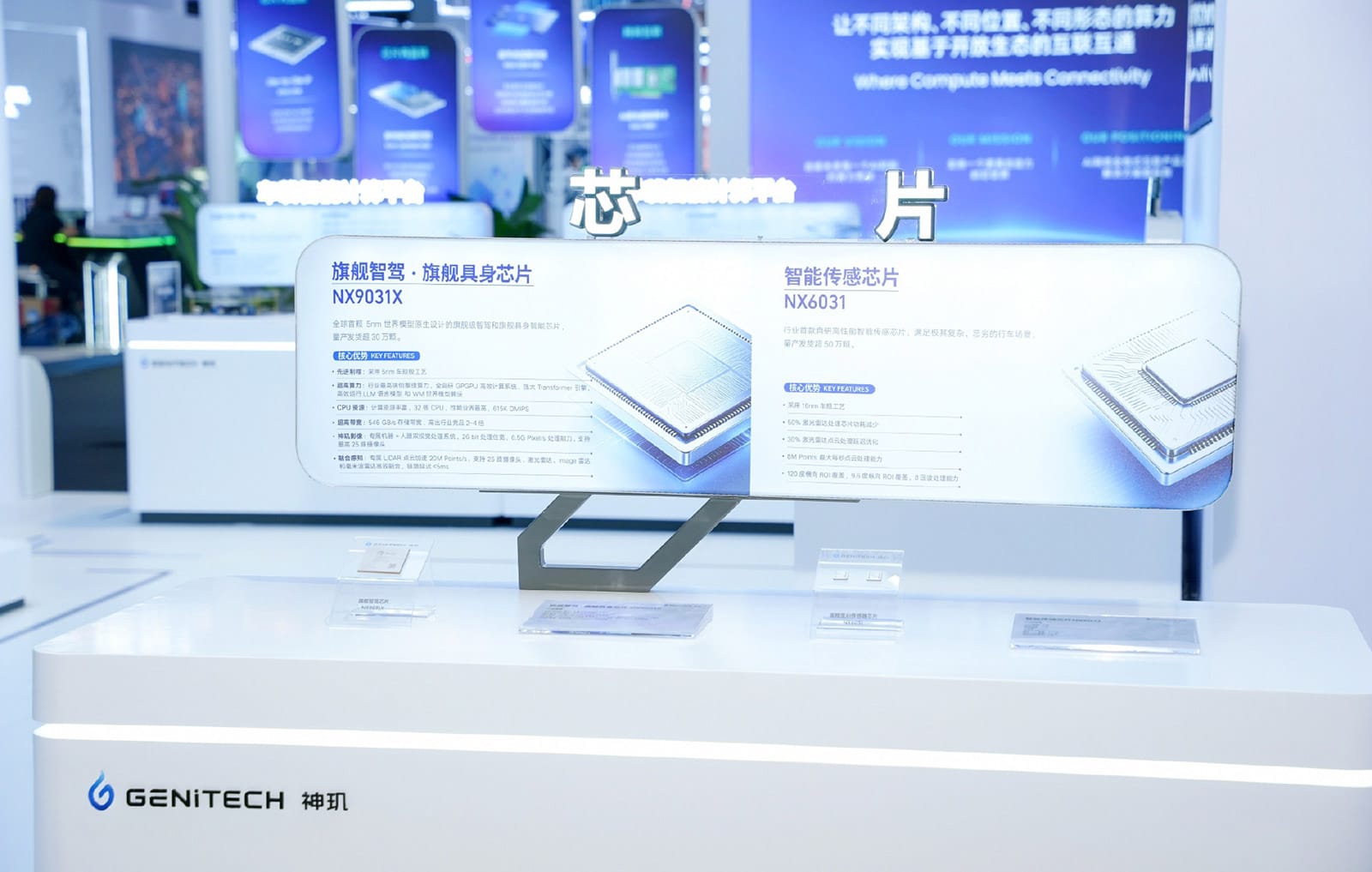
Shenji, Nio’s chip subsidiary, showcased several chips at WAIC 2026 in Shanghai. Credit: Nio
- Shenji displayed several chips including the NX9031X, NX9031U and NX9031C, covering assisted driving, embodied intelligence and agent inference.
- The high-end NX9031X chip has been deployed across all Nio and Onvo models, with cumulative shipments exceeding 300,000 units.
The chip-making subsidiary of Nio Inc (NYSE: NIO) showcased multiple chips at the World Artificial Intelligence Conference 2026 (WAIC 2026) in Shanghai, showing that the Chinese electric vehicle (EV) maker is extending its self-developed semiconductor capabilities to broader AI scenarios beyond cars.
GeniTech Co Ltd (Shenji) made its first independent appearance at the conference, which opened on Friday, displaying several chips including the NX9031X, NX9031U and NX9031C, according to a statement by Nio.
An image accompanying Nio’s statement showed that an NX6031 intelligent sensing chip was also on display.
In addition to chips, Shenji launched new AI products during the event, including the Ruidong embodied intelligence development platform and a distributed intelligent agent platform.
Shenji has built a complete product lineup consisting of multiple chips including the NX9031X, NX9031U and NX9031C, covering three cutting-edge AI fields — intelligent assisted driving, embodied intelligence and agent inference.
Among them, the high-end NX9031X chip is used for assisted driving and has been deployed across all models of the Nio and Onvo brands, with cumulative shipments exceeding 300,000 units, the company said.
The Ruidong embodied intelligence development platform is powered by the middle-tier NX9031U chip, which is built on a 5-nm automotive-grade process and can run the various complex models needed for a robot brain’s perception and autonomous planning, Nio said.
When Shenji first disclosed the NX9031U earlier this week, it said the chip has an equivalent computing power of up to 800 TOPS, uses air cooling, and targets scenarios including embodied intelligence, intelligent computing and advanced manufacturing.
For emerging AI application fields such as embodied intelligence and agent inference, the NX9031 series is one of the few China-made chips on the market with large computing power that has been tested through mass production at scale, Nio said.
The company said it will leverage its technology accumulated in intelligent assisted driving to transfer capabilities such as vehicle perception, real-time control and functional safety to AI application scenarios including humanoid robots, driverless logistics vehicles and high-computing-power terminals.
Shenji is currently the only company in China shipping chips in all three major general-purpose AI fields: autonomous driving, embodied intelligence, and agent reasoning, said Ma Lin, Nio’s vice president of branding and communications, on Weibo.
From its beginnings in Nio’s in-vehicle business, to the mass production of core chips for smart driving, and on to the continuous expansion of application scenarios and external supply, Shenji has grown steadily under Nio’s incubation, Ma said.
Shenji positions itself as an all-domain, all-scenario chip company covering autonomous driving, embodied intelligence and agent inference, Nio said.
The subsidiary has completed nearly 3 billion yuan ($440 million) in financing since its establishment in June 2025, Nio’s statement noted.
For Nio, extending its chip capabilities beyond its own vehicles could help improve the commercialization potential of its costly chip program.
The chip business has been one of the most expensive items in Nio’s research and development spending. William Li, Nio’s founder, chairman and CEO, once said the development cost of the NX9031 ran into billions of yuan, close to the cost of building 1,500 battery swap stations.
To balance funding pressure with long-term technology investment, Nio confirmed in February this year that several Chinese investors would invest 2.26 billion yuan in Shenji, giving the business a post-investment valuation of about 8.27 billion yuan.
After the transaction, a Nio subsidiary continues to hold a 62.7 percent controlling stake in Shenji, and Nio Inc continues to consolidate its financial statements.
Nio unveiled the NX9031 in December 2023 and announced its successful tape-out in July 2024. The chip is built on a 5-nm automotive-grade process and contains more than 50 billion transistors.
Nio previously said that one NX9031 delivers computing power equivalent to four Nvidia Orin chips. The company’s models based on the NT 2.0 platform previously came standard with four Orin X chips, offering a total computing power of 1,016 TOPS.
The NX9031U has up to 800 TOPS of equivalent computing power and targets embodied AI, intelligent computing and advanced manufacturing.
($1 = 6.7733 yuan)
