

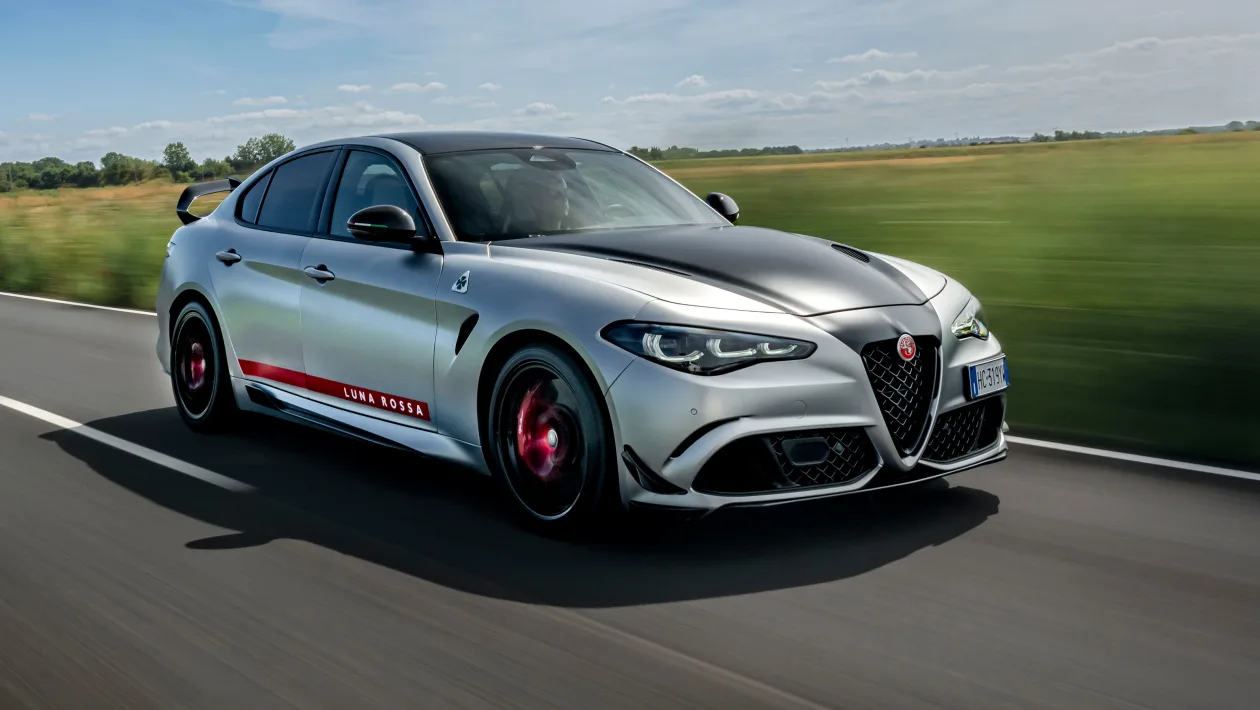
Where the Luna Rossa’s impression starts to break down, however, is the lack of any real bespoke engineering. Unlike the more dramatically modified Giulia GTA of 2020, there’s no bespoke carbon fibre bodywork, unique wheels or revised suspension – these elements were all of a direct collaboration with the Sauber F1 team, of which Alfa Romeo was the title sponsor at the time.
Do we wish the Luna Rossa had a little more of the GTA’s attitude in the driving department? Yes, but is this still a captivating and enthralling car to drive in isolation? Absolutely. Time might not have been kind to the Giulia’s sat-nav system or the fact it lacks wireless Apple CarPlay, but its driving experience is timeless, and all the more captivating as rivals continue to become bigger, heavier and more technically complex.
There’s an immediacy to the Giulia’s response that is totally unique in 2026. You sit low in the cabin, the steering is razor sharp and while the ride is quite soft on first impression, switch the car up to Dynamic mode and the body control is absolute. Compared to something like a modern BMW M3 or Audi RS 5, which barge their way along roads like Antarctic ice-breakers, the Alfa Romeo glides across ridges in the road with a far lighter touch.
The carbon brakes are a little dead at the top of the pedal, but once you’re through that initial movement they’re easy to modulate and have immense stopping power. Drive out from a tight bend and the Alfa will leap away from the apex with as much performance as any German rival, as while its 513bhp is down on the contemporary M3 by a factor of 10bhp-or-so, it’s also 200kg lighter. At around 1,660kg, the Alfa is 695kg less than a contemporary Audi RS 5 – let that sink in for a moment as the RS 5 does just precisely that on a grassy verge.
Advertisement – Article continues below
