

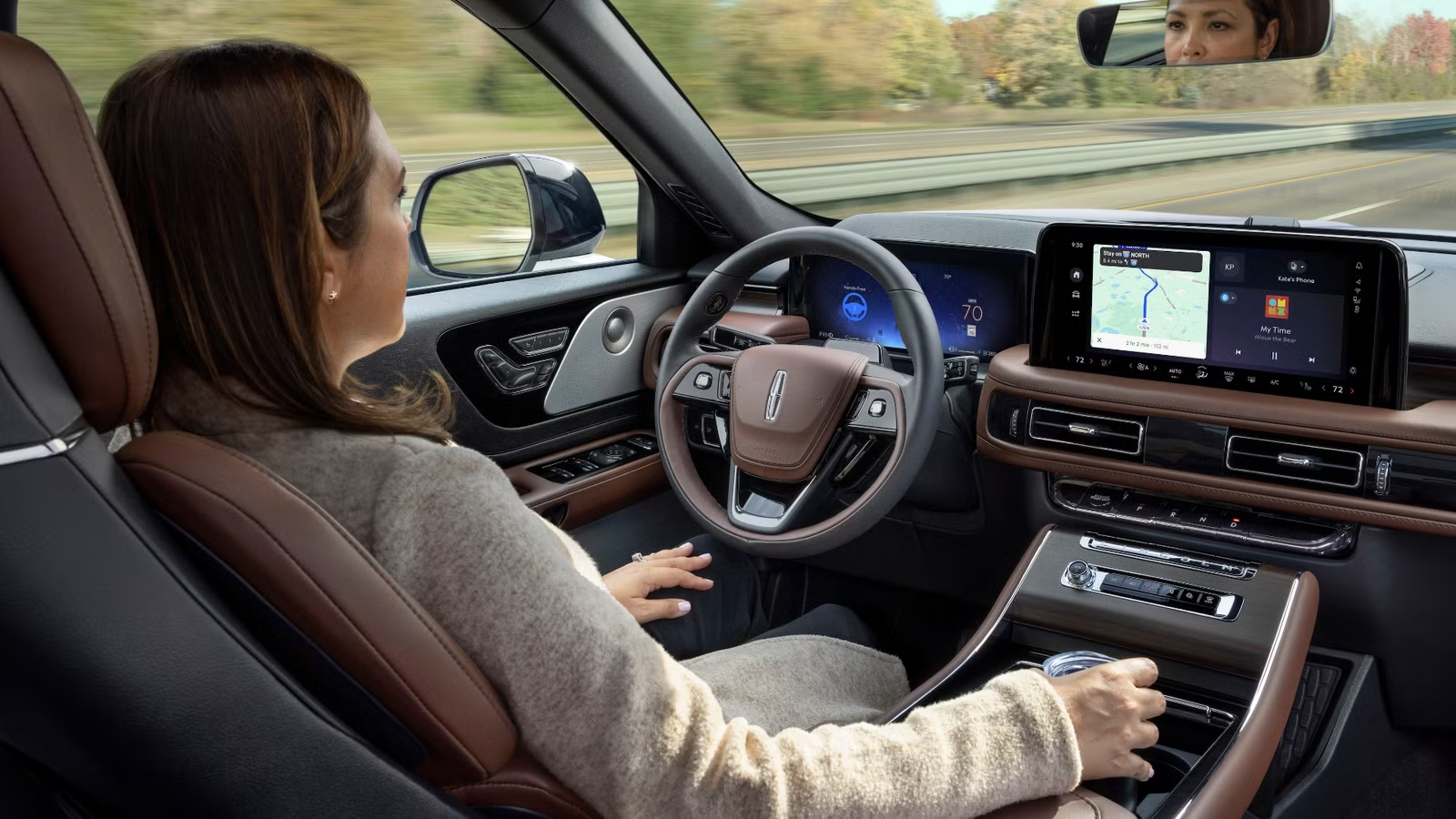
“Move fast and break things” became the motto of the software-defined tech industry in 2014. Mark Zuckerberg coined it for Facebook. Those four words encapsulate the belief that speed beats caution, progress requires collateral damage, and that disruption beats tradition. The belief is that moving fast might break things, but those things can be fixed, adapted, or thrown away. Which is fine for a social network nobody really needs, but not so much for cars that people rely on.
That’s not usually a philosophy for automakers, perhaps other than Tesla. However, software-defined vehicle architectures are being developed and put into production incredibly quickly, following a similar pattern as the tech industry. Producing software-defined vehicles that cut down on mechanical parts has become a race to integrate complex electronics faster into new vehicles than validation cycles can keep up with. The result is a seemingly insane, but somewhat predictable rate of EVs being recalled at 2.84 times more than traditional combustion-engine vehicles.
Ambition Is Outrunning Quality Control
Close-up of a phone with the BMW AI quality control inspection app.BMW
Essentially, software-defined architecture requires verification, validation, and configuration management to meet safety, performance, and compliance demands. In theory, software tools enable engineers to simulate 10,000+ driving scenarios, from extreme weather to sensor failures, before the car is even driven. Continuous verification processes can cut development timelines by 40% compared to traditional methods.
It’s intensive, painstaking, and time-consuming work, but quicker than physically validating every function of the car in the real world. It’s also a large part of the reason cars can get to market quicker now, but it’s clearly not working. Recent industry data confirms US light-vehicle recalls have surged, with roughly 27.7 to 30 million vehicles recalled in 2024 and Q1 2026 alone hitting almost half of that with 11.6 million units.
Ford Is Leading The Problem And The Best Example
Ford F-150 Lightning at the Rouge Electric Vehicle Center.Ford
Add to that how single platforms are underpinning multiple models for automakers and brands, and we find that single software or electrical flaws are triggering massive, multi-model recalls. Ford appears to be the biggest culprit this year with its 26C10 electrical system recall covering over 4.3 million vehicles and accounting for more than 35% of all vehicles recalled in Q1 of 2026.
The best example of software causing problems is Ford’s recall involving mainly 2013 models, where “the bushing that attaches the shifter cable to the transmission may degrade or detach.” One result was vehicles failing to shift into park and rolling away. The physical problem was a small $2 bushing, and Ford thought that moving to a shift-by-wire system would solve any similar problems.
However, in 2025, a recall was issued for 272,645 units where the integrated park module could “fail to lock into the park position” when the driver shifts into park, resulting in yet another Ford transmission problem that could cause a “potential roll-away incident.” Another recall came about through a loss of signal between the transmission range sensor and the powertrain control module. These are just a few examples of software and hardware glitches leading to massive safety problems for car owners and costly recalls for Ford.
The Over-The-Air Update Solution Is A Problem
BMW OTA connectBMW
There was a period in the automotive news cycle where automakers were excited to announce their Over-The-Air (OTA) update systems as the ultimate solution for fixing small bugs and major issues, including recall-worthy problems. However, there are two issues. One is cautionary and theoretical about where things could go with the auto industry; the other is very real.
The cautionary issue with OTA updates is the trap of rushing something to market with the attitude that bugs can be fixed later with an update. It’s a problem that irritates the hell out of, in particular, video game enthusiasts. The habit has become that games get rushed to market on deadlines with bugs, with the intent of fixing them later. The result is that the product is delivered in an unsatisfactory state, frustrating customers. Then, a week or so later, a huge update arrives fixing some of the issues, then more updates trickle through over the following months.
The very real issue is an OTA two-tier class system, as older vehicles still need to visit dealerships for an update, and not all cars have the internet or wireless connectivity needed for OTA updates. The beauty of OTA updates is that software-based recalls (or even new features and improvements) can be addressed without the vehicle owner even knowing what’s being updated, let alone having to book the car into a dealership and costing them time. The downside is that there are also cars out there with recalls that are unaddressed and could be fixed by a software update.
The Problem Of More Complex Cars Is Real
2027 Rivian R2Tom Murphy / CarBuzz / Valnet
We’ve explored at length how modern cars are becoming mobile data-gathering computers for automakers, but the modern complexity of vehicles is just as big an issue. And this is shown by the numbers being gathered, both in the volume of recalls and the size of some individual recalls. While Ford has a long history of not being able to build vehicles that reliably go into or stay in park, the mechanical nature of cars is, overall, a mature technology.
Now, however, a lever doesn’t necessarily operate the transmission, as the shifter is often now a button operating the transmission wirelessly. The same goes for the steering wheel, which no longer necessarily has a physical connection to the actual steering wheel. The direction is to replace as much mechanical linkage as possible with a software-based network.
Complexity Means More Things To Go Wrong
Volkswagen Software Defined VehicleVolkswagen
However, it brings a huge amount of software complexity, which is mixed in with all the other software-defined features, including the now common Advanced Driver Assistance System (ADAS) as well as infotainment features. All the automaker’s versions of ADAS are based around automated technology, which uses sensors and software to detect nearby obstacles or driver errors and react accordingly. That’s everything from forms of adaptive cruise control to automatic emergency braking to reading road signs and transmitting them to the gauge cluster.
It’s a huge volume of technology, which means there’s a lot to go wrong. Automakers rushing vast, increasingly complex software-defined systems to market is showing in the recall data. Add that to the data created by computer-based vehicles, and it’s time to wonder if the industry is rushing too fast towards a goal that isn’t worth aiming for in the long run.
A Used Car Might Be The Sensible Choice
2018 Honda Accord Hybrid finished in black with black interiorHonda
We’re not yet at the point where fully realized software-defined vehicles exist, but the problems are already mounting with the technology that’s advancing the industry to that point. When it comes to technology that’s being developed at great speed, consumers become beta testers. Being a beta tester is all well and good if you’re enthusiastic about the tech and prepared to deal with problems. However, for those who just need a car to commute in and move their family around with, it’s a terrible idea. Particularly when the beta-tested technology is in a 4,000-pound vehicle capable of great speed.
A car, at the end of each day, is a tool. It needs to be reliable and easy to use. Simpler is better, and older cars (even by just a few years) can be much simpler and with less to go wrong, even for hybrids and all-electric cars. The trick for reliability and ease of use when technology is on a steep curve is to stay behind it and let others be the beta testers.
Picking A Used Car Wisely
Front dynamic shot of a 2020 Toyota CorollaToyota
When it comes to the used market, there’s a huge back catalog of proven vehicles with low mileage. It’s not necessary to go back to a gas-only car with an AM/FM stereo system, either. Once a car is a few years old, recalls and updates should be addressed or ready to be addressed. A good rule of thumb is to go for something that’s in its final year of a generation, as the bugs should be worked out. If that’s not ideal for the car you want, look for a generational refresh year, which is often a “fix the problems” refresh as well as an aesthetic one, and often adds a few features.
Of course, there are brand-new cars available that aren’t chasing and competing based on the software technology curve. It’s not just brands like Toyota, which is typically conservative about adopting the latest and greatest technology and has the reputation for reliability that goes with it. Particularly tech-forward brands like Hyundai and Mercedes are still underpinned by solid and proven models.
Truck and truck-based SUV manufacturers also tend to avoid throwing new tech into vehicles as robustness is a major selling point. But, that’s not a blanket statement. Research is always key before buying a car, whether it’s new or used.
