

Like most high-performance auto manufacturers, Porsche loves flexing its engineering muscles every now and again by developing a limited-run supercar that shows just what it’s capable of. The 911 Turbo of 1982 showed that its venerable sports car could make bona fide supercars sweat, while the 959 of 1986 illustrated that the brand could produce a car that could not only take on the world’s best supercars on the road but off it, too.
And then came the Carrera GT, which was essentially a race car for the road. As a result, it included plenty of racing-derived goodies. Like its impressive wheel nuts, for instance.
The Carrera GT Wasn’t Initially Meant For Production
The Porsche Carerra’s V10 engine was originally developed for Formula One racing. When that project was canned, the engine was repurposed for a role in endurance racing, but that project also didn’t get out of the starting gates. Finally, Porsche decided to use the engine in a brand-new road car.Porsche
The fact that the Carrera GT ever turned up at all comes down to circumstances falling just right for Porsche, which had been in a battle to survive less than a decade before it was launched. Its fortunes were turned around thanks to new models like the Boxster sports car and Cayenne SUV, but the bones of the Carrera GT were formed somewhere in the middle of these machines. Porsche is world-renowned for its racing operations, but rule changes meant its 911 GT1 racer, which won the 1998 24 Hours of Le Mans, had been banned.
The GT1 regulations to which this car conformed were replaced by the LMP rule set, which demanded more hardcore prototype-style machines going forward. Porsche was interested, and had gone as far as developing a car called the LMP1-98, which was set to receive a bespoke 5.5-liter V10 engine. Thanks to changing priorities, though — which involved not taking on sister brand Audi at Le Mans and focusing on its Cayenne SUV project — the LMP1-98 never hit the track in anger. Not wanting to see the V10 shut away from the public eye though, Porsche instead cooked up a supercar concept to slot it into. The so-called Carrera GT concept was debuted at the 2000 Paris Motor Show, and its main job was to tempt onlookers to spend more time at the Porsche stand.
The car received much more attention than was first expected though, to the point where Porsche elected to put it into production. Following a successful launch of the Cayenne in 2002, the completed production Carrera GT was unleashed a year later.
The V10 Porsche Built For Le Mans And Then Gave To The Public
The Porsche Carerra’s V10 engine was originally developed for Formula One racing. When that project was canned, the engine was repurposed for a role in endurance racing, but that project also didn’t get out of the starting gates. Finally, Porsche decided to use the engine in a brand-new road car.Porsche
Given that it was inspired by Porsche’s exploits at Le Mans, it shouldn’t come as a surprise to learn that the Carrera GT was hardcore. Seriously hardcore. For starters, the naturally aspirated V10 rescued from the ruins of Porsche’s abandoned LMP program was enlarged to 5.7 liters, which afforded the car 603 wailing horsepower. The engine was built seriously tough, since it needed to reach a peak redline of 8,400 rpm. Each block was sand cast to allow for crucial cooling and oil lubrication channels to be intricately crafted, while forged pistons and connecting rods ensured it could be pushed to its limits without a hint of expiring. The thing was originally developed to pound around one of the world’s most demanding racetracks for 24 hours straight, after all.
Beyond the wild engine, the Carrera GT was also graced with an advanced clutch made from carbon fiber and silicon carbide, which provided the strength to take the strain of the car revving way past realistic limits, to 16,000 rpm if needed. You’d have to seriously money-shift to reach those kinds of revs. The machine’s chassis was crafted from carbon fiber as well, which afforded it not only excellent strength, but also ensured the supercar could be kept nice and light. The same racy theme was applied to the braking system, which was a high-performance carbon ceramic setup that allowed the Carrera GT’s driver to attack corners relentlessly without suffering from brake fade.
Then there were the aerodynamics. The Carrera GT was equipped with an electrically folding rear wing that provided a huge 881 pounds of downforce, which helped keep the rear end pinned to the road at high speed. Its sleek body was also strenuously designed to cut through the air as cleanly as possible, gifting it a silhouette that was slippery enough to allow the Carrera GT a top speed of 205 mph. But perhaps the most surprising piece of Le Mans DNA Porsche transplanted into the Carrera GT wasn’t under the hood at all. Instead, it was holding the wheels on.
The Carrera GT’s Wheel Nuts Were Borrowed From Its Le Mans Racers
Porsche Carrera GT Centerlock Wheel Featured ImagePorsche
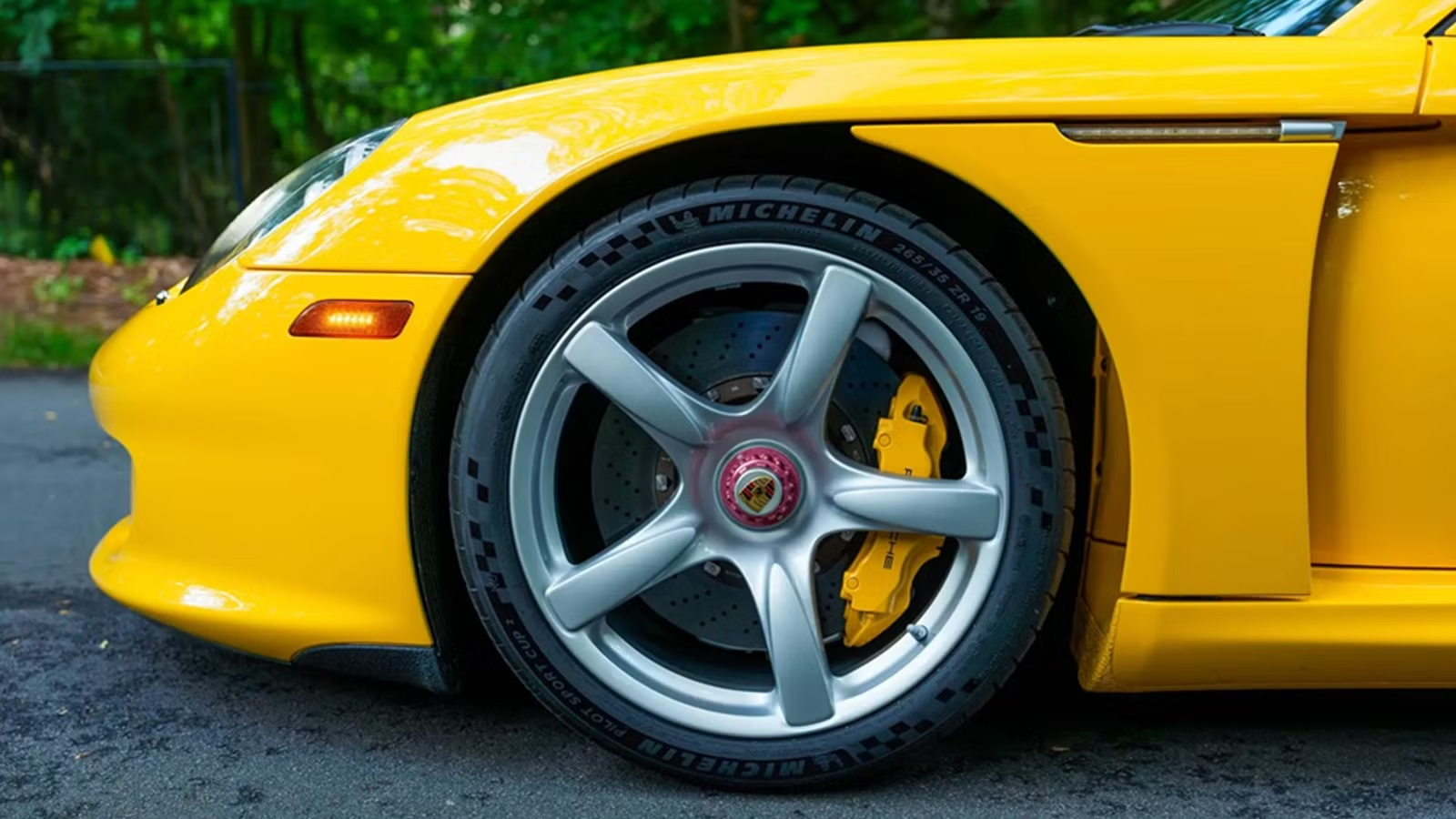
Suffice to say, the Carrera GT comes packed full of tech you’d expect to find on one of its Le Mans racers of the time, rather than a road car. Well, the goodies didn’t end there. The Carrera GT also used a similar center locking wheel design to its sports car racers, as opposed to a more traditional four, five, six or eight lug system found on most production vehicles. Usually, more nuts are used since they each demand smaller torque levels to remain properly tight, as they spread the load equally around the wheel.
A single center lock nut has to take all the brunt all by itself, which means it has to be torqued up significantly higher to do the same job. For reference, while a traditional smaller lug nut needs around 100 lb-ft of torque to get the job done, the center lock nuts on the Carrera GT have to be torqued up to an eye-opening 442 lb-ft. This huge figure therefore requires specialist equipment to achieve, which usually only Porsche had. The manufacturer typically used extra-long breaker bars to get the leverage needed to achieve that level of torque, though these days you can buy a torque gun that is capable of getting the job done. It does cost north of $5,000, so it’s far from affordable. Alongside these tools, the unique pattern of the nut requires a special socket so that the bar or gun can attach to the component in the first place.
This raises the question: why bother? The main advantage of a single lug design is that it allows for faster pit stops in races, since only one nut has to be removed, as opposed to four or more. As a street car, this advantage isn’t needed. Well, there are other benefits. Firstly, due to the weight of the nut being concentrated at the center of the wheel, rotational inertia is reduced thanks to the rotational mass being significantly lower than a conventional design. This allows the car to roll more easily, improving acceleration. Additionally, using a single nut helps save weight, as well as provide extra space around the back of the wheel so that larger braking systems can be more easily equipped. Basically, it’s more space for bigger brakes, which you need in this notoriously difficult machine.
Porsche’s Serious Supercar Could Prove Dangerous When Not Taken Seriously
2004 – 2005 Porsche Carrera GT exteriorPorsche
The Carrera GT was no grand tourer, as its name suggested. This was a serious supercar that demanded a highly elevated level of driving skill to get the most from. This also expanded to the way you prepared the vehicle, as those trick wheel nuts could quickly prove to be a ticket to the nearest ditch if they weren’t tightened properly. You had to tighten them up to the required torque figure, then remove and tighten them again to ensure they were properly set, for example.
Also, the left and right side nuts on the Carrera GT were finished in different colors, blue and red to be exact. This was because the threads on each side were essentially reversed, and using them the wrong way around would mean the nut wasn’t properly seated on the wheel. After a while, the wheel would work its way loose and depart the vehicle, leaving you with the challenge of somehow bringing a three- or possibly two-wheeled Carrera GT to a safe stop. Therefore, making sure the correct color nut was used on the right side was critical in ensuring you kept all four wheels on your very expensive wagon.
Beyond the potentially deadly wheel nuts, the Carrera GT also had the tendency to bite if its handling balance wasn’t respected. The Carrera GT was finely balanced and great fun when driven below the limit, but its stiff chassis, short wheelbase, and mid-engined layout meant it could quickly snap and sap away the illusion of control you thought you had when you started exploring its limits. The steering and chassis provided plenty of communication, but the Carrera GT’s uncompromising setup meant only the sharpest drivers could understand what the car was about to do once they started to test its mettle.
The Carrera GT Is Worth A Fortune In 2026
2004 – 2005 Porsche Carrera GT exteriorPorsche
Should scaring yourself silly behind the wheel sound like your perfect weekend, then you’d be forgiven for wanting to get your wallet out and purchase yourself a Carrera GT. After all, they retailed for $390,000 when new just over 20 years ago, so they can’t be that expensive, right? Well, Porsche only produced 1,270 examples, so they’ve become desirable collectibles in the years since. Amazingly, according to Hagerty’s Valuation Tool, simply securing yourself a good one will require a budget of $2.3 million.
If you’re after a mint specimen, you’ll need to track down around $3.5 million. Even a sub-par example requires $1.7 million, illustrating just how stratospheric values for the mighty V10 supercar have become. To hammer this point home even further, Hagerty reports that the car’s value has risen by around 90% across the board in the last 12 months alone. In July 2025, you could have expected to find a tidy Carrera GT for $1.2 million. That opportunity has well and truly passed.
Still, if you fancy pretending you’re a member of a motorsport pit crew, you could always go for the budget option of a 2026 Porsche 911 GTS or GT3 model, which also come with centrally-mounted wheel nut designs. These only cost $181,000 and $235,800, respectively. That’s considerably more attainable.
Sources: Hagerty Valuation Tool, Porsche.
