

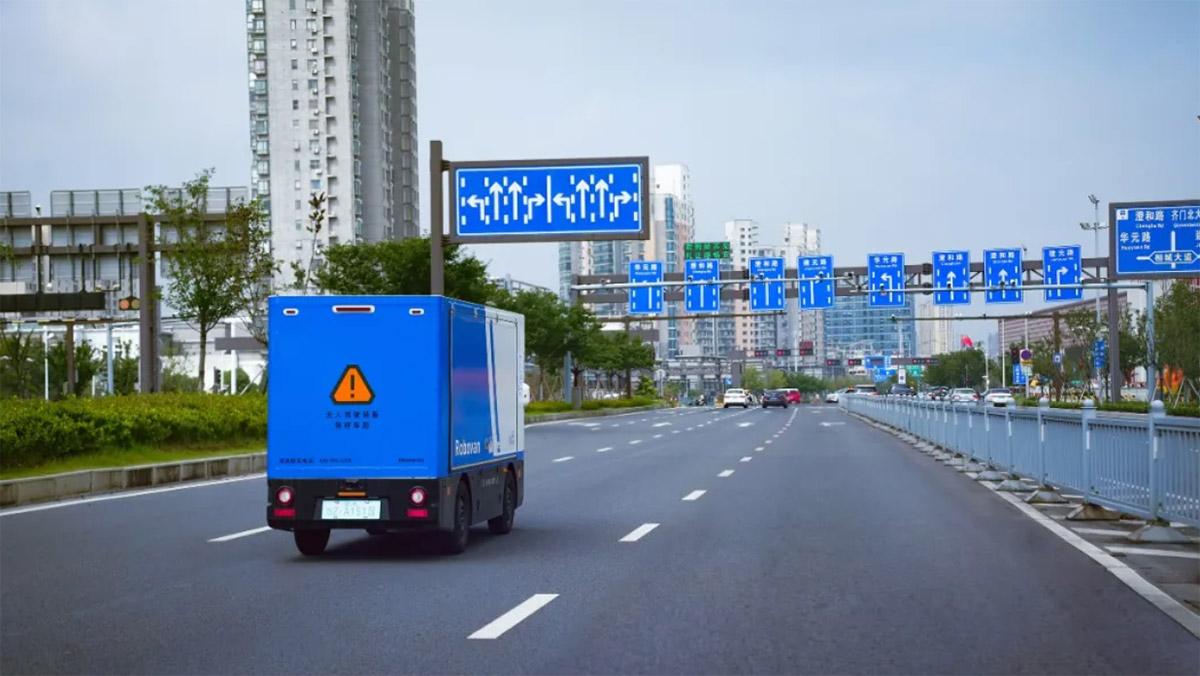
A Momenta robovan operating in Xiangcheng District, Suzhou. Credit: Momenta
- Momenta said its robovans are already running express and overnight delivery routes in Suzhou, built on its in-house R7 world model.
- The company is spreading its autonomous driving capabilities across more scenarios to absorb heavy upfront R&D spending.
Chinese autonomous driving company Momenta (HKEX: 6880) has officially announced its entry into the robovan business, with vehicles operating this year in Xiangcheng district of Suzhou, where it is headquartered.
Momenta robovans have moved into express delivery and overnight delivery scenarios, using round-the-clock driverless transport to close the urban “last mile,” the company said on Monday.
Local media outlet 21jingji reported last week, citing people familiar with the matter, that Momenta’s robovans had been running in Suzhou for several months. Monday’s announcement is the first time the company has publicly confirmed the business.
The product is built on Momenta’s in-house R7 world model and meets automotive-grade standards.
Momenta said it is the first to bring the “HD map-free solution,” proven over years of passenger vehicle mass production, into the robovan industry. Removing the reliance on high-definition maps improves delivery efficiency and lowers delivery costs, it said.
The company’s mass-production business has generated more than 12 billion kilometers of real-world driving mileage, from which it has distilled over 100 million segments of “golden data,” according to figures it cited.
The move means Momenta is spreading its autonomous driving capabilities across more scenarios to absorb heavy upfront R&D spending. The company spent 1.87 billion yuan ($275 million) on research and development in 2025, equal to 77.5% of total revenue.
Momenta was listed in Hong Kong on July 8, raising about HK$6.8 billion. It has said about 60% of the IPO proceeds will go to R&D and about 20% to commercializing robotaxis.
The R7 world model made its mass-production debut in April. Momenta’s strategy is to use a single large model to support the scaled roll-out of passenger cars, robovans, robotrucks and robotaxis, and to extend it further into embodied intelligence.
Driverless delivery is seen as one of the first commercially viable use cases for Level 4 autonomous driving. More than 33,000 driverless delivery vehicles had been deployed in China as of the end of December 2025, according to a report by the China Federation of Logistics & Purchasing.
By 2030, annual production and sales of such vehicles in China could reach 860,000 units, with the total fleet exceeding 2 million.
Momenta is entering a highly concentrated market, however. As of the first quarter of 2026, Cainiao-backed Zelos had a fleet of more than 25,000 vehicles for a 52.3% share, while Neolix had 17,000 units, or 36.2 percent. Together with Rino, the top three account for more than 95 percent.
Rapidly falling costs are one reason the industry is nearing a breakout. LiDAR prices have dropped from around 100,000 yuan in the early days to the thousand-yuan range, and the bill-of-materials cost of a single driverless delivery vehicle has generally fallen below 100,000 yuan.
The main constraint is road rights. China still has no national-level product access or certification standard, leaving local governments to set their own rules. That means companies must apply for licenses city by city.
Momenta is not the only newcomer. WeRide’s (NASDAQ: WRD) mass-produced robovan W5 was rolled out in 2025.
As of press time, Momenta’s stock price had risen by about 6%, bringing its total market capitalization to 73.6 billion Hong Kong dollars.
($1 = 6.7911 yuan)
