

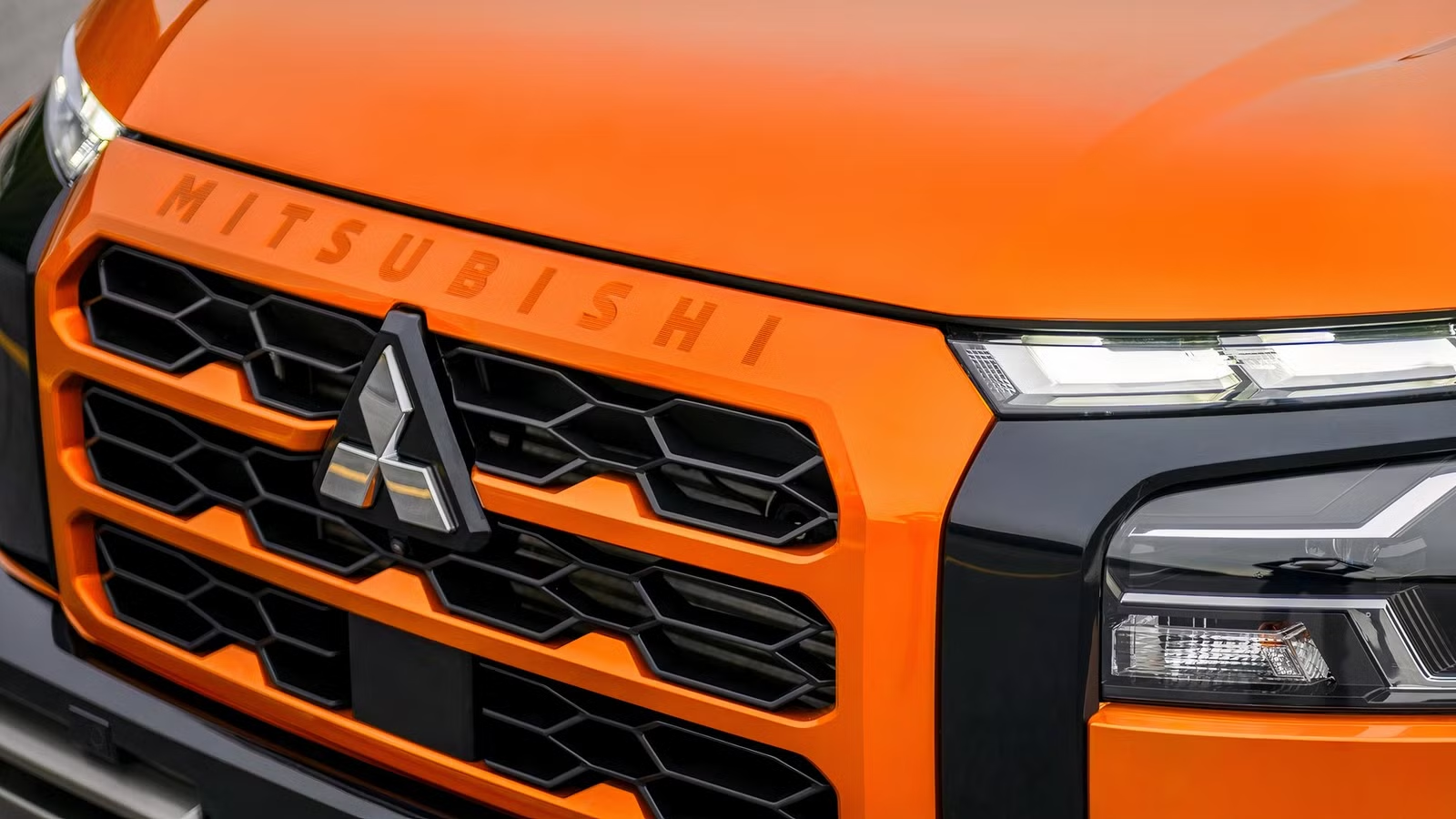
For our younger readers, a Mitsubishi pickup sounds almost like one of those AI-generated concepts your uncle keeps falling for on Facebook. We haven’t seen the three-diamond mark on a truck since the 2009 model year, when the brand sold the mid-size Mitsubishi Raider here in North America.
The booming small and mid-size truck market has created a golden opportunity for the brand to return to the segment, aiming to cut the Toyota Tacoma and its hybrid variant off at the knees with a clever tariff-dodging market strategy.
Mitsubishi Is Looking To Compete On Price
2006 – 2009 Mitsubishi Raider – front 3/4 angleMitsubishi
One of the key ways that Mitsubishi is looking to compete with trucks like the Tacoma and the Ranger is by selling a more affordable alternative to those popular pickups. And we know what you’re asking, how is a Japanese company going to compete with Ford when we’ve got these tariffs to worry about? Well, for starters, Mitsubishi is building the trucks here in the US, with the most likely option being the automaker’s plant in Canton, Mississippi.
The 25% Chicken Tax, an import cost predating the latest wave of tariffs by more than half a century, actually robbed Americans of the 2015 Mitsubishi Triton. The brand didn’t feel that the truck would be able to turn a profit in the US after forking that much money over to Uncle Sam, so we missed out on that one.
So that’s step one: build local. Step two: Mitsubishi is doing some platform-sharing with Nissan to keep development costs down. This is going to be a new platform supporting the next-gen Nissan Frontier for 2028, as well as the Xterra and a new Infiniti SUV. Mitsubishi CEO Takao Kato has announced that the truck will be a key part of a plan to improve global sales between now and the start of the next decade.
Super Select Could Help To Attract Truck Enthusiasts
Mitsubishi Triton from the rear three-quarter angleMitsubishi
Introduced in 1991 as Active-Trac, Mitsubishi’s signature Super Select four-wheel drive system lets drivers switch between rear and four-wheel drive with both high and low ranges, using a lever mounted alongside the gear shift. You can switch modes on the fly, between the following options.
- 2H – Rear-wheel drive high-range, sending 100% of the power output to the back end.
- 4H – Four-wheel drive high-range, sending power to the front and rear axles with the center diff unlocked.
- 4HLc – Four-wheel drive high range locked center differential, sending power to both axles with the differential ensuring that all four wheels are kept spinning.
- 4LLc – Four-wheel drive high range locked center differential, but with the gearing ratio doubled for extreme off-roading.
The Ford Ranger and Toyota Tacoma’s drive modes are relatively simplistic, essentially letting you switch between rear-wheel and 50/50 modes, and four-wheel drive low, for low-speed rock-climbing.
Super Select might not do much to tip the scales in terms of mainstream sales numbers, but it could be a major selling point for truck enthusiast types. Off-roaders, work truck fans, and people who just appreciate having access to a wide range of drive modes for all types of driving scenarios would be getting something out of Super Select that they’re not getting from Toyota or Ford.
Mitsubishi Used To Be A Name In The US Pickup Segment
2006 – 2009 Mitsubishi Raider – taillightMitsubishi
Mitsubishi may have never been a serious threat to Toyota, Ford, Dodge, or Chevrolet, but the Mitsubishi Mighty Max and the Mitsubishi Raider definitely had their fans.
The Mighty Max, a rebadged Triton, sold in the US from 1978 to 1996, with sales peaking at 37,835 in 1987. The final model year was a 116-horsepower mid-size truck running on a 2.4-liter straight-four, cranking out 136 lb-ft of torque and towing up to 3,500 lbs of cargo in its wake. This truck predated the more SUV-like pickups of the late 1990s and early 2000s, making it one of the last real truck-type trucks of its era.
More recently, you had the Mitsubishi Raider, offered from 2005 to 2010, with sales peaking at 8,262 units in 2007. The 2006 Raider was available with a 4.7-liter V8 paired to a five-speed automatic transmission, running in rear-wheel drive or part-time all-wheel drive, and producing 230 hp and 290 lb-ft of torque for up to 6,600 lbs of towing capacity. A 3.7-liter V6 could pull up to 2,950 lbs.
Mitsubishi discontinued the Mighty Max when drivers started to take more interest in larger trucks, resulting in a steady decline in sales for the rebadged Triton. Emissions regulations played a part, but it was the slow sales that convinced Mitsubishi it wasn’t worth updating the truck for American highways. It was basically the same deal with the Raider, the truck was out of date, and it wasn’t selling well enough to justify bringing it up to code.
The Raider Can Be Had For Cheap In 2026
Just for fun, we decided to take a look at the used market to see what a used Raider sells for in 2026, and we turned up the following listings.
- A 102,000-mile 2009 LS is selling for $6,700 in North Carolina.
- A 97,376-mile 2007 LS Is selling for $4,399 in Indiana.
- A 138,120-mile 2006 Duro Cross is selling for $3,995 in Minnesota.
- An 86,461-mile 2006 Duro Cross is selling for $6,995 in New Jersey.
- An 83,467-mile 2006 XLS is selling for $9,995 in Florida.
These numbers tell us that it’s not hard to find a Raider selling for dirt cheap, but it is hard to find one with low miles.
The truck has been off the market for almost two decades, and the Raider’s appeal largely comes down to its utilitarian functionality, meaning you’re going to see a lot of well-worn listings. Still they make for some attractive beaters.
How Is Mitsubishi Doing In The US These Days, Anyway?
2026 Mitsubishi Outlander PHEVEvan Williams/CarBuzz/Valnet
Mitsubishi sold a total of 94,754 units in the US last year, which represents a 14% decrease in sales from the year prior. The Outlander sold 35,895 units, leading the pack, with its hybrid variant taking up the rear at 6,294 sales.
The outdated Outlander Sport somehow managed to sell 20,480 units in 2025, which, honestly, boggles the mind. We don’t know how many times we’ve told you not to buy that thing, but it does seem to be keeping the brand in business.
It might be a stretch to say that Mitsubishi is “just holding on,” but the brand has definitely seen better days here in North America, and we’re betting some of you are surprised to learn that they’re still selling in the US at all. You could easily be forgiven for assuming that the brand had gone the way of Suzuki and Isuzu, pulling anchor from American shores.
Mitsubishi’s New Market Strategy Might Be All-Or-Nothing
2026 Mitsubishi OutlanderMitsubishi
We don’t really care if the Outlander Sport sticks around, but we’re rooting for Mitsubishi. The more options American drivers have to pick from – especially in the booming small and mid-size pickup segment – the better.
Globally, Mitsubishi hopes to make somewhere around 930,000 sales a year by the early 2030s, which we have to say is a pretty reasonable goal, based on last year’s sales of 797,000 units worldwide. Models like the Outlander have managed to stay relevant thanks in large part to their low MSRPs, and it’s easy to imagine Mitsubishi achieving a growth of 17% over the next four or five years by retooling the lineup.
If the plan is to beat the Tacoma and the Ranger on pricing, it’s a safe bet that the truck will launch, at the entry level in the low $30,000 range, but with a launch still two years away, at the very soonest, it’s anyone’s guess what an affordable pickup will look like near the end of the 2020s.
Sources: Mitsubishi, TechStory.
