

Here’s a question worth asking the next time a shop quotes you four figures for a headlight replacement: why can’t you just fix the part that’s actually broken? In most modern vehicles, the answer comes down to a tube of adhesive. Headlight assemblies are glued shut at the factory, which means a cracked lens or a failed seal condemns the entire unit — a wasteful outcome that costs owners real money and sends perfectly serviceable hardware to the landfill. Mercedes-Benz has decided that’s no longer acceptable, and it’s doing something about it.
The fix sounds almost comically simple: use screws instead of glue. But that single design change is just one piece of a sweeping sustainability initiative the German automaker calls “Tomorrow XX” — a program that reaches far beyond headlights to rethink how cars are built, repaired, and ultimately recycled. It’s an ambitious undertaking, and if it gains traction across the industry, it could meaningfully change what it means to own and maintain a modern vehicle.
This program is an attempt at radically changing several aspects of the automotive industry, from manufacturing to repairs to end-of-life recycling. Let’s take a closer look at what Mercedes is trying to do, and why it could have a major impact on the car world.
Mercedes’ Tomorrow XX Program: Driving Towards Sustainability
Mercedes-Benz Tomorrow XX ProgramMercedes-Benz
Mercedes-Benz unveiled its “Tomorrow XX” program as a sustainability initiative aimed at making the company’s vehicles and manufacturing processes more environmentally friendly. The core pillars of Tomorrow XX are decarbonization, circular processes (such as recycling of used vehicles and materials), and intelligent manufacturing practices.
Mercedes-Benz Tomorrow XX ProgramMercedes-Benz
Mercedes-Benz is working in collaboration with several other organizations — including start-ups and suppliers — to push the limits of innovation and reach higher standards of sustainability across all parts of a vehicle’s lifespan. Still in its early stages, the Tomorrow XX program is expected to expand over the coming years, with an ever-increasing range of materials being brought into scope. The ultimate goal is to embed sustainability at the core of everything Mercedes-Benz does, from building cars on the production line to recycling them at the end of their life.
“There can be no doubt that the overriding goal for all our products is to excite our customers while decarbonizing the automobile, driving down resource use and growing the circular economy. Innovation is a key route to achieving this and Tomorrow XX makes clear the huge strides we are taking. Together with our suppliers and partners, we are leading the way and embedding sustainability deep into our operational business and along the entire supply chain.”
-Olaf Schick, Member of the Board of Management Mercedes-Benz Group AG. Integrity, Governance & Sustainability
Every single component of a Mercedes-Benz vehicle is put under scrutiny: bodywork, interior trim, batteries, and more. When it comes to cutting down carbon emissions, Mercedes is leaving no stone unturned, examining how parts can be redesigned and materials altered to shave off an extra kilogram of CO2.
The “Recyclable Headlight”: A Concrete Example Of Tomorrow XX’s Impact
Mercedes-Benz Tomorrow XX ProgramMercedes-Benz
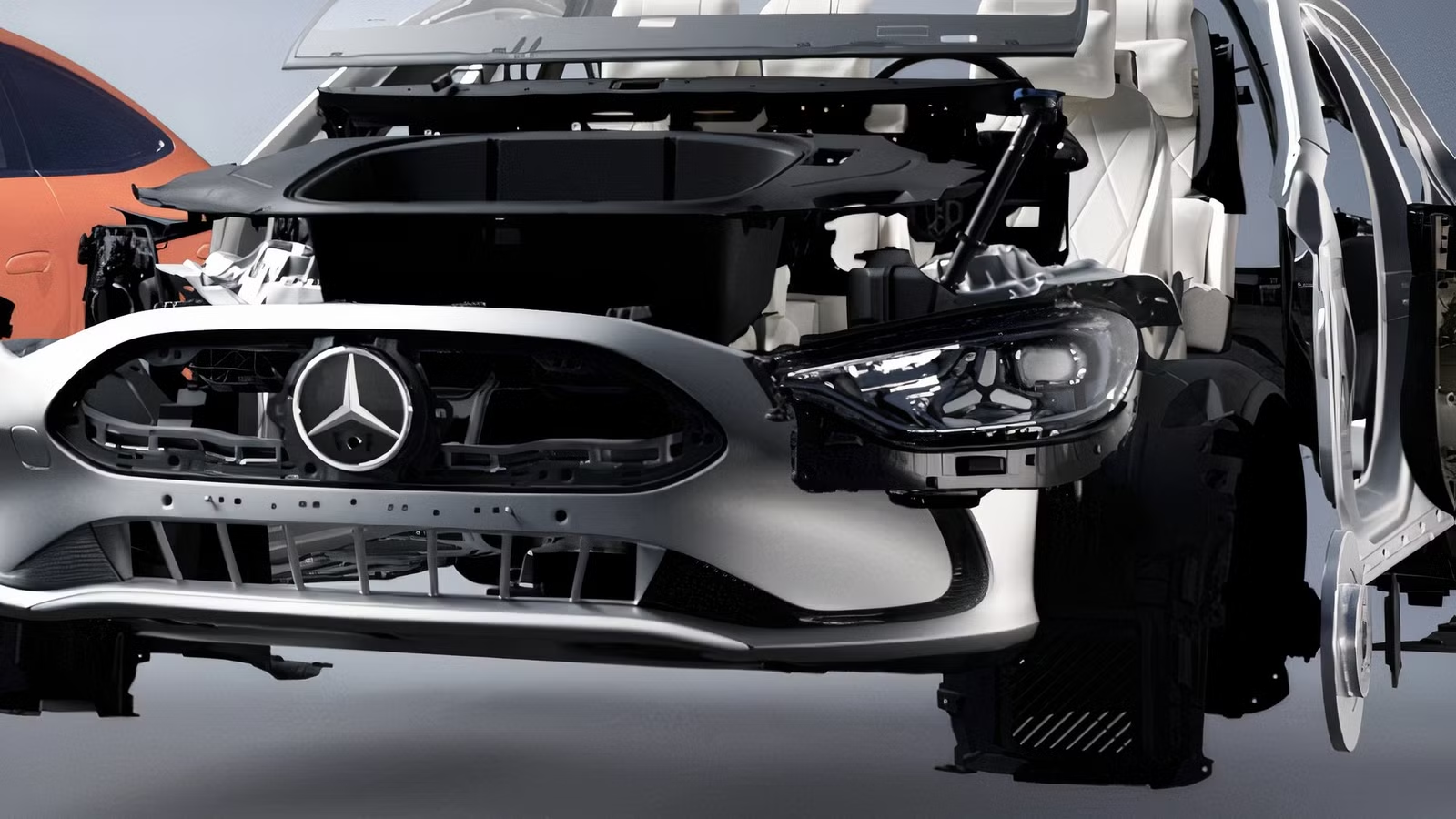
One particular project Mercedes is working on as part of the Tomorrow XX program is the recyclable headlight. In most modern vehicles, headlight components (such as the lens, frame, and cover trim) are glued together, making the headlight near-impossible to repair because individual components cannot be separated from the rest.
Mercedes’ new headlight design, by contrast, uses components that are screwed together. This makes targeted repairs far more achievable, which dramatically reduces the environmental impact of the vehicle. For example, instead of replacing an entire headlight assembly over something as minor as a stone chip, the lens can simply be unscrewed and swapped out on its own.
Mercedes-Benz Tomorrow XX ProgramMercedes-Benz
This approach gives the headlight a significantly longer service life, meaning that environmental impact is reduced and costs for the consumer are cut down considerably. Broken headlights are a common source of unexpected, expensive repair work, and being able to fix rather than replace completely makes a substantial difference to the bill.
The prototype headlight also features a mono-material design: all of its components are made from a single material. This makes it easier to incorporate recycled materials during manufacturing, and when the headlight eventually reaches the end of its lifespan, sorting and recycling its individual components becomes far more straightforward. This type of design could cut total carbon emissions by almost half.
What Mercedes Is Up Against: The Modern Automotive Throwaway Culture
Mercedes-Benz Tomorrow XX ProgramMercedes-Benz
The Tomorrow XX program has the potential to have broader effects not just within Mercedes, but across the wider automotive world. A frequent complaint among car enthusiasts is that modern cars are essentially “smartphones on wheels”: throwaway appliances that are difficult to repair, with individual components that can’t easily be replaced. Screens and other tech items become obsolete quickly, cheap plastics deteriorate, and parts are glued together and impossible to take apart.
As a result, swapping out entire assemblies (such as a headlight), or even buying a new vehicle, is frequently seen as a more cost-effective and practical solution than spending large amounts of time and money on repair work. However, this approach generates massive amounts of waste and carries a significant environmental cost. Mercedes’ approach could, if successful, reintroduce some of the core characteristics of older, simpler vehicles: modular components that are easier and cheaper to swap out, making repairs more attainable.
Mercedes-Benz Tomorrow XX ProgramMercedes-Benz
The end of a vehicle’s lifespan also stands to benefit from Tomorrow XX: although it is already common practice to harvest a scrapped vehicle for spare parts, Mercedes’ ideas could take recycling further still, by repurposing raw materials as well as whole components. Tomorrow XX is a highly ambitious project that aims to radically change the way we think about cars, from the production line to the scrapyard. Repairing rather than replacing, recycling rather than wasting: these are the steps that can make the manufacturing process and the ownership experience of a vehicle more environmentally friendly and more cost-effective.
Another Aspect Of The Tomorrow XX Project: The Intelligent Production Of Key Materials
Mercedes-Benz Tomorrow XX ProgramMercedes-Benz
The Tomorrow XX project does not just aim to revolutionize the way cars are built; it also targets the way materials are manufactured long before a car reaches the production line. Mercedes is working to increase its use of materials that are created sustainably and can be recycled efficiently at the end of their lifespan, in order to establish a circular process with lower carbon emissions.
Several interior components in modern Mercedes models, for example, are built using recycled PET plastic. This material appears in components such as seat covers, wheel-arch liners, floor mats, and door panels, which are constructed with a bone-like structure that drastically reduces their weight without compromising performance. PET is highly recyclable, making it a strong candidate to replace other types of plastic currently used in vehicle manufacturing.
Mercedes-Benz Tomorrow XX ProgramMercedes-Benz
Metals are also heavily targeted by the Tomorrow XX project. Mercedes is looking to improve sustainability in the way it produces aluminum and steel, both of which are used extensively throughout its vehicles. The production of aluminum is typically very energy-intensive; however, Mercedes is transforming the process through the use of electrolysis plants powered by renewable energy. Low-carbon aluminum already forms a significant part of Mercedes’ manufacturing process, and the company is working to increase that share even further.
Steel production is also energy-intensive, but Mercedes is collaborating with leading steel manufacturers to cut greenhouse gas emissions during the process. The traditional blast-furnace route is being replaced with electric arc furnaces, and most of the steel used in Mercedes vehicles is recycled — which further reduces environmental impact.
The start of automotive materials’ life cycle is important, but the end is equally crucial: another aspect of Mercedes’ project focuses on recycling and using scrapped vehicles as a source of raw materials. A take-back facility for end-of-life vehicles is currently being built in northwestern Germany, in an effort to reduce waste and create a circular economy where old cars are recycled into new ones. Here are a few components from old cars that could find a second life thanks to Mercedes’ efforts:
Brake Pads: Mercedes already has a scheme in place (MeRSy) to collect and recycle friction components. As part of Tomorrow XX, it has also designed an innovative new brake pad concept that contains approximately 40% waste material from old brake pads.
General Plastic Residue: The underbody cladding of new vehicles can be manufactured using so-called “shredder residue” produced when old cars are recycled. This residue can substitute for virgin plastics, reducing carbon emissions in the process.
Airbags: The Tomorrow XX program has identified engine mounts and the valve housing in the thermal management system as two components that could potentially be built using recycled airbag material.
Tires: Old tires can be recycled to produce a high-quality leather alternative, or shredded and used as acoustic insulation.
Sources: Mercedes-Benz.
