
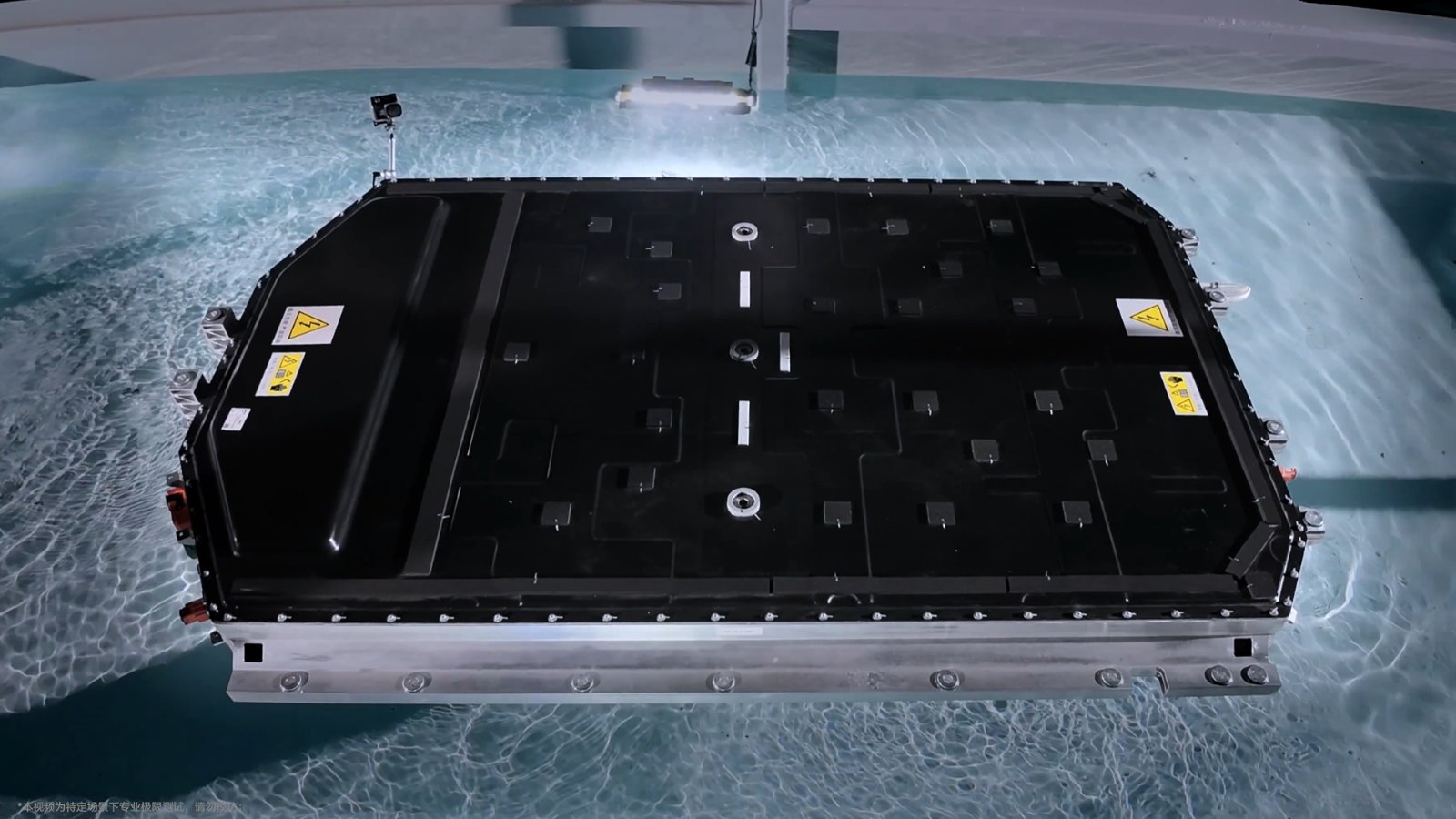
A Lianshan battery pack undergoes a water immersion test in a screenshot from a Li Auto video.
- The launch comes as Li Auto shifts its batteries from CATL to in-house developed ones produced by its joint venture with Sunwoda.
- The Lianshan system covers batteries, electric drive units and the charging network.
Li Auto (NASDAQ: LI) has launched its in-house developed electric powertrain technology system named Lianshan, covering batteries, electric drive units and charging network.
The company pledged two lifetime guarantees — against battery self-ignition and against fire after collisions — as it seeks to ease consumer safety concerns while expanding the use of its in-house batteries.
The Chinese automaker announced the system at its Power Day electric technology event on Tuesday. It said the Lianshan battery, Lianshan electric drive and charging network are all developed in-house, and that it will take care of “everything about electricity.”
Under the Lianshan battery guarantee program, if a vehicle self-ignites due to quality problems with the original battery and meets scrapping criteria, Li Auto will compensate the owner with a new vehicle of the same configuration.
If a battery catches fire following a collision or chassis scraping and the vehicle is scrapped, the company will cover the gap between the vehicle damage insurance coverage amount and the actual insurance payout. The program is subject to eligibility conditions.
The launch comes as Li Auto accelerates the switch of its models’ batteries from CATL (HKEX: 3750) to in-house developed batteries, which are produced by a 50-50 joint venture it established with Sunwoda (SZSE: 300207) in 2025.
Li Auto also disclosed on September 4 that it plans to invest 2.65 billion yuan ($394 million) in Sunwoda’s power battery subsidiary, Sunwoda Electric Vehicle Battery Co Ltd (Sunwoda EVB), and will directly hold an 8.79% stake after the deal closes, becoming its second-largest shareholder.
CATL is the world’s largest power battery maker, and its batteries are generally seen by Chinese consumers as safer and more premium. Persuading potential customers to accept batteries made by Sunwoda will not be easy for Li Auto, and the raft of safety commitments unveiled on Tuesday appears to be aimed at that concern.
When CATL signed a 5-year strategic cooperation agreement with Li Auto in September 2025, the battery maker said more than 1 million Li Auto vehicles equipped with its batteries had been delivered, with no thermal runaway incidents caused by the batteries themselves.
In January, Li Auto delayed some Li i6 deliveries due to insufficient battery supply and encouraged order holders to switch to versions equipped with Sunwoda batteries, offering an additional 2-year or 40,000-kilometer battery warranty extension.
Sunwoda EVB was sued in December 2025 by Vremt, a Geely-affiliated company, which sought 2.31 billion yuan in damages, alleging quality problems with the battery cells it had delivered.
At Tuesday’s event, Li Auto said the Lianshan battery uses a high-stability cathode, a low-lithium-consumption anode and a dual-formula electrolyte for long life, supporting continuous dynamic repair. Batteries across all models will retain at least 75% health within 8 years or 160,000 kilometers, it said.
The company said cell-level material improvements, highly integrated battery packs and vehicle-level energy management have increased range across all models. Under the CLTC standard, the new Li L8 offers 430 kilometers of pure electric range and the 2026 Li i6 offers 780 kilometers, an overall improvement of more than 8% over the 2025 versions.
On safety, Li Auto said the underside of the Lianshan battery can withstand a 500-joule impact without catching fire or exploding, remain watertight after 48 hours submerged in 1 meter of water, and that the full pack will not catch fire for 24 hours after a single cell goes into thermal runaway at 50 degrees Celsius.
The company said its new-generation 5C ternary lithium cells run 12 degrees Celsius cooler during supercharging than ordinary 2C ternary lithium cells. For lithium iron phosphate batteries, its adaptive algorithms keep state-of-charge estimation error within 3% and increase peak power output at low charge in winter by more than 40%.
The Lianshan electric drive uses a proprietary patented CAR119 cast aluminum rotor material, adding more than 15 kilometers of pure electric range in urban driving and more than 8 kilometers on highways.
Li Auto also restructured the power module so that current flows directly to the chip, adding another 30 kilometers of range and freeing up 24 millimeters of headroom.
The company said 4 million of its in-house developed silicon carbide power chips have gone into production vehicles over the past year with zero failures. The next-generation electric drive system will deliver more power and range without increasing in size, it said.
On the charging network, Li Auto’s supercharging stations now exceed 4,200, covering cities, highways and scenic areas, and span the “12 vertical and 13 horizontal” expressway corridors, with an average of one station every 100 kilometers to be achieved within the year.
The company said equipment availability stands at 99.9 percent, and all highway supercharging stations are equipped with 5C superchargers.
Li Auto founder, chairman and CEO Li Xiang said on Monday that the company decided in 2020 to develop its own batteries, and that its existing battery suppliers remain partners to this day.
On September 28, he said the company would not define its in-house development strategy as “de-anyone,” and thanked CATL for its support in the joint development of batteries for the Li One and Li Mega.
Li had previously mentioned that the company uses a in-house developed Lianshan quality monitoring system to connect data from upstream materials, cell manufacturing, pack production and vehicle use. The system unveiled on Tuesday shows the name has been extended to the entire electric powertrain technology suite.
Li Auto said on September 7 that its in-house developed batteries are already used in the Li L8, Li L6 and Li i8, and will be extended to all models. The 2026 Li i6, equipped with the in-house developed 5C battery and Mach chip, will launch on October 28, with deliveries scheduled to begin in early November.
Li Auto delivered 31,817 vehicles in September, down 6.29% year-on-year, and 293,436 vehicles in the first 9 months of the year, down 1.25% year-on-year.
Li Auto has several solid-state battery projects underway and has validated prototypes in eyewear products.
($1 = 6.7200 yuan)
