

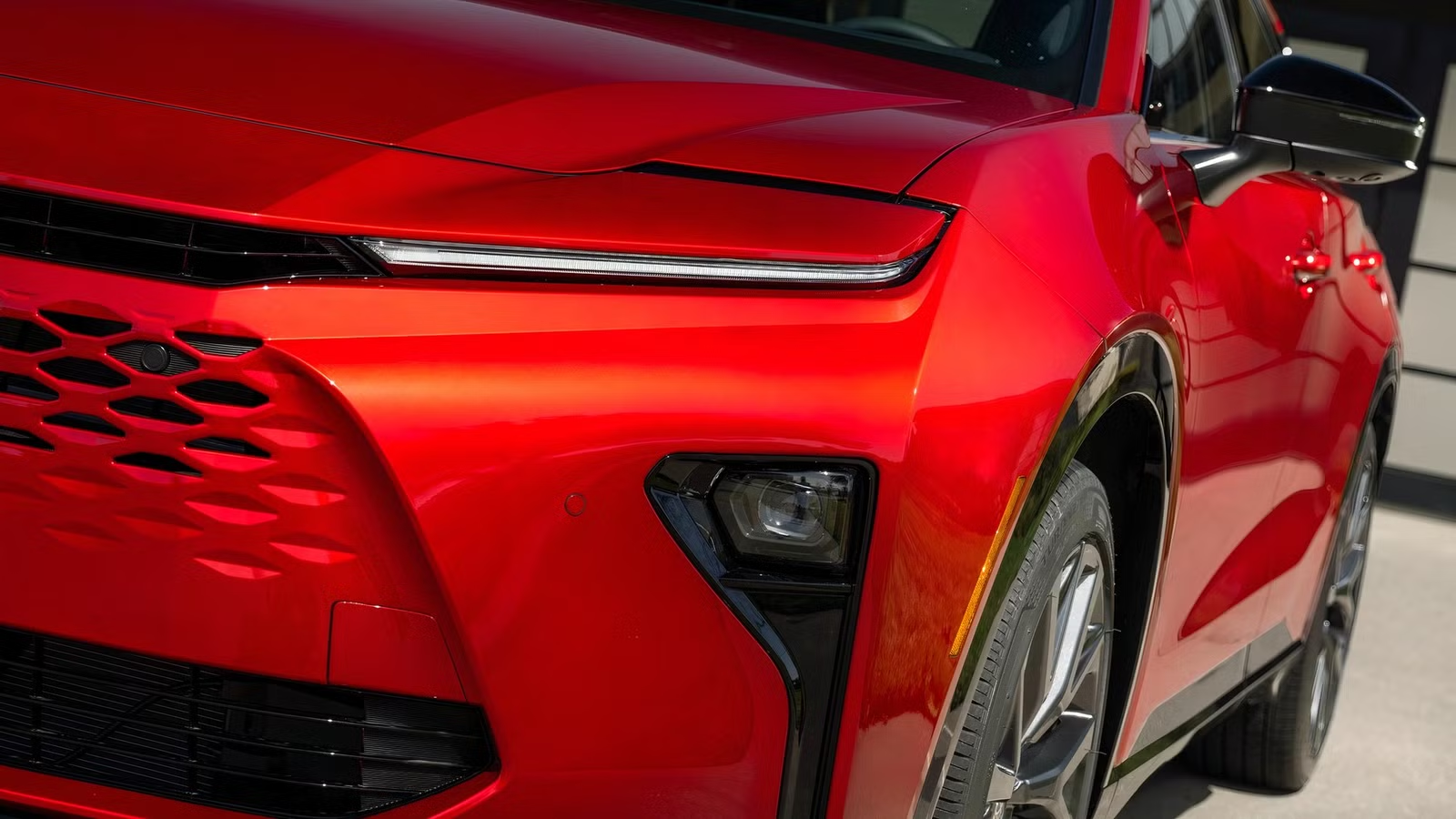
There’s a lot of redundancy in the automotive industry. And we’re not just talking about badge-swaps like the Chevy Silverado and the Sierra 1500, or crowded segments like mid-size crossovers. We’re also looking at automakers that are stepping on their own toes, selling multiple vehicles that do essentially the same thing.
At a glance, the Toyota Crown Signia seems to be an especially egregious offender, offering less space than a Grand Highlander, while costing $2,430 more, and nixing the third row. Is Toyota really trying to double-dip, or is there a good reason for both SUVs to exist?
The Crown Signia Is More Expensive At The Base Level
2026 Toyota Crown SigniaToyota
To start with, let’s take a look at the MSRPs for the Toyota Crown Signia, and the Toyota Grand Highlander. The Crown Signia is available in just two trims for 2026, the Crown Signia XLE for $44,690 and the Crown Signia Limited at $49,090.
The ICE Grand Highlander is available in four trims, the base of which is the Grand Highlander LE for $42,260. The XLE ($45,030), Limited ($49,760) and Platinum ($55,445) complete the set.
Finally, the Grand Highlander Hybrid is available in six trims, starting with Grand Highlander Hybrid LE for $45,610, increasing in price all the way up to the top-trim Grand Highlander Hybrid Max Platinum, for $60,175.
What we’re seeing at a glance is that the Crown Signia has a higher floor and a lower ceiling, when it comes to pricing and trims. That is, it starts at a higher base price, but you can only upgrade it to the Limited, which comes in at under $50,000, and every model is a hybrid. The Grand Highlander is available across 10 trims, with the priciest costing over $60,000, and you have your pick of ICE and hybrid variants.
All of this just makes the existence of the Crown Signia all the more confounding. Whatever the Crown Signia offers, surely the Grand Highlander could deliver across one of its many trims?
Less Cargo, Less Legroom, Fewer Seats: The Crown Signia’s Size Deficit By The Numbers
2026 Toyota Grand Highlander Dynamic Front QuarterToyota
Comparing key interior size dimensions across both of these SUVs, here’s what we turn up.
Toyota Crown Signia
Toyota Grand Highlander
Seating Capacity
5
8
Front Seat Headroom
39.1 inches
40.2 inches
Front Seat Leg Room
42.1 inches
41.7 inches
Rear Seat Leg Room
37.1 inches
39.5 inches
Maximum Cargo Volume
68.8 cu ft
97.5 cu ft
The Grand Highlander is bigger than the Crown Signia in more ways than not. Its wheelbase stretches 116.1 inches to the Crown Signia’s 112.2 inches, it’s four inches wider at the front, at 78.3 inches across, and it stands an inch or so higher off the ground, at eight inches of ground clearance to the Crown Signia’s 6.7 inches.
Toyota managed to build a surprisingly roomy second row for the Grand Highlander, considering that they had to make space for the third row, which further begs the question of what the Crown Signia is for, and why it costs more than its big sibling.On paper, the Grand Highlander wins every dimension battle. But one number in the performance specs flips the entire value argument upside down.
The Grand Highlander Wins On Power And Towing – But The Crown Signia Has One Trick Left
2026 Toyota Grand Highlander SideToyota
Maybe if we compare performance specs, it’ll start to make sense.
Toyota Crown Signia
Toyota Grand Highlander
Toyota Grand Highlander
Hybrid (LE FWD)
Engine
2.5-liter Hybrid 4-Cylinder
2.4-Liter 4-Cylinder
2.4-Liter Hybrid 4-Cylinder
Power
240 hp
265 hp
245 hp
Fuel Economy (Combined)
38 MPG
24 MPG
36 MPG
Maximum Towing Capacity
2,700 lbs
5,000 lbs
5,000 lbs
Now it looks like we’re finally getting somewhere. The Grand Highlander is more affordable, more powerful, and roomier, it has more seats, and it has a proven reliability track record, being based on the Toyota Highlander, which launched in 2000 for the 2001 model year. But, the Crown Signia is considerably more fuel efficient at the base level.
Comparing fuel costs across the Crown Signia, Grand Highlander, and Grand Highlander Hybrid, here’s what FuelEconomy.gov says we’ll be spending each year:
- Crown Signia – $1,600
- Grand Highlander – $2,550
- Grand Highlander Hybrid – $1,700
These estimates assume you’re driving 15,000 miles a year, split 45/55 between highway and city driving. We’ve gone with the front-wheel-drive versions of the Grand Highlander in both instances.
The Crown Signia may be smaller and less powerful than every version of the Grand Highlander, but it’ll save you $950 a year in fuel expenses over a standard Grand Highlander. That means you’ll make up the difference in price after just a few years on the road.
On the other hand, an entry-level Grand Highlander Hybrid starts at $45,610, just $920 more than you’d spend on a base Crown Signia, and will only cost you another $100 each year in gas, so we’re back to square one. What do we need a Crown Signia for when we have a Grand Highlander Hybrid?
Inside, The Crown Signia Is Basically A Lexus
2026 Toyota Crown SigniaToyota
Our senior road tester Jared Rosenholtz remarked on the Crown Signia, back when it was brand-new, that “No matter which trim you choose, the Crown Signia looks and feels premium inside, verging on Lexus territory. In fact, we’d say the nicest Crown Signia is nicer inside than the base Lexus NX.”
At the entry level, you’re getting leather upholstery, a power liftgate, cooled and heated seats, and a heated steering wheel. It definitely earns its stripes as a luxury-lite SUV.
On the other hand, the experience of actually driving it may feel a bit underwhelming. It has all the refinement of a Lexus, with none of the punch you want from a luxury SUV. The CVT may be more reliable than it’s been made out to be, but it’s still a bit underwhelming, and the 240-hp powertrain takes seven seconds to hit 60 mph, at the minimum.
The Grand Highlander is no drag-strip king, either. The standard combustion-powered model takes 8.3 seconds to hit 60 mph, and the hybrid only shaves about a second off the time. Then again, the non-hybrid model packs an 8-speed automatic transmission, which means it’s just more fun to drive.
The Grand Highlander LE’s cabin isn’t quite as cushy as that of the Crown Signia, but when we last reviewed the SUV, we noted the “impressive material quality” throughout, with SofTex leatherette upholstery. It’s hard to mistake it for a Lexus, but it doesn’t feel cheap, either.
Does Toyota Really Need Both Of These SUVs?
2026 Toyota Crown SigniaToyota
It’s not just us saying that Toyota has too many darn cars in its lineup. Toyota’s newly inaugurated CEO, Kenta Kon, has gone on record himself saying that the brand’s portfolio is overstuffed, with 21 nameplates to pick from, or 32 if you want to count hybrids separately.
Based on everything we’ve covered here, we think there’s a good argument to be made that the Crown Signia has its place on Toyota’s sales lots. It’s simply not as powerful, not as fun to drive, and not as spacious as the Grand Highlander. But it’s more upscale, it’s more fuel-efficient, and it’s not that much more expensive than its larger sibling.
That said, the argument will ultimately be won on sales. Kenta Kon is clearly looking to trim some fat, and the Crown Signia will need to carry its own weight if it wants to stick around.
Inside The Passionate (And Growing) Crown Signia Owner Community
2026 Toyota Crown SigniaToyota
In 2025, Toyota sold 136,801 Grand Highlanders, and 20,550 Crown Signias. Toyota hasn’t shared its sales goals for the car, but the relative lack of advertising for the nameplate suggests that the brand is comfortable with it being a niche product.
Perhaps most importantly, the Crown Signia has its fans. A user in the r/ToyotaCrownSignia subreddit reports falling in love with the car, thanks in large part to the incredibly comfortable seats, which almost invite the driver to nap in the second row between trips. That whole subreddit is full of owners who’ve found a new favorite, so there’s reason to keep this car around.
But we’ll have to wait to find out if Kenta Kon sees it that way.
Sources: Toyota, r/ToyotaCrownSignia.
