

Stellantis Investor Day 2026 was expected to focus on electrification and platform consolidation. Instead, Jeep quietly revealed one of its boldest performance pushes in decades: the return of the Scrambler as a two-door, Hemi-powered Gladiator variant, alongside Hellcat-powered Grand Cherokee and Grand Wagoneer models.
Together, these vehicles signal something Jeep hasn’t seriously attempted before — a coordinated performance offensive spanning muscle truck, luxury SUV, and hardcore off-roader. While EVs remain central to Stellantis’ future, Jeep just made it clear it has no intention of abandoning combustion-powered performance.
Why The Scrambler Name Matters
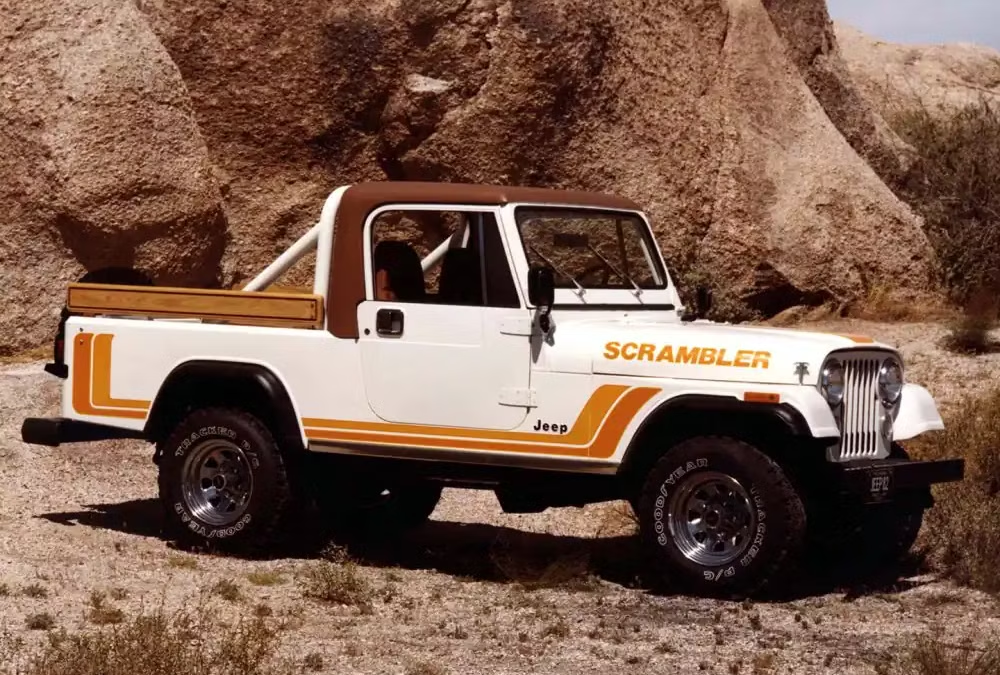
The original Jeep Scrambler, sold as the CJ-8 from 1981 to 1986, was essentially a stretched CJ-7 with a small pickup bed. It never sold in huge numbers, but it earned a loyal following thanks to its mix of utility, off-road capability, and unmistakable Jeep character.
That heritage gives the Scrambler name real emotional weight among enthusiasts. Much like Wagoneer and Cherokee, it represents a period when Jeep built niche, personality-driven vehicles without worrying about mainstream appeal. Reviving the Scrambler taps directly into that nostalgia while aligning perfectly with the modern Gladiator platform.
Unlike the four-door Gladiator, the revived Scrambler is expected to adopt a shorter, two-door configuration closer in spirit to the original CJ-8. That alone changes the truck’s identity dramatically.
A Two-Door Gladiator With V8 Power
2020 Jeep Gladiator MojaveJeep
The current Gladiator already stands apart from midsize pickups thanks to its Wrangler-based architecture. It features solid front and rear axles, body-on-frame construction, removable doors, and serious off-road hardware. In Rubicon trim, it comes equipped with locking Dana 44 axles, disconnecting sway bars, and 33-inch tires straight from the factory.
A two-door version would shorten the wheelbase considerably, improving maneuverability and approach angles on technical trails. Serious off-road enthusiasts have long favored shorter-wheelbase Jeeps because they’re easier to place in difficult terrain, and the same principle applies here.
The bigger transformation comes under the hood. The current Gladiator’s 3.6-liter Pentastar V6 makes 285 horsepower—perfectly adequate, but hardly thrilling. A Scrambler fitted with Jeep’s 6.4-liter Hemi V8 from the Wrangler Rubicon 392 would change that instantly. That engine produces 470 horsepower and 470 lb-ft of torque, turning the truck into something far more aggressive both on-road and off-road.
A V8-powered Scrambler would occupy a space no current midsize truck touches: a lightweight, solid-axle, two-door performance pickup with genuine rock-crawling ability.
Jeep Enters The Muscle-SUV Wars
TopSpeed | Garret Donahue
The Scrambler isn’t the only major performance play. Jeep also confirmed Hellcat-powered versions of the Grand Cherokee and Grand Wagoneer, pushing the brand deeper into the high-performance SUV segment.
That market has exploded in recent years, led by vehicles like the BMW X5 M, Mercedes-AMG GLE 63, and Porsche Cayenne Turbo GT. Jeep already proved there’s demand for extreme American SUVs with the Dodge Durango Hellcat, which packed a 710-horsepower supercharged V8 into a family hauler.
A Hellcat Grand Cherokee would likely use the same supercharged 6.2-liter V8, producing at least 707 horsepower. Combined with Jeep’s all-wheel-drive systems and available air suspension, it would instantly become the most powerful production Jeep ever built.
The Grand Wagoneer version is even more surprising. Positioned as Jeep’s luxury flagship, the Wagoneer competes with SUVs like the Cadillac Escalade and Lincoln Navigator. A Hellcat-powered variant would effectively become Jeep’s answer to ultra-performance luxury SUVs like the Bentley Bentayga Speed — absurdly powerful, unapologetically American, and unlike anything else in the segment.
Why This Matters For Jeep
2026 Jeep Wrangler Willys 4D dynamic off road shotStellantis
These announcements aren’t just nostalgia plays or temporary distractions from electrification. Developing V8-powered specialty models requires significant engineering investment, especially in an era increasingly focused on emissions and efficiency.
The Gladiator’s success since launching in 2019 likely helped justify that investment. Jeep discovered a strong market for buyers who wanted real off-road capability in pickup form without moving to a full-size truck. The Scrambler targets an even more enthusiast-focused version of that customer.
More importantly, Jeep appears willing to lean back into the personality-driven vehicles that built its reputation in the first place. A Hemi-powered Scrambler, Hellcat Grand Cherokee, and Hellcat Wagoneer may not align perfectly with the industry’s electric future, but they reinforce something equally valuable: Jeep’s identity.
And in a market increasingly filled with interchangeable crossovers and software-defined platforms, that identity might matter more than ever.
