

Ever since I nabbed spy shots of Ford testing a camouflaged Maverick in Michigan in the fall of 2020, there have been exactly three thoughts I’ve had concerning the small pickup: When does it go on sale? How much does it haul? When will there be a hopped-up performance street truck variant? Well, we have the answer to the first two, but the third (and arguably the most important) went unanswered for nearly five years.
The Lobo didn’t add any extra power to the 2.0-liter turbocharged four-cylinder that other Mavericks use, but it reigned in how that power reaches the pavement. The recently launched SV300T performance package for the Maverick might just be the solution we’ve been searching for to make the most out of America’s darling mini truck.
Oh, Sport Trucks, How We’ve Missed You
Ford Custom Garage 2026 Maverick Lobo with SV300T PackageBrett T. Evans/CarBuzz/Valnet
The Maverick is a great starting point for anyone looking to build their own modern-day sporty mini truck. Its compact stature harkens back to the 1990s, when entire magazines were dedicated to the mini-truck craze. Choices were plentiful, with compact pickups produced by Mitsubishi, Toyota, Mazda, Nissan, Chevrolet, Ford, and more. In 2026, this segment of pickup is all but gone, with brands cutting models or feeding their mid-size trucks Miracle-Gro to make them as big as full-size pickups from 30 years ago.
At the time, a few automakers experimented with performance versions of their little trucks. For example, GMC introduced the Syclone as a 280-horsepower turbocharged pickup that could beat a Ferrari in the quarter-mile, which Car and Driver did in 1991. It could show up at anystoplight and blow the doors off just about anything at the time. However, the Syclone was compromised as a pickup, with a payload capacity of just 500 pounds and a tow rating of 2,000 pounds.
1991 GMC Syclone front quarterBring a trailer.
Among larger performance trucks, there were the F-150 Lightning and Chevrolet 454 SS based on the C/K-series. Both firms took V8 engines and juiced them for all the power they could. Ford cranked out 240 horsepower from a 5.8-liter Windsor tuned by its Special Vehicle Team (SVT), and Chevy shoved a 7.4-liter (454-cubic-inch) V8 making up to 255 hp and 405 lb-ft under the truck’s hood.
Today, when a brand decides to build a super truck, they usually have a setup better suited to tackling the Dakar Rally than the drag strip. Ford offers the FP700 performance kit for the F-150, which boosts the output of the 5.0-liter Coyote to 700 supercharged horsepower, but the factory-built performance-oriented Ford trucks focus on jumping dunes rather than burning rubber on asphalt. General Motors doesn’t participate in such antics across both of its truck brands, though Ram quickly saw the opportunity and debuted its new fleet of Rumble Bee trucks to relaunch the Hemi V8 in the 1500.
But as much fun as monster trucks are, mini trucks are still something we miss dearly, and Ford has heard our cries.
What Does The Maverick’s SV300T Package Do?
Close
Just like the box of parts that come with the F-150 when you ask for the FP700 package, the SV300T is the same deal. Ford will open its ordering forms later this year for upgraded Mavericks, offering trucks equipped from the factory with the parts installed in the Ford Custom Garage, or shipped as a kit for around $5,000.
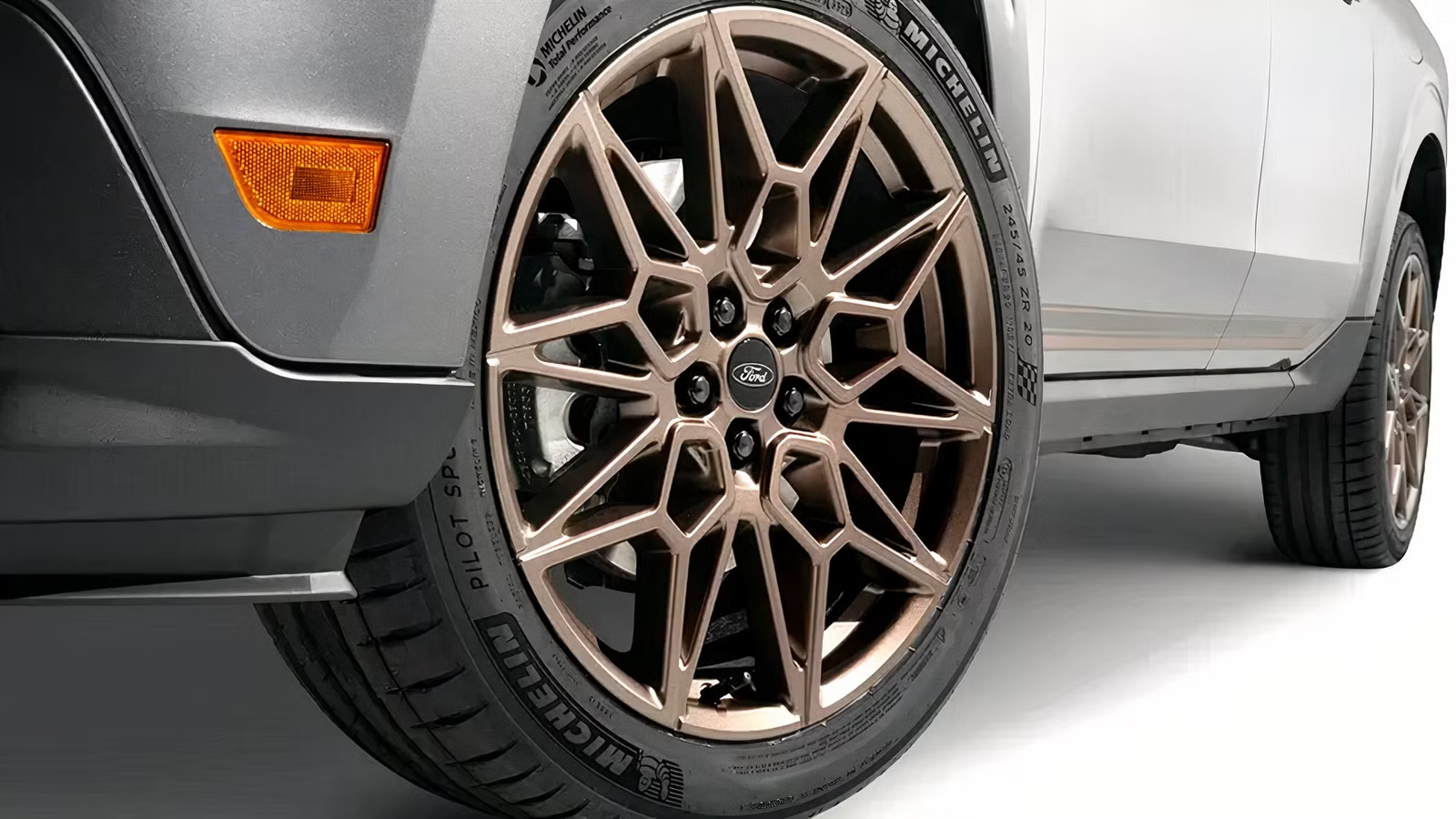
The package gets you the twin-scroll turbocharger from the EcoBoost Mustang, suspension upgrades, a set of 20-inch wheels from the Mustang Mach-E GT, a cat-back Borla exhaust, and a handful of software upgrades. The powertrain tuning coaxes 300 horsepower and 317 pound-feet of torque from the Maverick’s turbocharged 2.0-liter four-cylinder, up from 250 hp and 277 lb-ft in stock form.
The parts can be installed on any non-hybrid Maverick, but the Lobo might be your best bet for combining the extra power with street-truck looks.
Ford doesn’t provide a set of tires as part of the package. Still, we highly recommend fitting the same Michelin Pilot Sport 4S rubber we used when testing the Mav SV300T around an autocross course in the parking lot of Michigan International Speedway. Brett Evans was tasked with hooning the Maverick around the cones and checking the pulse of where the Maverick stacked up in today’s $30,000-$45,000 performance car market.
“The Lobo is a pretty cool truck, but it leaves a little to be desired when it comes to street performance. Luckily, the SV300T package solves all of those problems with a snappy throttle and exciting rush of power once the turbocharger spools up. It’s even possible to coax the Maverick into a delightful little four-wheel drift, with the stability controls loosening the leash just enough to enable some fun.”
With 300 hp and AWD, this Maverick has attributes comparable to those of the Toyota GR Corolla. Not to mention, the Maverick’s smaller engine produces 15 hp less than the EcoBoost Mustang with 315 hp. The same turbocharged 2.3-liter four-cylinder was packaged in Ford’s last run at making a Focus RS, where it was pumped to 350 hp, mated to a six-speed manual, and blessed with AWD. Excitingly, the Maverick with the SV300T package is the closest we can get to the original taste of the Focus RS experience these days. This time, it comes in the form of a pickup with a spacious cabin and 33.3 cubic feet of cargo volume.
Ford hasn’t admitted if the package takes away any of the Maverick’s utility. In stock form, the truck has a payload capacity of up to 1,500 pounds and a towing up to 2,000 pounds. An optional 4K tow package increases the number to 4,000 pounds. Even if this turns out to be a Syclone ordeal, where power takes precedence over utility, neither a Hyundai Elantra N nor a Volkswagen Golf GTI should be up to the tasks a Maverick can handle.
Are Sport Trucks On The Rise Again?
If the resurgence of wide-leg jeans and tiny sunglasses is any indication of a nineties’ comeback, the street performance truck comeback isn’t without warning. The Maverick is still alone in its segment with its Ranger-beating sales figures, something others are watching and carefully considering their next steps. Larger pickups like the Ram 1500 are repopulating the market with muscle trucks, not to mention taking part in the mega off-roader craze with the TRX and RHO.
The upcoming Dakota will be part of a mid-size pickup market that looks to scale down the fun found in full-size trucks rather than take a different approach to restoring performance elsewhere. All brands offering a mid-size pickup play to the off-roading crowd, which those trucks are built to handle from the factory. But trucks that do their best work on pavement have all but faded away. The Maverick, as it stands with its new go-faster parts, delivers the best of both mini and street trucks. Toyota teased a street-truck-like Tacoma for SEMA in 2023. Still, it has yet to make that project a reality, unlike Ford, which, after first teasing the Maverick 300T concept at the 2025 show, put the Maverick in a competitive space with no real rival.
No one else is putting forth an effort to build street trucks in-house. Then again, the real street truck movement happened with mini trucks in the aftermarket space. Owners built trucks, and the fad lived as long as the people who built them could get away with a single-cab pickup as their only car. Those enthusiasts grew up, had kids, and those kids are grown.
Ford might have just found its niche with the Maverick: buyers looking to reclaim their youth in a pre-made package. Not only does it have performance, but there’s also growing nostalgia for this segment.
Sources: Ford
