

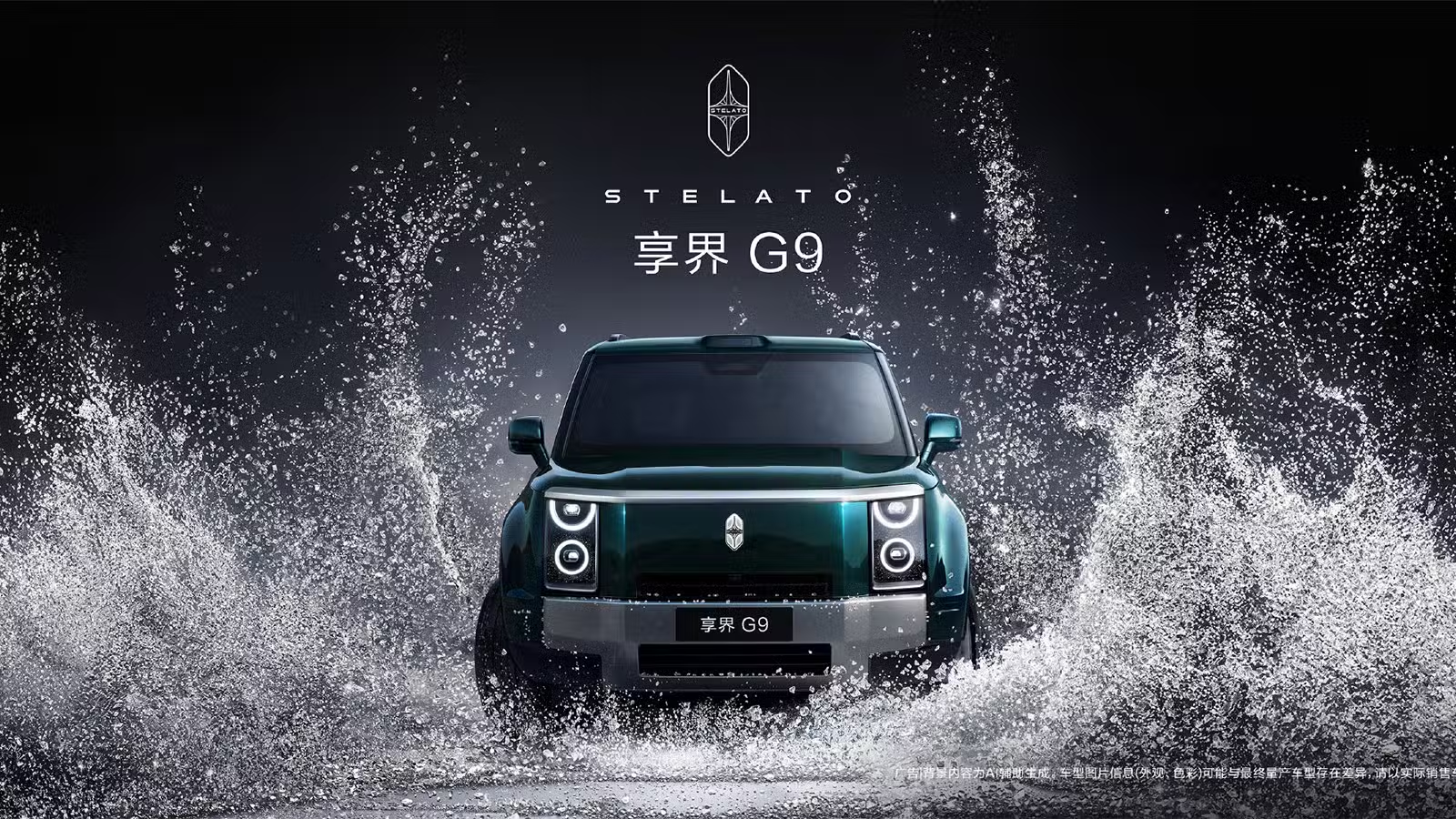
Huawei’s Harmony Intelligent Mobility Alliance (HIMA) teased its first hardcore SUV, the Stelato G9, on June 15. Credit: HIMA
- Stelato G9 offers both extended-range and all-electric powertrains, with the EREV version featuring a 75-kWh large battery.
- Stelato G9 will be equipped with Huawei Qiankun’s 896-channel LiDAR and support the Huawei ADS 5.0 smart driving system.
Huawei’s Harmony Intelligent Mobility Alliance (HIMA) on Monday teased its first off-road sport utility vehicle (SUV). The model, named Stelato G9, is jointly developed by Huawei and Beijing Automotive Group (BAIC Group).
HIMA released the vehicle’s official poster on its Weibo account, calling it the alliance’s first tech-luxury rugged SUV.
Earlier on June 10, the Stelato G9 appeared in the latest batch of new-vehicle filings from China’s Ministry of Industry and Information Technology, paving the way for its official launch.
Peng Lei, Huawei’s product director for the Stelato series, said today that the Stelato G9 will be launched in the third quarter, offering fresh innovation and experiences across all-terrain and all-scenario driving.
The Stelato G9 comes with both battery electric vehicle (BEV) and extended-range electric vehicle (EREV) powertrains, according to its filing.
The new vehicle can be configured with 5 or 6 seats, with an overall style leaning toward rugged off-road.
Peng said last week that the vehicle is built on an 800-volt powertrain platform across both its EREV and BEV versions, paired with the new Huawei Giant Whale battery pack.
In terms of range, the EREV version carries a 75-kWh large battery, while the BEV version is fitted with a 120-kWh battery. This configuration far exceeds that of most rivals in the same class, Peng said.
Intelligent driving is one of the vehicle’s core selling points. The Stelato G9 will be equipped with Huawei Qiankun’s 896-channel dual-optical-path image-grade LiDAR, and will support the Huawei ADS 5.0 smart driving system.
To strengthen its off-road capabilities, the new vehicle offers expansion options including a roof rack, an electric tow hook, electric running boards and multiple wheel-hub styles. The filing shows that an externally mounted spare tire can also be added at the rear.
In terms of dimensions, the Stelato G9 measures 5,206 to 5,377 mm in length, 2,050 mm in width and 1,897 mm in height, with a wheelbase of 3,160 mm. The vehicle has a top speed of 220 km/h.
The EREV version uses a 1.5L engine as its range extender, while the BEV version is fitted with a dual-motor all-wheel-drive system supplied by Huawei.
Notably, in the filing the manufacturer name on the Stelato vehicle’s rear badge has been changed from “BAIC New Energy” to “BAIC Group,” with the direct producer changed to Stelato. Peng said this reflects BAIC Group’s determination to go “all in” on Stelato.
He also said that the results of the 2.0 cooperation between Huawei and BAIC Group around Stelato are gradually being unveiled.
Last September, Huawei and BAIC Group announced they would deepen their cooperation, upgrading Stelato to a “strategic community” approach. The two sides pledged to invest 20 billion yuan ($2.96 billion) over the next 3 years.
The funds will be used for technology iteration in areas such as design, assisted driving, intelligent cockpit, as well as quality and safety.
Stelato is one of the five auto brands under Huawei’s HIMA. The other four are Seres’ (HKEX: 9927) Aito, Chery’s (HKEX: 9973) Luxeed, Anhui Jianghuai Automobile Group’s (JAC) Maextro, and SAIC Motor’s (SSE: 600104) Shangjie.
Stelato’s current lineup includes the S9 sedan and the S9T wagon. The addition of the Stelato G9 will take the brand into the rugged off-road SUV segment.
Huawei HIMA’s cumulative deliveries for the first five months of the year reached about 192,000 units, up 26.5% year on year.
($1 = 6.7634 yuan)
