

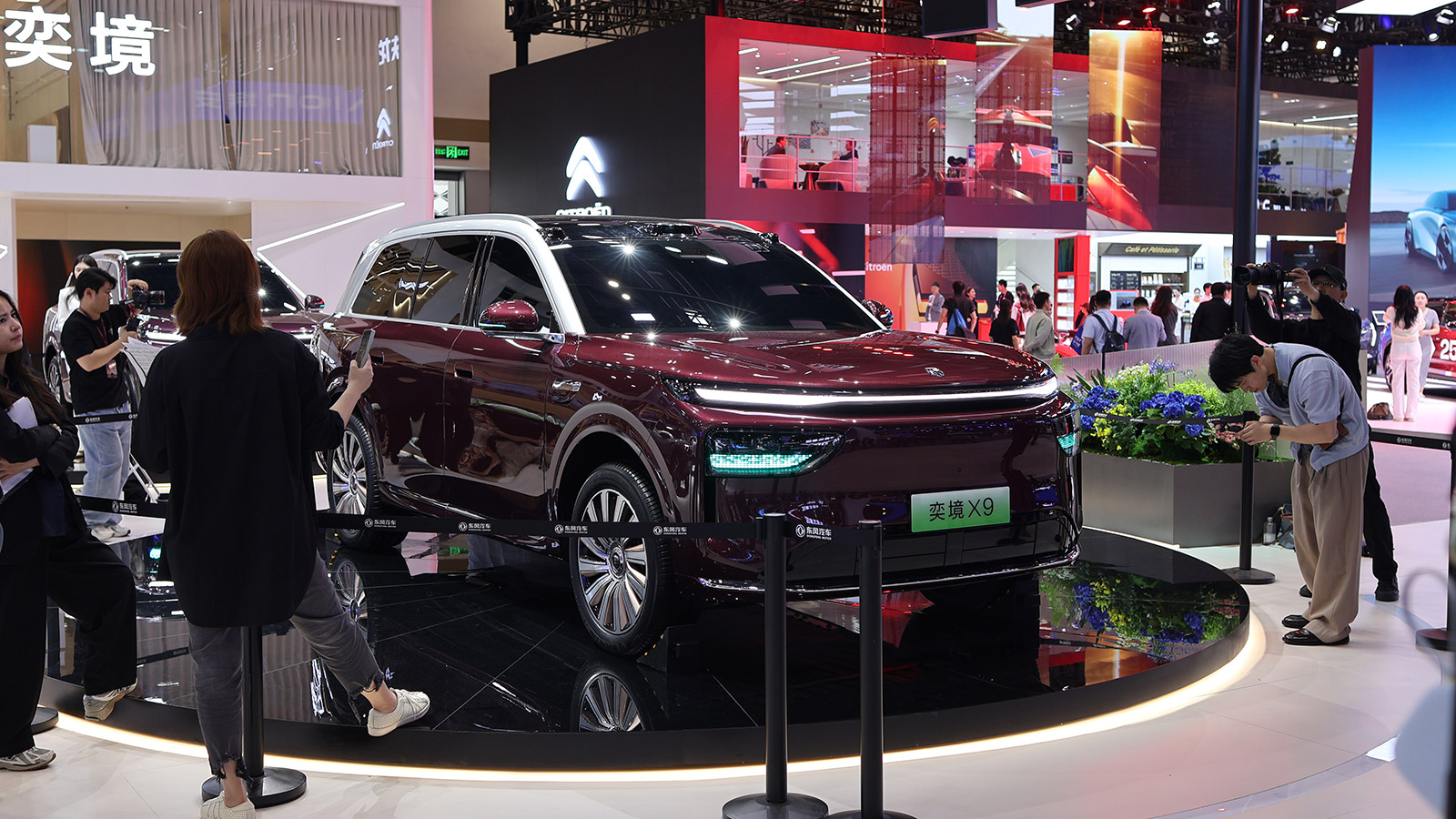
An Epicland X9 on display at the Beijing Auto Show in April 2026. Credit: CnEVPost
- If the plan materializes, Epicland would be among the first brands in Huawei’s automotive partnership ecosystem to explore battery swapping.
- Seres-backed Aiva is also discussing a battery-swap solution with CATL, showing more new brands are considering public battery-swap networks.
Epicland, a brand jointly developed by Dongfeng Motor and Huawei, is reportedly considering a battery-swap version of its second model.
Chinese media outlet 21jingji cited multiple independent sources on Friday as saying that the project remains at the preliminary research stage and that no final decision has been made.
The report did not disclose the second model’s name, powertrain type, or expected launch date. It also did not say whether Epicland favors joining an existing network or building its own battery-swap system.
If the plan materializes, Epicland would be among the first brands in Huawei’s automotive partnership ecosystem to explore battery swapping, giving it a selling point distinct from other Huawei-partnered models.
Epicland began pre-sales of its first model, the X9, on August 18, offering 3 extended-range variants priced from 299,800 yuan ($44,210) to 379,800 yuan.
The full-size 6-seat SUV (sport utility vehicle) comes standard with Huawei Qiankun ADS 5 and HarmonySpace 6 across the lineup. Its official launch is scheduled for the third quarter of this year.
Epicland previously said it would launch another 3 new models in 2027.
Under the partnership, Dongfeng and Huawei are jointly involved in product definition, development, and marketing, instead of following a conventional component-supplier relationship.
However, as Huawei’s smart-driving and cockpit technologies are adopted by more partner brands, it is becoming harder to differentiate products solely through intelligent features.
Battery swapping can separate the battery cost from the vehicle’s sticker price, reducing consumers’ upfront purchase costs while offering replenishment speeds close to refueling a gasoline vehicle.
For new brands, joining a mature public battery-swap network can also reduce the capital needed to build dedicated infrastructure and shorten the time required to establish coverage.
Epicland is not the only new brand to have recently considered this approach.
LatePost reported earlier this week that Saidou Technology, backed by Seres (HKEX: 9927), is in talks with CATL (HKEX: 3750) about connecting Saidou’s Aiva brand to the battery maker’s swap network.
Aiva’s first production model, the ME7, is scheduled to debut in 2026 and open for pre-orders in early 2027. The specific battery-swap plan remains under development.
CATL is expanding its battery-swap ecosystem through standardized battery packs. As of June 30, the company had built 2,000 Choco swap stations in China, covering 31 provincial-level regions and 180 cities.
The company aims to increase the number of swap stations to more than 3,000 by the end of 2026. It has established partnerships with automakers including Seres, Changan Automobile (SZSE: 000625), Chery (HKEX: 9973), and GAC Group (HKEX: 2238).
CATL is one of Epicland’s main battery suppliers. Dongfeng Motor has also previously worked with CATL to jointly develop battery-swap ecosystems in cities including Wuhan and Xiangyang.
Those ties provide a potential foundation for Epicland to join CATL’s network. However, adopting third-party standards would also require vehicles to accommodate specific battery packs, chassis interfaces, and communication protocols, 21jingji noted.
If Epicland chooses to build its own network, it would face significant upfront investment and need sufficient sales volume and swap frequency to break even.
The preliminary research project does not mean Epicland has decided to enter the battery-swap market. Still, another new brand considering the technology after Aiva suggests battery swapping is evolving from closed systems operated by a handful of automakers into a broader public energy-replenishment option.
The milestone comes just 6 months after the 100 million mark was reached on February 6, showing accelerating usage.
($1 = 6.7811 yuan)
