

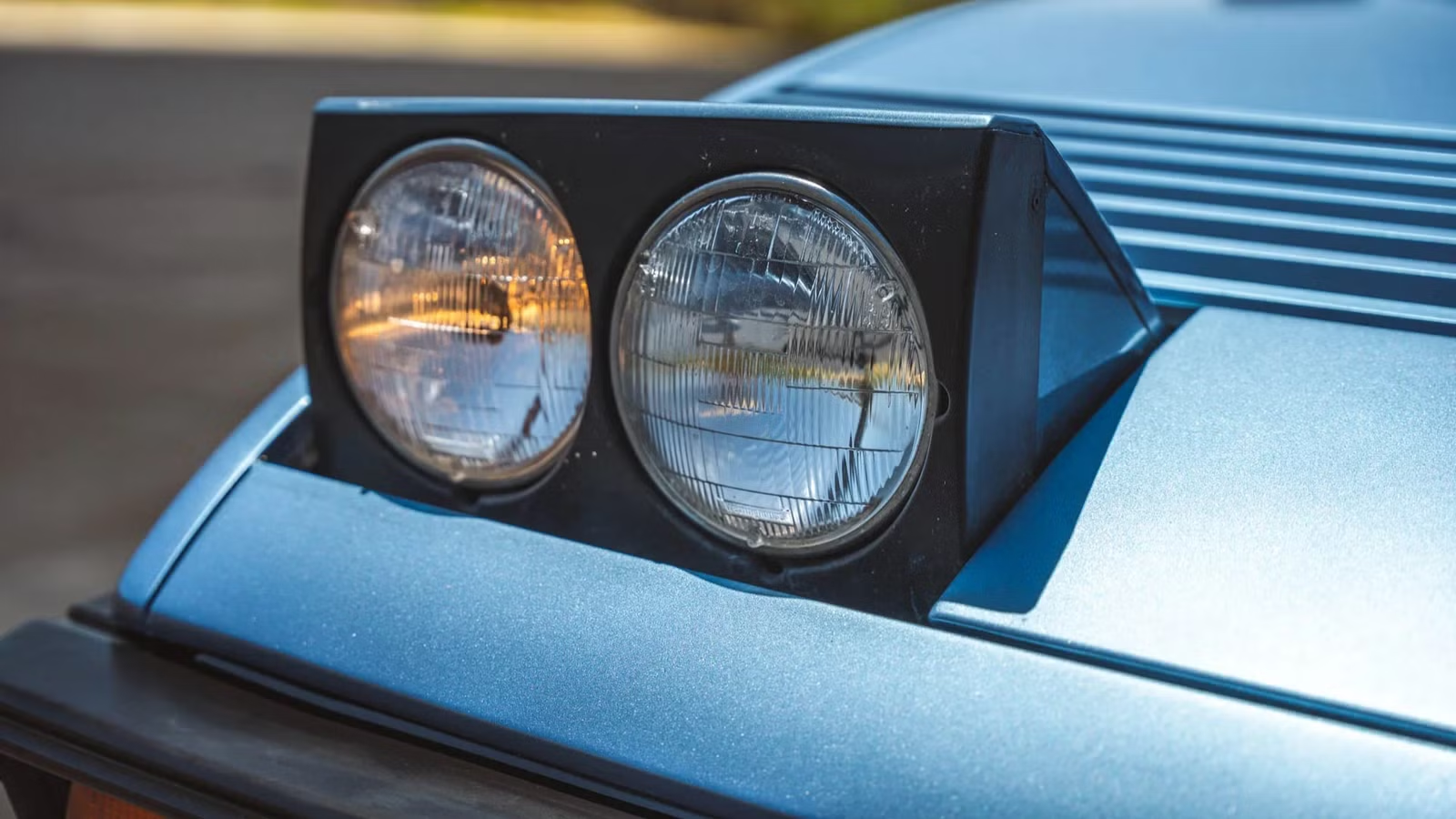
Mid-engine cars are usually designed as sporting platforms for enthusiastic drivers to enjoy, as they boast impressive handling properties; think Toyota MR2, Lotus Elise, or just about any modern supercar. There are downsides to the configuration, and among them is packaging. Slotting the engine between the driver and the rear axle generally means there is very little in the way of space, so cars like these usually sacrifice a rear row of seats and truck space.
However, some automakers have managed to work around such compromises and bring to market four-seat mid-engine cars. Most are still geared toward performance, and come from nameplates such as Lotus and Ferrari. Others are actually triumphs of cost-cutting engineering, boasting small footprints for city driving, and yet enough space for a small family inside.
These are those creations, listed chronologically, and, crucially, these are all rear-mid-engine cars, rather than front-mid-engine models. The latter design is far easier for engineers to work around when it comes to maximizing interior space, which makes the efforts below all that more impressive in our eyes.
Zündapp Janus
Far from a household name, the Zündapp Janus is a German microcar produced only in 1957 and ’58, so we’ll forgive those unfamiliar with its unusual name and even quirkier design. During that short window, 6,902 were produced, all powered by a tiny single-cylinder two-stroke engine producing around 14 horsepower.
The Zündapp’s party piece, however, was its layout. That single-cylinder engine sat slap-bang in the middle of the car, with a bench seat on either side. Those bench seats sit back-to-back, creating a unique interior layout. Very few of these classic microcars exist, and those that do command impressive sums of money, starting around $50,000, from avid microcar collectors.
Lamborghini Urraco
By the early 1970s, Lamborghini had made a name for itself as a Ferrari-rivaling manufacturer of super-fine automobiles. Early creations like the 3500 GT and the Miura proved the Italian firm had what it took to take on the very best in the game, while the Countach, which followed, proved it was so much more than just a one-hit-wonder.
However, Lamborghini needed a way to broaden its customer base, and so it introduced an entry-level model that still boasted a true sporting pedigree. The answer was the Urraco; a 2.0-liter V8-powered coupe (later efforts saw displacement grow to both 2.5 and 3.0 liters) with 2+2 seating. It blurred the lines between sports car and a grand tourer, delivering a sleek silhouette and impressive performance alongside a four-seat cabin.
Maserati Merak
Clearly, a new segment in the world of Italian performance was emerging, as alongside Lamborghini, both Maserati and Ferrari opted to launch four-seat mid-engine offerings. The Merak was Maserati’s effort, and instead of a V8, it used a 3.0-liter V6 derived from the same engine as the marvelous Citroën SM.
A 2.0-liter V6 was also offered post-1980 in the Italian market, as a way of working around newly introduced displacement taxes, which was also why there were 2.0-liter offerings from both Lamborghini and Ferrari at the time. Sleek, stylish, and sporting, these mid-engine 2+2s allowed performance-dazzled drivers to enjoy the finery of Italian sports cars without having to leave their families behind.
Ferrari 208/308 GT4
To complete the trio, Ferrari introduced the 208/308 GT4 as its entry-level 2+2 sports car. A transverse V8 delivered grunt to the rear wheels via a gated five-speed manual transmission. Models which took motivation from the tax-avoiding 2.0-liter models bore the 208 GT4 designation, while the 3.0-liter cars were aptly dubbed the 308 GT4.
Much like the 1960s V6-powered 206 and 246 models, these ’70s creations wore Dino badges. Ferrari felt it was more appropriate to reserve the Ferrari name for the flagship models, perhaps to avoid diluting their specialness. However, around 1976, the automaker dropped the Dino name and let these cars be true Ferraris, which no doubt boosted their appeal.
Ferrari Mondial
Ferrari designed the Mondial to replace the GT4 model, this time with a little more space inside, so that it was better as a family-oriented grand touring model. Much like its predecessor, the Mondial was very much the entry-level Ferrari, and some felt it fell quite short of what a “proper” Prancing Horse should be.
Its styling was a little awkward, thanks to the extra space afforded to rear passengers, and its performance was rather limp, early American models delivered no more than 214 hp and 179 lb-ft of torque. Despite the criticism, the Mondial was a huge commercial success for the brand, with more than 6,000 units sold over a 13-year production window. Fun fact: the drop-top version is the only four-seat mid-engine cabriolet ever to make it into production.
Honda Z
Moving away from four-seat sports cars for a moment, the Honda Z exists more in the Zündapp’s lane, as a money-saving commuter for those who value low running costs and a tiny physical footprint. It shares much of its mechanical makeup with the ever-popular Honda Acty truck, which means a 656-cc three-cylinder engine, and real-time four-wheel drive.
A small rear bench sits atop the engine compartment, and impressively, the little Z was available with both a naturally aspirated or turbocharged three-cylinder. The former kicks out around 52 horsepower, while the latter sports a mighty 63 hp.
Lotus Evora
Back in the world of performance, this time it’s over to England rather than Italy. The Evora was Lotus’ first attempt at a more grown-up mid-ship sports car, capable of swallowing up many miles on the highway in total comfort, rather than solely focusing on tearing up twisty tracks and challenging back roads.
Power came from a Toyota-derived V6 engine, but don’t let its Camry roots fool you; Lotus suitably tweaked (and supercharged) it so it wouldn’t disappoint. Like the Italian classics that occupied this space before it, the Evora offers little legroom or headroom for rear passengers; it’s a space best reserved for very small children or extra luggage.
BMW i8
The final two entries on this list are hybrids, and about as technically different from the early Zündapp as a car can be, yet they share a link through this rare configuration type. The BMW i8 debuted as a 2014 model year, sporting a myriad of truly impressive technologies.
Its body was clad in carbon-fiber-reinforced-plastic panels, while a turbocharged 1.5-liter inline-three engine provided propulsion, aided by a front-mounted electric motor. This gave the i8 a combined output of 357 horsepower and an EPA-rated all-electric range of 15 miles, making it a seriously capable everyday “supercar.”
Koenigsegg Gemera
There’s no argument about where the pinnacle of mid-engine four-seat design sits: right here, in the Koenigsegg Gemera. The first thing to note is that the Gemera is genuinely spacious. Koenigsegg claims adults can sit comfortably in either the front or the rear, which is more than you can say for most, if not all, of the other entries listed above.
Base Trim Engine
2.0L Twin-Turbo Inline-3 Plug-in Hybrid
Base Trim Transmission
Hydracoup Direct Drive
Base Trim Drivetrain
All-Wheel Drive
Base Trim Horsepower
1,703 hp
Base Trim Torque
2,581 lb-ft
Fuel Economy
TBC
Infotainment & Features
9 /10
Wafer-thin carbon-fiber bucket seats help maximize that space, while truly gargantuan doors let passengers climb in and out without adjusting the front seats. The Gemera also offers ISOFIX mounts, reading lights, a pair of cup holders, and a 13-inch infotainment/climate-control screen for each rear passenger, so the Gemera is about as practical as a supercar can get.
Sources: RM Sotheby’s, BMW, Ferrari, Honda, Maserati, Koenigsegg, Lamborghini, Lotus.
