

When every 911 in the range has a turbocharger, what does that do to the name that signifies the fastest one of them all? Can it no longer be defined by the five letters glued to the back that tell you something wicked sits just behind them? Is it still fast? The latest Porsche 911 Turbo S answers each query posed and more.
Its namesake still serves as the archetype which all brain-bending Porsche Turbo models have followed: above all else, be the fastest one of the bunch. As always, it employs forced induction to ignite combustion and the tires alike, but Porsche’s T-Hybrid gadgetry has crept its way up from the Carrera GTS into the Turbo S to keep it the poster child of turbo technology.
Yes, The Turbo S Is Still As Crazy As You Think
Close
So crazy, in fact, that it’s the only 911 sold in 2026 with a 200 MPH top speed, second only to the 202-MPH Panamera Turbo S E-Hybrid as the fastest Porsche available today. Both coupe and cabriolet flavors of the Turbo S share their high speed achievements, but the 2.4 seconds Porsche claims the Turbo S coupe can sprint to 60 MPH is the quickest of the 911 range, with the Turbo S Cabriolet a tenth of a second behind it at 2.5 ticks, and the GTS clocking 2.9.
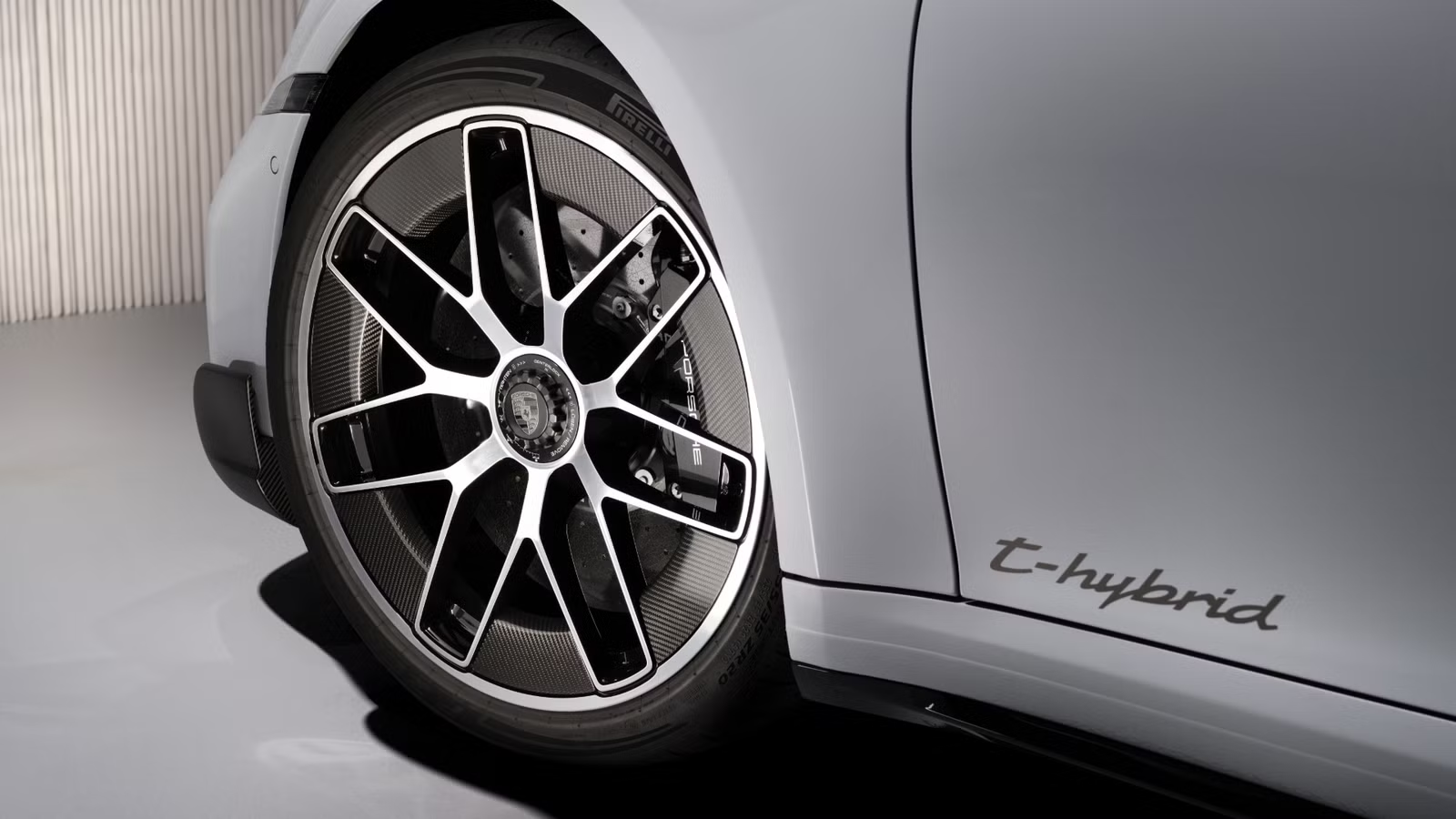
The Carrera GTS became the first electrified 911 when it was introduced in 2024, pairing its 3.6-liter flat-six with a handful of electric motors to increase power output and engine efficiency—which is the order in which Porsche likes to make clear what its hybrid intentions truly are. The 1.9 kWh battery pack—developed by Rimac—that’s stashed up front powers the T-Hybrid’s 400-volt system, breathing life into a handful of motors to do the system’s dirty work. One runs the A/C compressor, a small one sandwiched within the turbo’s snail shell spins the impeller to minimize lag (and can even be spooled by exhaust gases to recoup some energy), and a third lives inside the dual-clutch eight-speed PDK gearbox for additional power. The total system output of the GTS’ system is 532 horsepower and 449 pound-feet of torque—ready to be sent to just the rear wheels in standard models, or all four in Carrera 4 GTS models.
Take that up a notch, and we’ve got the basic blueprints for the beating heart of the Turbo S that arrived for 2026. The same 3.6-liter engine hangs off the rear axle (a unit that lost 40 pounds and shrunk 4.3-inches in length to accommodate the new electrical components over the old engine) and the 400-volt architecture is juiced by the same 1.9-kWh battery, this time spinning two turbos and a brawnier motor in the same eight-speed gearbox. Standard output sans electric assist is 631 horsepower and 560 pound-feet of torque. Factor in the hybrid system and power explodes to 701 and 590 pound-feet. Compared to the last 911 Turbo S that extracted 640 ponies and 590 pound-feet of torque, that’s quite the jump.
Those turbos? While smaller than the single until used in the GTS to blow an extra 18.9 psi of boost from its 83 millimeter compressor wheel and 80 millimeter turbine wheel, it still packs a bigger punch than the GTS. The pair in the Turbo S have 73 mm and 65 mm internals and are spun by the same electric motors to pump 26.1 psi of boost into the engine. They spin at faster speeds compared to the GTS, too, reaching a maximum of 145,000 RPM compared to the other’s 125,000 top speed. While the current base Carrera matches the same 12 psi of boost that the first-generation Turbo cars had, it’s still no 911 Turbo. That title clearly still belongs to its rightful owner.
Those Five Letters Still Mean Something
Gauge shot of a 2021 Porsche 911 Turbo SPorsche
The dawn of turbocharged 911 models began when engineers from Porsche’s Can-Am racing teams got an idea so wild, it sounded too good to become reality. The no-holds-barred racing series that was the Canadian-American Challenge Cup was where racing teams went to see who had the craziest technicians and bravest drivers. The twin-turbo flat-12 917 race cars Porsche entered were punching out 1,200 horsepower at the crank, and unbeknownst to the world, would serve as the genesis for the 911 Turbo.
Porsche knew that it could build a faster 911 with the help from a turbocharger, but controlling the output of said turbo was crucial for developing a road-going vehicle that wouldn’t implode or put drivers at risk of skidding their brand-new car off the road. Early prototype models had wastegates limiting boost to just 12 psi, but oil cooling became a pertinent issue as oil temp rose to 1,600 degrees Fahrenheit after passing through the turbo.
Once the oil cooling issues were sorted, Porsche took turbocharged Carrera RSRs racing. One year later, the 930—as it was dubbed by Porsche for Europe—arrived by the mid-1970s and became a thing of legend; a machine remembered with each iteration of 911 getting a Turbo model of its own.
Throughout the years since, each Turbo model has gotten with the times and made the changes when needed to continue being the 911-shaped rocket ship it truly is. A second snail was added to 993 models in the mid-1990s when more power was asked of its 3.6-liter engine, marking that generation of 911 the first to offer a twin-turbo powertrain. When all 911s shed their air-cooled internals for a water-cooled system, the 996 Turbo had to follow suit when it debuted for 2001. Hybridization is just the next step in its evolution, and since it doesn’t detract from the fun expected from a Turbo-badged 911, it’s easy to embrace.
The 911 Hierarchy Is Complex At Best
Close
There are 22 distinct variants of the 911 available for purchase in 2026–23 if you count the limited edition run of 90 GT3 90 F. A. Porsche models built to celebrate the 911’s designer, Dr. Ferdinand Porsche. Not a single one of them can be considered better than the other, but each is suited to distinct palates. The Carrera models are the softer 911s built for long-distance cursing packed with ample power and excellent dynamics. Targa models continue their open-top legacy and still provide the iconic quasi-convertible look all ragtops were presumed to have if Ralph Nader had his way.
GT3 models are the rough and tumble track-ready models with lightweight bodies, stiffer chassis, and larger 4.0-liter naturally aspirated flat-sixes. The near quarter-million asking price is quite a sum, but for what you get, it’s well worth the look. These are the 911s designed to make each corner as thrilling as Eau Rouge at Spa. If the “look at me” rear wing isn’t your style, the GT3 Touring solves that problem, just as the GT3 S/C shaves the roof off for those who like turning hot laps with the top down. But above all, the Turbo models reign supreme for those who want all the power, all the speed, and will pay whatever it takes to get their hands on it.
2026 Porsche 911 Turbo S CoupePorsche
The starting price of a 2027 Turbo S in coupe form is $270,300, with Porsche charging an additional $14,000 for soft-top cabrio models. Compared to the GT3, which many believe is the be-all, end-all of the 911 range, it trounces the 502 horsepower milled from its naturally-aspirated 4.0-liter by nearly 200 horsepower, and it will go 6 to 7 MPH faster given enough room. The Turbo S is the card you want in your hand for a round of Top Trumps, mainly because it feels like a rocket disguised in familiar Porsche clothing.
Where the GT3 and even some Carrera models do their best work to highlight the 911’s true character with their own kinds of simplicity. You can enjoy the tail-heavy dynamics and even take charge over the powertrain with six-speed manual gearboxes offered in those models, but the Turbo S? It’s more intercontinental ballistic missile than 911. Turbo models have gone from being wild-hearted beasts forged in the foundry that was an unregulated racing series, to, well, ultra-modern interpretations of their former selves. The new Turbo S is just as crazy as it’s always been. It just has a leg-up with nerdy hybrid tech to make it just that much more insane.
Sources: Porsche Newsroom, Excellence Magazine
