

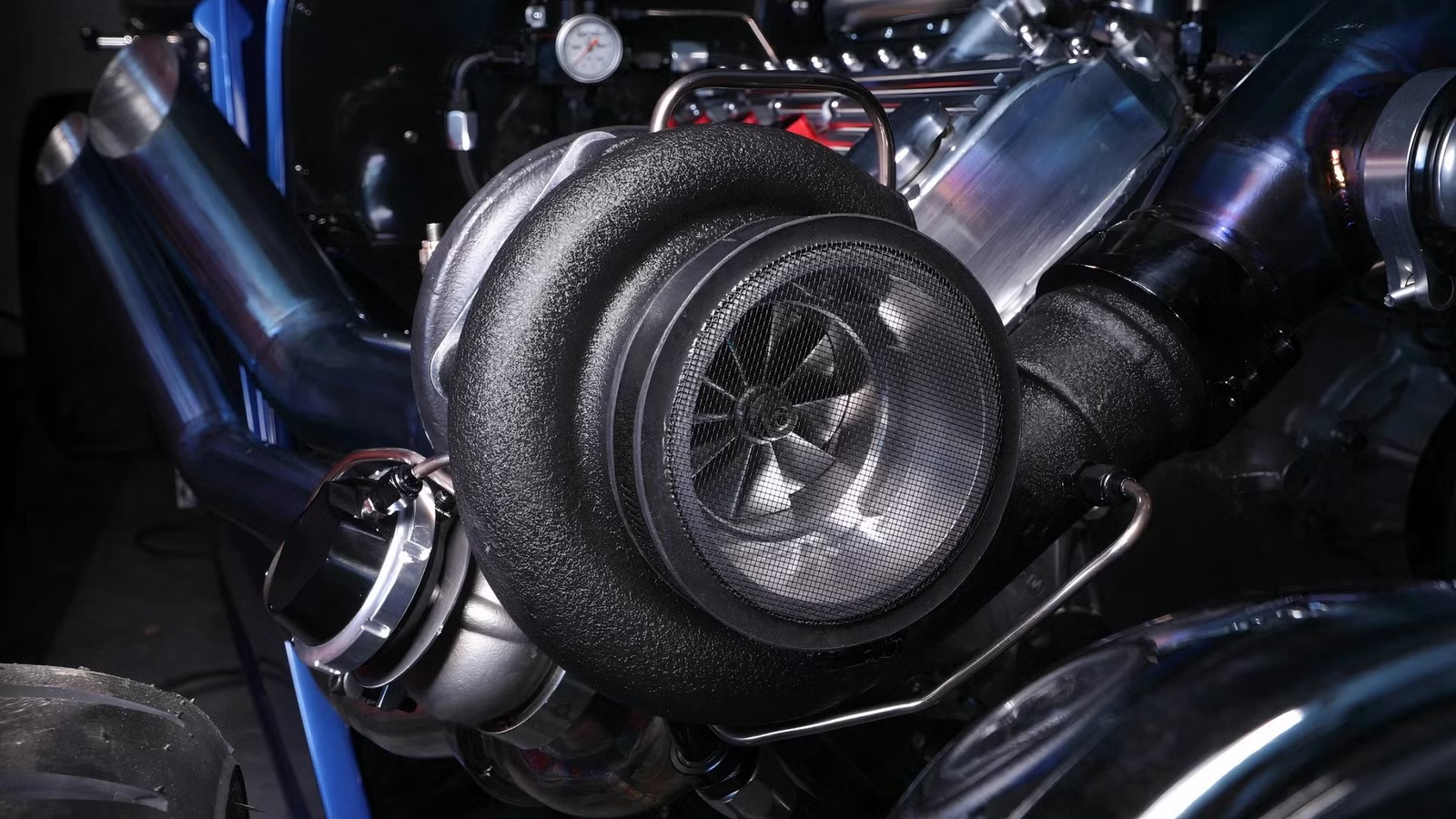
In the grand scheme of things, turbocharging hasn’t been around very long. But, in its rather short time on the automotive scene, it’s been responsible for some truly impressive feats. For instance, the Bugatti Veyron 16.4, the first road-legal, series-production car to surpass 250 mph, used four turbochargers to help force a massive amount of air into its 8.0-liter W16 engine. The incoming 2025 Chevrolet Corvette C8 ZR1 utilizes a pair of turbos to produce a whopping 1,064 horsepower.
As with any invention or innovation, the turbocharger has its downsides. For one thing, turbos create an incredible amount of heat, which places additional demands on the cooling system, and to produce maximum power requires an intercooler to keep the temperature of the intake charge down for higher air density. Turbochargers are also prone to something called turbo lag, which is basically a delay in operation from throttle input to increased engine power. Turbo lag can seriously put a damper on a car’s fun factor, so several automakers have worked to create their own anti-lag systems.
Related
What Is Turbo Lag?
Turbocharged performance comes with a downside.
Anti-Lag: What It Is And Where It Came From
Quick Facts About Anti-Lag
- Reduces the duration of lag in turbochargers, improving throttle response in vehicles where it’s deployed
- First used in racing
- Currently done in a few different ways
- Recent electronically controlled turbochargers help to mitigate and avoid turbo lag in road cars
Upon the introduction of the turbocharger at the beginning of the 1960s, there was no such thing as an anti-lag system or electronic controls for turbochargers. The first manufacturer to use a turbocharger was Oldsmobile with its Jetfire in 1962. Before the Olds, turbochargers were relegated mainly to heavy machinery and farm equipment, and weren’t used outside of diesel applications. However, in conjunction with Oldsmobile and GM engineers, the popular turbocharger manufacturer, Garret AiResearch, produced the first-ever turbocharger to be used by a road car.
1962-1963 Oldsmobile Jetfire Gold Front Angled ViewBring a Trailer
In racing, the first vehicle to employ a turbo was the Porsche 917/10 Can-Am race car in 1972. The car was so powerful and dominated the series to the point where Americans lost interest in the racing series, leading to the discontinuation of the Can-Am series in late 1974. Turbo lag was an issue, but the 917/10 was so much faster than everybody else that it didn’t matter. At least, not yet.
Related
10 Times Oldsmobile Was A Trendsetter In The Automotive Industry
This now-defunct brand is responsible for several leaps forward in automotive innovation. Let’s explore 10 of them.
Enter Anti-Lag
By the early 1980s, turbocharging had made its way firmly into Formula 1. Upon its adoption, suddenly, larger displacements and complicated valvetrains weren’t the only way to increase an engine’s power output in F1. Renault were the first to turbo an F1 car in 1977, with several other manufacturers following suit. However, there was a problem with turbocharging – the lag. Ferrari were one of the first teams to crack this in the early 1980s.
An Image of the historic 126 C2 of 1982 was the development follow-up to 1981’s 126 CK, Ferrari’s first turbocharged F1 car.Ferrari
Is system worked by preemptively injecting air and partially combusted exhaust gases directly into the F1 car’s exhaust manifolds, forcing the turbocharger to spool up quicker than it would by normal means. This meant that by the time the driver pinned the throttle back, the turbocharger was already raring to go and could provide full boost immediately. Anti-lag tech had a short tenure in F1, as rule changes regarding fuel restrictions rendered it unusable just a few years after the tech’s debut.
A Few Anti-Lag Methods And How They Work
2015 Nissan GT-R Exterior Red Photographed With Mountains In BackgroundNissan
There are quite a few methods of creating an anti-lag system in road cars these days. There are traditional means such as exhaust manifold fuel injection, and more modern means such as electrically assisted torque fill, electrically driver compressors, hybrid-electric assistance, and the use of electronically controlled turbochargers. Ferrari has also recently patented a novel way of achieving a lag-free turbocharging system via the use of, basically, a gear reduction configuration mounted within a turbocharger.
Related
Ferrari Solves Turbo Lag With ‘Turbo Gears’ And An Upside Down Engine
Ferrari’s gear-driven turbocharger design will allow for more power and greater efficiency without the drawbacks of excessive turbo lag.
Torque Fill
Torque fill is a way of achieving an anti-lag feel in a hybridized vehicle without actually using any sort of engineering magic on the turbocharger. Basically, torque fill comes into play between gear shifts. The technology will, in effect, estimate the amount of torque that will be required after the gear shift in order to keep things moving seamlessly by filling the torque gaps with assistance from the electric motors. The torque fill tech utilizes a computer, which will adjust the amount of torque applied to the vehicle’s drive axle between shifts.
The Electric Turbocharger
2024 Porsche 911 GTS from the front three-quarter anglePorsche
We have to thank Garrett for this next one, at least when it comes to actually applying it to a road car. And this year, the first Lambda 1 engine is on the market in the 2025 Porsche 911 GTS, which maintains the ideal air:fuel ratio without mixture enrichment – only possible through a complex hybrid system and an electrically assisted turbocharger.
While that sounds like some sort of performance-oriented gimmick for use in an EV, it’s actually meant for internal combustion. Basically, the tech utilizes an electric motor that will independently spool up the turbo, meaning max boost will be readily available as soon as the driver needs it.
Gear-Operated Anti-Lag
Ferrari Gear-Driven Turbocharger Patent SketchUnited States Patent and Trademark Office
One of the most recent innovations surrounding road-car anti-lag is Ferrari’s reported gear-operated anti-lag technology. CarBuzz happened upon a patent filed with the United States Patent Office last summer outlining the tech. Apparently, it’s slated to use excess crankshaft kinetic energy to keep the turbo spooled up, along with employing spent exhaust gases. The patented schematics show a crank-driven gearset and a variable intake system.
The BMW i8 Featured Anti-Lag Tech
2014-2020 BMW i8 Coupe Silver Doors Up Front AngleVia: BMW
Remember the i8? BMW’s strange-looking hybrid-electric sports car? It set the automotive world on fire upon its introduction in 2013 with its futuristic look and the equally forward-thinking 1.5-liter I3 hybrid powertrain. Its steep price tag of $135,915 in 2014 meant not many got to own one, but it was on the edge of what was possible regarding automotive technology at the time for many reasons, one of which was its use of torque-fill tech.
The Same, But Different
1991 Toyota Celica All-Trac At The Lake Superior Performance RallyToyota
Thanks to wide-reaching governmental regulations, turbo anti-lag systems used in racing throughout the years are not legal in most jurisdictions worldwide. The reasons are, reportedly, excessive noise, concerns about emissions, along with the sheer increase in performance. This means automakers have had to dance around anti-lag in a way, and why so many unique innovations have been made in the pursuit of anti-lag for road-going vehicles.
As those emissions restrictions continue to tighten around the world, the anti-lag systems that have been brought into the fold are, maybe, the closest we’ll get to being able to flick a dashboard-mounted switch which activates the anti-lag, much like what’s seen in some older rally cars. It would be cool, though, wouldn’t it?
Sources: Ferrari, Porsche, BMW, US Patent Office.
