

Everybody wants their vehicle to be the perfect balance of comfortable, powerful, reliable, and affordable, but there isn’t a single new model that can hit all four points at once. Think about it: any rig that fits in the first three categories isn’t actually all that affordable, and so on.
The used truck market can bear some fruit, but one model in particular can fill the pickup-shaped hole in our hearts. The first-generation Toyota Tacoma is one of the best versions of the legendary model. It all started when the Tacoma was born, so stick around to learn the history of the most famous Toyota in modern times.
All specs are pulled directly from the manufacturer. Used prices quoted are averages and may not reflect exactly what your Tacoma is worth. Used values vary depending on factors like location, mileage, mechanical and cosmetic conditions, and more.
Toyota Built More Than a Work Truck
1998 Toyota Tacoma PreRunner front 3/4 angle in whiteToyota
Toyota’s pickup trucks in the United States can date all the way back to the 1960s, with the introduction of the adorable Stout. It didn’t get more serious until the first Toyota Truck dropped at the end of that decade. A second, third, fourth, then a fifth-generation pickup came and went through the years, growing and changing as the brand’s robust work truck until the mid-1990s. By then, buyers began demanding safer and more comfortable rides. Seeing as the Truck didn’t even have airbags, the market was due for a change.
Across the ocean, other markets were blessed with the Hilux, which remains a staple of reliability and rugged durability for off-roaders and work fleets alike. That said, the United States got a separate model that became famous on its own: the first-generation Tacoma. Launching on its own brand-new platform in 1995 (alongside the 3rd-generation 4Runner in 1996, which shared the platform after years of sharing with the Truck), the Tacoma made a name for itself.
The first-gen Tacoma came with a host of upgrades over the outgoing Truck. Necessities like airbags became standard, along with a softer, more comfortable ride. The interior felt like a modern truck that shifted from all work to focusing on a balance between work, play, and daily drivability.
The Recreational Truck and Outdoors Movement Grew
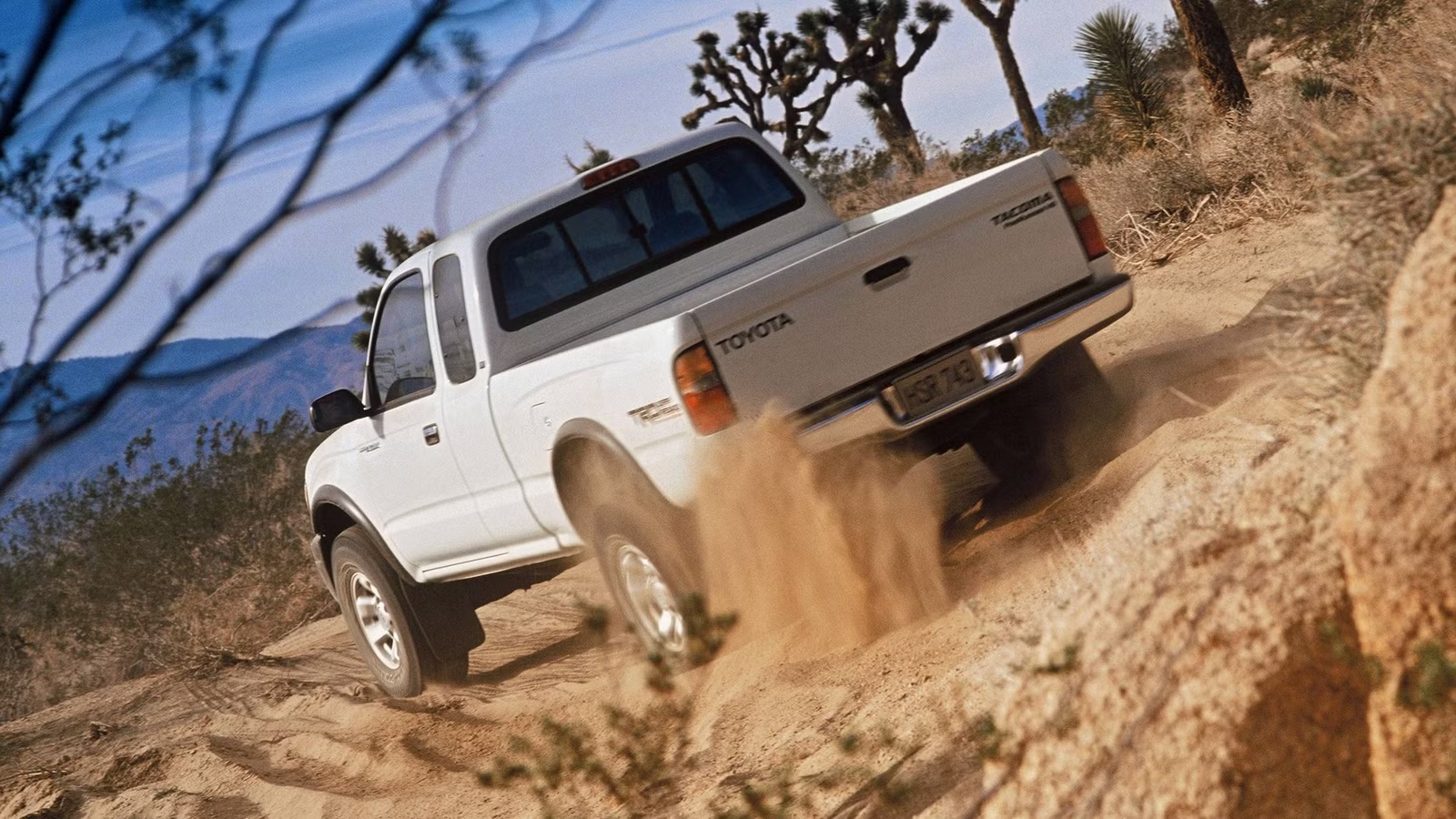
An action shot of the 2000 – 2001 Toyota Tacoma off-roadingToyota
Off-roading has a rich history, and Toyota wanted in on it. The brand technically began its off-road adventure in WWII, when it commandeered an American Jeep and reverse-engineered it to build the first Land Cruiser. Nevertheless, truck buyers in the United States began driving into the wilderness for fun around the 1960s and ’70s, and the hobby has grown exponentially.
Trucks had moved beyond the commercial market by the time the first Tacoma debuted. Toyota knew it had to offer a truck that could do it all. That meant offering four-wheel drive, front coil-spring independent front suspension, and even the first Toyota truck to come with a rear differential locker from the factory as long as you upgraded to the TRD Package.
The Tacoma Found the Sweet Spot
2001–2004 Toyota Tacoma engine detail shot (5VZ-FE 3.4L V6)Toyota
The Tacoma rests in a seemingly impossible position that not many other trucks have reached. Somehow, the engineers at Toyota made the first-gen Tacoma incredibly reliable, relatively powerful for a midsize truck of its era with an available V6 engine, relatively comfortable and ready for daily driving, compact dimensions with a practical bed for work, and extremely off-road capable.
First-gens could come with your choice of two four-cylinder engines or one six-cylinder. At the bottom was a 2.4-liter inline-four, known internally as the 2RZ-FE, that made 142 horsepower and 160 lb-ft of torque. Next is one of the greatest four-cylinder engines ever made: the 3RZ-FE, which is a 2.7-liter four-cylinder that produced 150 hp and 177 lb-ft of torque. For the most power, buyers should opt for the 5VZ-FE (pictured above), which was a 3.4-liter naturally aspirated V6 with 190 hp and 220 lb-ft of torque.
Both rear-wheel and four-wheel drivetrains were available, and buyers could choose between a four-speed automatic and a five-speed manual transmission. As we mentioned earlier, buyers could even equip it with a locking differential in the rear axle from the factory.
Its compact proportions made this truck practical for everyday use. The truck was available as either a three-seater regular cab or a five-seater XtraCab. There was also a later full four-door Double Cab with more interior space. Depending on the model year and other specs, customers could choose between a five-foot and a six-foot bed. The regular cab models had a 103.3-inch wheelbase, which accommodated the 184.5-inch total length, 62–67.5-inch height depending on the trim level, and 66.5-inch width. The XtraCab models were the same width, but a 121.9-inch wheelbase allowed for up to 203.1 inches of length.
Powertrains, drivetrains, and locking differentials aside, its off-road capabilities came due to its approach and departure angles, among other specs. While the base model wasn’t that tall or especially impressive off the pavement, the hardcore PreRunner model had approach and departure angles of up to 36 and 24 degrees. It also had up to 12.4 inches of ground clearance when the PreRunner was properly equipped with the right tires. PreRunner and other four-wheel-drive models were equipped with skid plates under the front suspension, transfer case, and fuel tank.
It Changed the Truck Market as a Whole
A rear-right side shot of the 2000 – 2001 Toyota Tacoma SR5Toyota
As the market transitioned from only buying trucks for work to the Tacoma positioning itself as a lifestyle, it forced competitors to shift their focus. The model also began to feature strong aftermarket support and laid the foundation for TRD’s success to this day.
Trim levels throughout its generation included the SR5, SX, and LX, and the Limited trim would be introduced later in its lifetime. The TRD Off-Road package was technically an add-on to the SR5 and Limited trims, which went on to grow into the most sought-after model for used and new Tacomas alike. We can’t forget about the PreRunner, a two-wheel-drive performance trim, and the S-Runner performance-oriented trim.
Not all Tacoma trims were particularly upscale (if any), but they were generally far nicer than the earlier Toyota pickup. The 2003 Limited trim came with a color-keyed front bumper and fender flares, a chrome grille and door handles, power remote outside mirrors, a chrome rear bumper, sliding rear window with privacy glass, orange-illuminated white-faced meters, power windows and door locks, and a leather-trimmed steering wheel. This much luxury in a relatively cheap midsize pickup led rivals like the Ford Ranger and Nissan Frontier to pick up the pace and adapt to a more comfortable lifestyle-truck market.
There had almost always been some aftermarket support for trucks like the Tacoma, but its release opened a floodgate of more off-road parts brands and other customizable bits and pieces. Toyota still supports the first-gen Tacoma today by making new parts to keep them on the road. If you want to build the ultimate budget off-roader or overlander, owners can look to brands like RCI Off Road, SRQ Fabrications, Total Chaos Fabrication, and any other number of off-road parts builders.
Why the First-Gen Tacoma Still Matters
2001 – 2004 Toyota Tacoma interior view of the steering wheel and dashToyota
Owners and enthusiasts still believe the first-gen Tacoma is one of the most influential and important trucks in the brand’s history. It was among a new world of modern trucks with more safety features, more comfortable interiors, and some premium features, while remaining a practical size with reliable engines and incredible off-road prowess.
Enthusiasts today hunt for low-mileage examples, since they represent an era with the right combination of electronic assistance and analog experience. Even if you can’t find an example with low miles, the high-mileage examples might keep running forever with proper maintenance.
The truck’s size and capability are still the right for the current market, too. Buyers want small, cheap, reliable trucks that they can work on at home. The first-gen Tacoma fills that void, and keeps its values inflated as such. The average successful auction sale (including data spanning the last twelve months) results in an average price of $17,976. The majority of sales fell between $15,000 and $25,000. Some outliers in mint condition went to buyers for over $40,000 in the last year.
They’re Still Expensive for All the Right Reasons
2001 – 2004 Toyota Tacoma front 3/4 angle in silverToyota
Considering how the 2004 model’s original MSRP started at around $13,000 and ended at around $26,00 for the best-equipped versions, the fact that models are still worth about $18,000 today is a considerable feat. Toyota models tend to hold value better than rivals today, but even its old trucks manage to impress.
That said, we understand why they hold so much value. All three engine options remain solidly reliable, and any trim can be built into an off-roader. Some even come equipped with four-wheel drive, a rear differential locker, steel skid plates, and over 12 inches of ground clearance.
The first-gen Tacoma might seem simple by today’s standards, but it was a huge improvement in comfort and capability over what Toyota was offering before its release. Plus, its simple nature is exactly what makes it desirable today.
Sources: Toyota, EngineSpecs.net, Classic.com
