

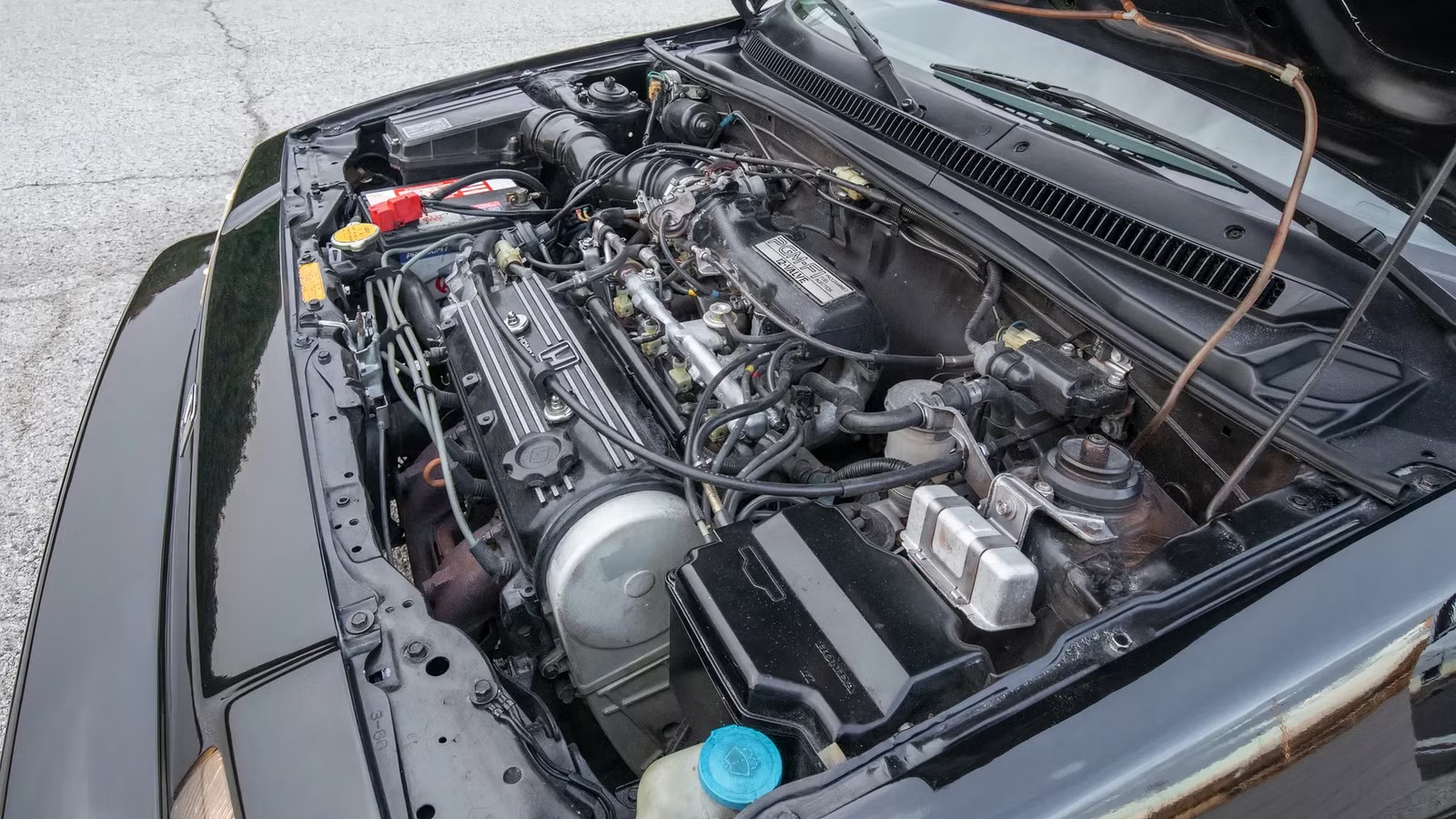
No, Honda’s D-Series engine doesn’t have the mythological whimsy of the B-Series, nor does it have the performance-hungry reputation of the K-Series engine or the exotic appeal of the NSX’s C30A V6. It spent most of its life underneath the hoods of everyday Honda Civics.
The D-Series family covered a wide range of engines measuring between 1.2 and 1.7 liters, and there were even variants with Honda’s VTEC technology. The D-Series fame, though, came from its unrelenting pursuit of reliability. Numerous vehicles exist packing engines reaching 250,000 and 300,000 miles with just simple maintenance. It’s so tough that achieving 300,000 miles doesn’t even seem like a big deal for the powerplant.
And that’s the magic of the D-Series.
The D-Series Wasn’t Supposed To Be Exciting
1995-2000 Honda Civic EK front quarterHonda
In the United States, the D15 (1.5-liter) and D16 (1.6-liter) D-Series engines were synonymous with Honda Civics produced between 1987 and 1999. It also found a home within the CR-X and Del Sol. Power output wasn’t this unit’s focus; for example, the D15B7 made just 102 horsepower from its 1.5-liter displacement. Larger versions like the D16A6 with 108 hp were a bit more powerful, but not by much. Later, the VTEC-equipped D16Z6 upped the power ante to 125 hp.
Even as time went on and later D-Series mills arrived, power outputs didn’t increase much. Most members of the family used a single overhead camshaft, four valves per cylinder, and an all-aluminum construction to help keep weight to a minimum. Multi-point fuel injection was common, but some D-Series powerplants used dual-point injection or carburation.
There was little reason to turn the D-Series into a tuner’s dream. The engine family was around during the B-Series’ time in the limelight, and Honda introduced the K-Series near the end of its lifespan. Instead of trying to pit the two engines against one another, Honda resisted the temptation to make the D-Series a screamer. The powerplant was for day-to-day transportation duties, like saving fuel and remaining quiet.
The engine family was also extremely simple to manufacture, compact, and straightforward in its design. If you like to do your own wrenching, you can respect that kind of construction. One downside to the D-Series’ longevity formula, though, is its timing belt, which means it must be maintained properly. If not, the belt can stretch over time and eventually snap altogether.
So no, the D-Series isn’t completely bulletproof because you still need to care for it. With proper maintenance, the powerplant will likely outlast the car it’s installed in.
300,000 Miles Is Not A Factory Prediction, But The Anecdotes Are Hard To Ignore
Honda del SolHonda
You don’t have to search long to find reports of D-Series mills regularly surpassing 250,000 or 300,000 miles. One such example comes from a Honda-Tech forum post from over 20 years ago. In it, the owner states their D15B7 mill was at 252,000 miles and counting, with virtually no hiccups along the way thanks to meticulous maintenance and easy driving.
The same can be said of a D16Z6 – that’s the VTEC one – which reached distances between 200,000 and 250,000 miles without a rebuild or major repairs. One user said their 1992 Civic reached roughly 350,000 miles with regular exposure to hard driving. Many other 300,000-mile reports existed too, as yet another Honda-Tech forum user stated theirs made it to nearly 300,000 miles before failing. Even mechanics reported that finding a D-Series engine in their shop with over 250,000 miles was a regular occurrence in one Honda-Tech post.
Front quarter view of a 1987 Honda Civic hatchbackBring A Trailer
Now, we can’t uniformly say the D-Series will outlast the earth itself. Some people will always push their cars hard without proper maintenance, and there will also be a lemon or two here and there. But, in the world of engines, the D-Series’ ability to reach 250,000 or 300,000 miles regularly almost makes the feat seem less impressive than it should be. It’s similar to a straight-A student ending up with a single B and being upset about it. You expect longevity from the D-Series in a way that you don’t necessarily expect from something like the BMW N63 twin-turbocharged V8.
Internet stories don’t equate to established durability data, but the large number of high-mileage D-Series examples is hard to shake off. At the same time, if you look at some of those posts, you can find some sneaky examples of D-Series failures, such as spun bearings. Even Superman has his kryptonite.
The Secret To A Long Life Didn’t Lie In Parts Or Magic
2001 – 2003 Honda Civic VTEC engineHonda
Sometimes, gearheads have the need to prove why an engine is so reliable by finding certain aspects that make it so, such as closed-deck blocks, low compression ratios, and so on. In the D-Series’s case, its overall operating method contributes to its potential for a long life. It’s an understressed engine. Many examples made well under 125 hp at a time when even that was on the low side versus competitors.
For context, the D15B7’s 102-horsepower output translates to just 68 hp per liter. Take a Chevrolet 5.7-liter V8, multiply its displacement by that 68-hp figure, and you reach a total of 387 horsepower. For comparison, the 5.7-liter V8 in the latest Chevy Silverado makes 402 hp. The D-Series figures are anything but exotic, living well within the confines of “acceptable” for the mill’s main purpose as an economy car powerplant. Of course, a lower specific output doesn’t guarantee a longer engine life, but it sure helps.
1993 Honda Civic EX Coupe front 3/4Bring A Trailer
The factory-built D-Series engines were all naturally aspirated, avoiding added forced-induction components, higher heat production, and increased rotating-assembly wear. Also, the single overhead camshaft layout for most applications made the valvetrain simpler than Honda’s other twin-cam engines from around the same time. The D-Series is also understressed thanks to its near-exclusive use in lightweight economy cars. Less mass to move around meant it didn’t have to work as hard.
Timing belt maintenance, however, is critical to the D-Series’ longevity. It’s an interference engine, meaning the engine’s valves and pistons occupy the same space within the cylinder at different points in the combustion cycle. If the belt fails, a valve can remain open, allowing the piston to strike it. The result would be catastrophic damage.
High-mileage examples also tend to consume some oil, so keep an eye on the dipstick. Old age is another killer. Gaskets start to dry up, causing leaks and other issues.
Honda Proved An Engine Doesn’t Have To Be Heroic To Be Great
Front quarter shot of a 1992 Honda Civic sedanBring A Trailer
Everyone remembers the legends. For Honda, that includes the B16, B18C, and the K20, just to name a few. It’s no surprise, either, because these powerplants propelled Honda’s sporty reputation to incredible heights. All of those engines managed to combine high performance with durability, as well. The D-Series could be considered a middle ground between strict economy and high performance. On one hand, some D-Series mills made relatively little power. On the other, examples such as the VTEC-equipped D16Z6 existed to add a little more excitement to the lineup.
By and large, though, the D-Series went down in history as a reliable underdog – a utility player. Modern engines are increasingly obsessed with extracting as much power as possible from the smallest displacement, often with a turbocharger and complicated thermal-management systems. The D-Series could get great mileage, produce a decent amount of power in certain applications, and likely last a very long time while doing it. It could also survive mundane, daily commuting without making a fuss.
Front quarter view of a 1990 Honda Civic hatchbackBring A Trailer
Make no mistake: the average D-Series owner didn’t buy their car for the engine, and that’s exactly why its durability matters. Honda didn’t need to convince the Civic and Del Sol buyers that they were purchasing an exotic engineering marvel. Instead, Honda gave them a moderately attractive car with an engine that just kept running.
Sources: Honda, KSwaps, Honda-Tech, CarGeek, Honda-Tech
