

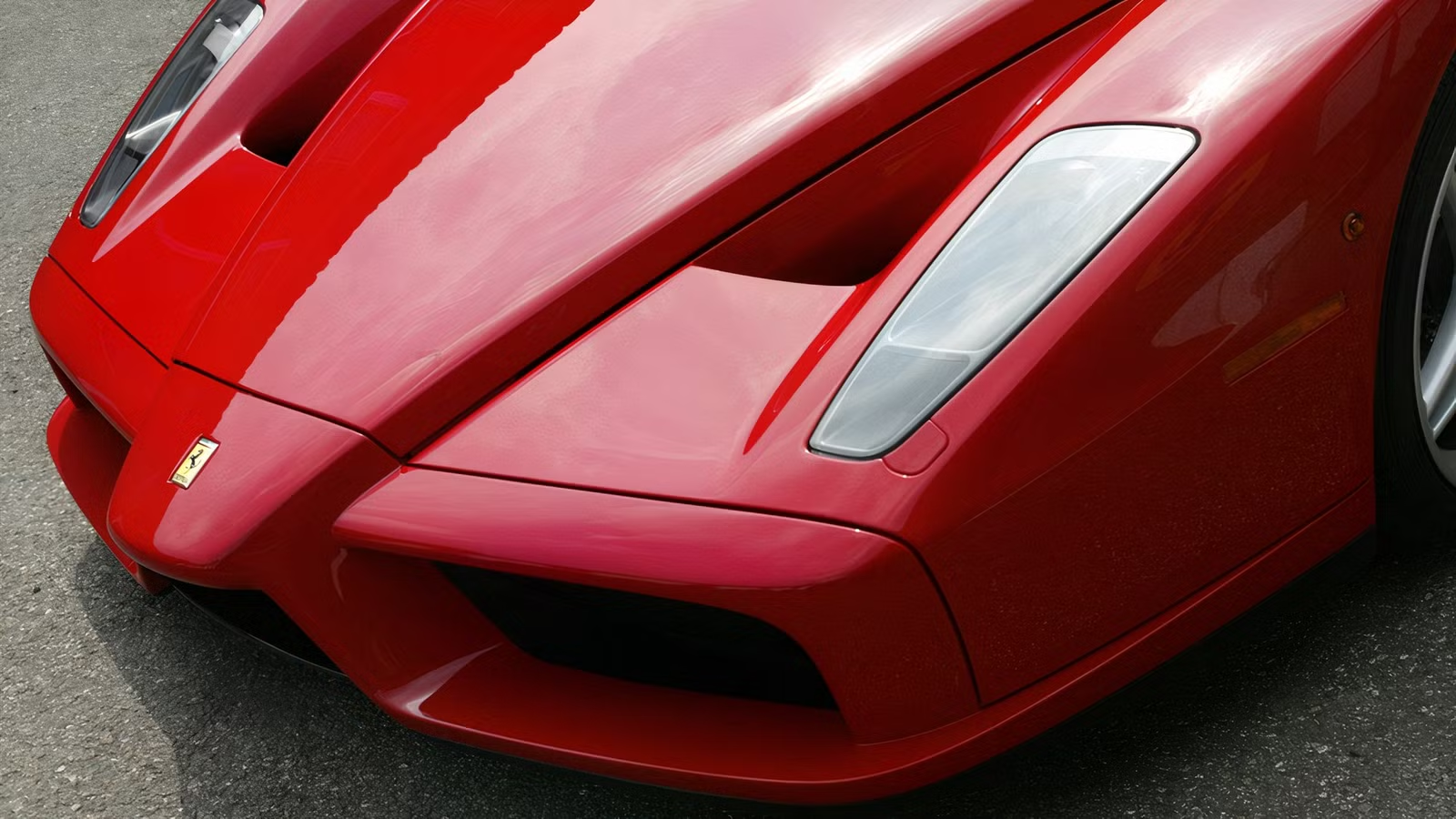
Halo cars represent the pinnacle of an automaker’s model lineup. In Ferrari’s case, the famed Italian automaker has produced six halo cars over the last five decades, with the first setting the precedent for subsequent models serving as showcases of Ferrari’s engineering and design capabilities.
Ferrari’s first halo car was the Ferrari 288 GTO, which was soon followed and superseded by the iconic Ferrari F40. That twin-turbocharged Italian was succeeded by one of the most underrated members of Ferrari’s halo car family, which itself was surpassed by one of the most recognizable members, the Ferrari Enzo. After that, Ferrari broke the performance mold with the introduction of the Ferrari LaFerrari, which changed the way people view hybrid models. We’ve recently seen Ferrari’s latest halo car, the Ferrari F80. Interestingly, of all Ferrari’s halo cars, the Ferrari F40 is the least valuable.
For this list, we’ve relied on Hagerty’s valuation tool and its value estimates for the halo cars. We’ve arranged the list in ascending order, using the halo car with the lowest value. For this list, we’ve relied on the value estimates for the first or earliest available model year in Hagerty’s valuation tool.
Ferrari F40
Value: $1,800,000 — $3,800,000
Engine
2.9-liter twin-turbocharged V8
Horsepower
478 hp @ 7,000 rpm
Torque
424 lb-ft @ 4,500 rpm
0-62 mph
4.1 seconds
The mighty Ferrari F40 altered perceptions of performance when it debuted. Leveraging the strength of a twin-turbocharged V8 engine, it was quicker, faster, and more potent than its predecessor, the Ferrari 288 GTO. The last Ferrari that Enzo Ferrari ever commissioned and approved was created to commemorate 40 years since Ferrari’s first road car, and the effort resulted in a road car that, even today, is not to be trifled with, although some companies have tried to make it more docile.
Atop a steel spaceframe chassis was an angular carbon-fiber body that marked a new chapter for Ferrari in the use of lightweight materials. The combination of its lightweight frame and twin-turbocharged V8 ensured the F40 was a dominant force, as few could match its acceleration, steering precision, handling, and driving experience.
When it was new, Ferrari demanded roughly $400,000 for a base-spec example of the Ferrari F40. However, today, the Ferrari F40 is worth roughly $1.8 million in fair condition, while an example in condition worthy of a win at a Concours d’Elegance event is worth $3.8 million. While this may be a surprise to some, it’s the most affordable of all Ferrari halo cars, but prices are climbing, so it may not stay this way forever.
Ferrari 288 GTO
Value: $2,150,000 — $4,250,000
Engine
2.9-liter twin-turbocharged V8
Horsepower
400 hp @ 7,000 rpm
Torque
366 lb-ft @ 3,800 rpm
0-62 mph
4.9 seconds
As we’ve said, the Ferrari 288 GTO was Ferrari’s first halo car, and the company touts it as the first production model to feature race-car characteristics. Initially, the Ferrari 288 GTO was created to meet a 200-unit homologation requirement, but due to rapidly changing regulations, it would face a different fate. Ferrari ended up with a road-going race car but nowhere to race it. However, when the public reacted after it was unveiled at the Geneva Motor Show, Ferrari quickly sold all 200 units and then some, totaling 276.
Like the model it succeeded, the Ferrari 288 GTO relied on a longitudinally mounted V8 engine and, for the first time in Ferrari’s history, employed a pair of turbochargers. While the Ferrari 288 GTO was nowhere near as expensive as the Ferrari F40 when new, today its value is still higher than that of the Ferrari halo car it surpassed. One of the most recent Ferrari 288 GTOs sold by Hagerty went for $3,882,500, while the most expensive example sold for $4,405,000.
Ferrari LaFerrari
Value: $2,800,000 — $4,500,000
Engine
6.3-liter naturally aspirated hybrid V12
Horsepower
950 hp
Torque
664 lb-ft
0-62 mph
The Ferrari LaFerrari needs very little introduction, but that won’t stop us. It was the fifth member of Ferrari’s halo car lineage and is arguably one of the most important. Its innovative powertrain technology has helped shape how the world views hybrid cars, and the car is now remembered as a member of the Holy Trinity, sitting alongside the McLaren P1 and Porsche 918. At its core is a V12 engine that, at the time and for a long time since, was unrivaled in its output and performance. Add to that the fact it was assisted by the Ferrari Hy-Kers system, and we see the LaFerrari’s total power output rise to nearly 1,000 horsepower.
It is one of the quickest cars around Ferrari’s Fiorano test circuit and has been surpassed only by the variants of the Ferrari SF90 and the Ferrari F80. Alongside its many accolades and legacy, the Ferrari LaFerrari is one of the most important models in Ferrari’s history, and for that reason, it commands a hefty sum today. For example, potential buyers can expect to pay $2.8 million for a Ferrari LaFerrari in fair condition. In contrast, a well-maintained, sheltered example can cost upwards of $4.5 million, although some examples have sold for as much as $10.5 million.
Ferrari Enzo
Value: $2,950,000 — $4,900,000
Engine
6.0-liter naturally aspirated V12
Horsepower
660 hp @ 7,800 rpm
Torque
485 lb-ft @ 5,500 rpm
0-62 mph
3.65 seconds
In honor of Enzo Ferrari, the automaker debuted the only model to bear the company’s founder’s name. Leveraging everything its engineers had learned from motorsport endeavors, Ferrari refined the Enzo with the help of Michael Schumacher, who provided feedback and guidance on the Enzo’s handling and dynamics. At its core was a naturally aspirated 6.0-liter V12 engine, developed with experience gained in Formula One. As a halo car, it was a showcase of Ferrari’s capabilities at the time. Technological aspects of the Enzo would trickle down into other models as the years progressed, such as specially designed carbon-fiber brake discs, and aerodynamic trickery.
Ferrari, at this point, had cemented its strategy of increasing the value of its models by producing them in limited numbers, and the Ferrari Enzo was no different. Only 399 examples of the Ferrari Enzo were produced, and considering that Ferrari threw the kitchen sink at it, it demanded a hefty sum when it debuted at roughly $650,000. However, today, its value is more than double that, with an example that sold in 2024 selling for $4,510,000 at Mecum Auctions.
Ferrari F80
Value: $3,100,000
Engine
3.0-liter twin-turbocharged PHEV V6
Horsepower
1,184 hp
Torque
805 lb-ft
0-62 mph
2.15 seconds
The Ferrari F80 is the Italian automaker’s latest and objectively greatest road car. Although Ferrari strayed from its tradition of shoehorning a roaring V12 engine into its engine bay, as it has with two of the F80’s predecessors, it draws its strength from a twin-turbocharged V6 engine with an architecture and features derived from its Le Mans-winning Ferrari 499P hypercar.
Alongside the assistance of its hybrid system, it laps the Fiorano test circuit quicker than any Ferrari, road-going or not, that has come before it. While it’s too early to have a used-market value, the Ferrari F80 has a starting price of roughly $3.1 million, making it one of the most valuable members of Ferrari’s halo-car family.
Ferrari F50
Value: $3,300,000 — $5,400,000
Engine
4.7-liter naturally aspirated V12
Horsepower
520 hp @ 8,500 rpm
Torque
347 lb-ft @ 6,500 rpm
0-62 mph
3.87 seconds
It’s odd that the Ferrari, which is viewed by some as less desirable than its predecessor and one of the most underrated members of Ferrari’s halo car lineage, is the most valuable. The Ferrari F50 was designed to be as uncompromised by electrical nannies as possible, with Ferrari omitting assistance systems like a servo braking system, power steering, and ABS. Beyond that, the Ferrari F50’s body was made of composite materials, built using the same construction techniques as the automaker’s race cars. Some of the elements derived from its motorsport experience included ground effect aerodynamic systems and a suspension system that employed push-rod designs.
Its power source was another noteworthy aspect of the Ferrari F50, marking a departure from Ferrari’s reliance on a twin-turbocharged V8 engine; in this case, it was a naturally aspirated V12 that powered the angular Ferrari halo car. Only 349 Ferrari F50s were built, and today they are worth significantly more than any other Ferrari halo car. One example of the Ferrari F50 sold for $9.2 million, although that particular car had a noteworthy backstory that boosted its value to more than triple what it cost brand-new.
Sources: Ferrari, Hagerty
