

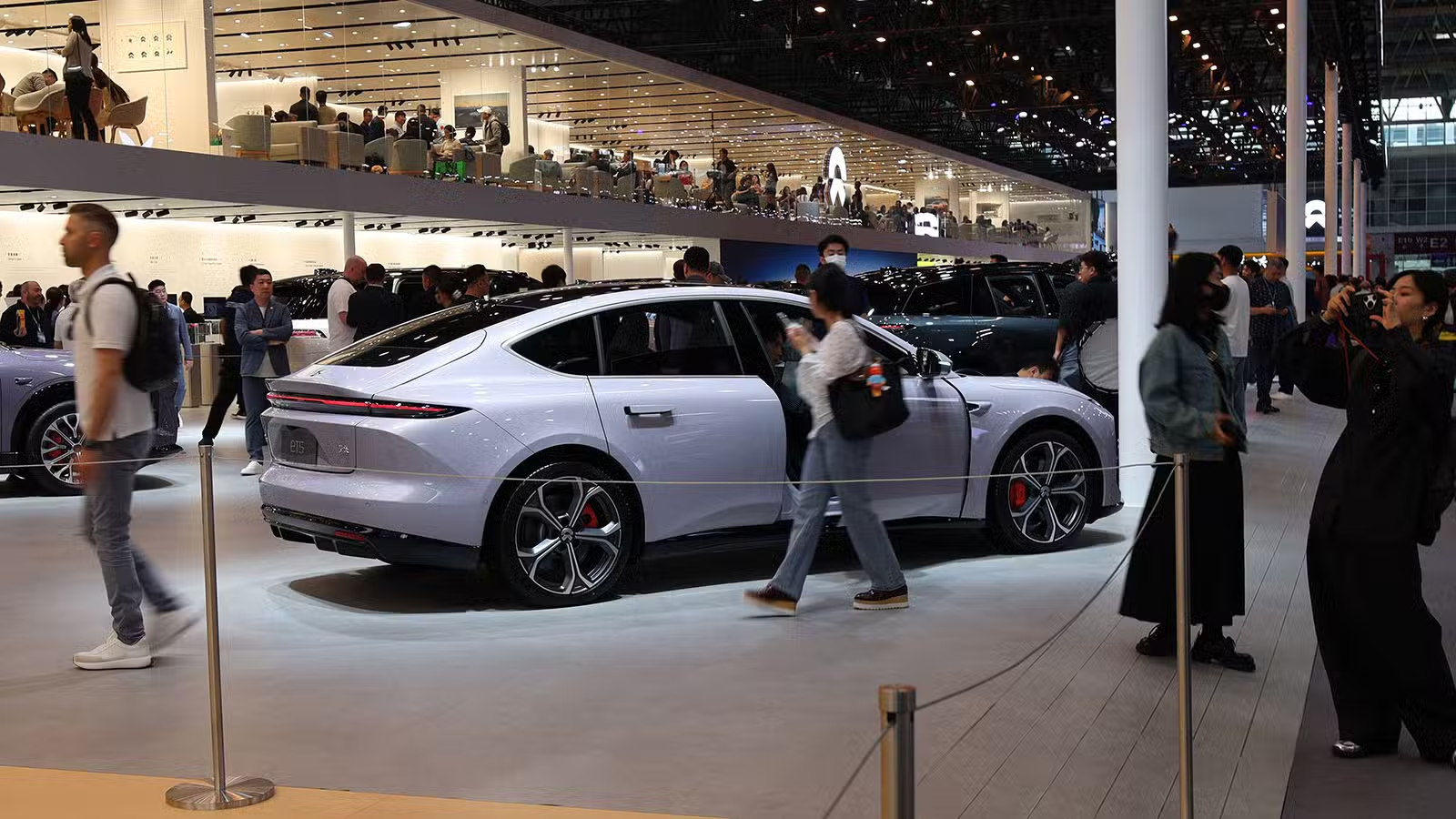
A Nio ET5 on display at the Beijing Auto Show in April 2026. Credit: CnEVPost
- Hainan plans to raise NEVs’ share of its vehicle fleet to 45% by 2030.
- The province’s target is more aggressive than China’s national goal of 30% NEV fleet share by 2030.
China’s Hainan province reiterated that it will steadily push ahead with a 2030 ban on gasoline-car sales, reinforcing the southern island province’s path to becoming China’s first to stop selling conventional internal combustion engine vehicles.
The Hainan provincial government said in its 15th five-year ecological civilization pilot zone plan released earlier this month that, by 2030, clean-energy vehicles will account for 100% of new and replacement vehicles in the province’s public-service and commercial operation sectors, excluding special-purpose vehicles.
The plan also said that new energy vehicles (NEVs) will account for 100% of new and replacement vehicles in the private-use sector, while the vehicle-to-charger ratio will be kept below 2.5:1.
That means Hainan is maintaining the timetable it set in 2022. The province said at the time that it would fully ban the sale of gasoline vehicles across the island by 2030, while shifting all new and replacement vehicles in the private sector to NEVs.
Under the latest plan, NEVs’ share of Hainan’s vehicle fleet is expected to rise to 45% by 2030 from 23.75% in 2025. That ratio is higher than China’s latest national target.
China’s State Council on July 9 released the 15th five-year carbon-peaking action plan, which calls for NEVs to account for about 30% of the country’s total vehicle fleet by 2030.
Hainan’s higher target shows local governments are making transport electrification a core lever for low-carbon transition. The province is also using its relatively closed island market to test more aggressive policies for phasing out gasoline cars.
In China’s policy context, NEVs generally include battery electric vehicles (BEVs), plug-in hybrid electric vehicles (PHEVs) and fuel-cell vehicles.
Hainan’s plan also mentioned that the province will promote demonstration applications of fuel-cell vehicles in heavy trucks, cold-chain logistics and public transport.
Hainan also plans to explore the construction of outbound zero-carbon freight corridors and promote research on demonstration routes for green shipping zones.
The plan said the province will increase the use of shore power by vessels at berth, and promote demonstration applications of green marine fuels including biodiesel, green ammonia and green methanol.
The province is also expanding its transport-energy infrastructure. The plan said Hainan will map out land-and-sea supply networks for hydrogen-based energy, and build deep-sea integrated energy platforms and refueling hubs that coordinate electricity, hydrogen, ammonia and methanol.
These targets extend Hainan’s policy direction in recent years as it builds a clean-energy island. The provincial government said renewable energy has become Hainan’s largest power source, while its NEV market penetration rate and fleet share rank first and second, respectively, among China’s provincial-level regions.
Hainan is also advancing a pilot program in Haikou for full electrification in the public sector. The province previously said it would focus on light logistics delivery, urban sanitation, rental cars and ride-hailing vehicles to accelerate the replacement of internal combustion engine (ICE) vehicles with NEVs.
Still, the phaseout of gasoline cars will require support from both charging convenience and vehicle supply. Hainan previously said it would build a charging infrastructure service network covering the whole province, and promote a unified service and regulatory platform for charging and battery swap.
For China’s auto industry, Hainan’s policy carries demonstration significance. If its 2030 target is met on schedule, it will become China’s first market to move the phaseout of pure gasoline-car sales from a policy vision to implementation at the provincial level.
China’s top 10 passenger cars by retail sales in May were all NEVs, with Geely Xingyuan ranking first and Tesla Model Y second.
