

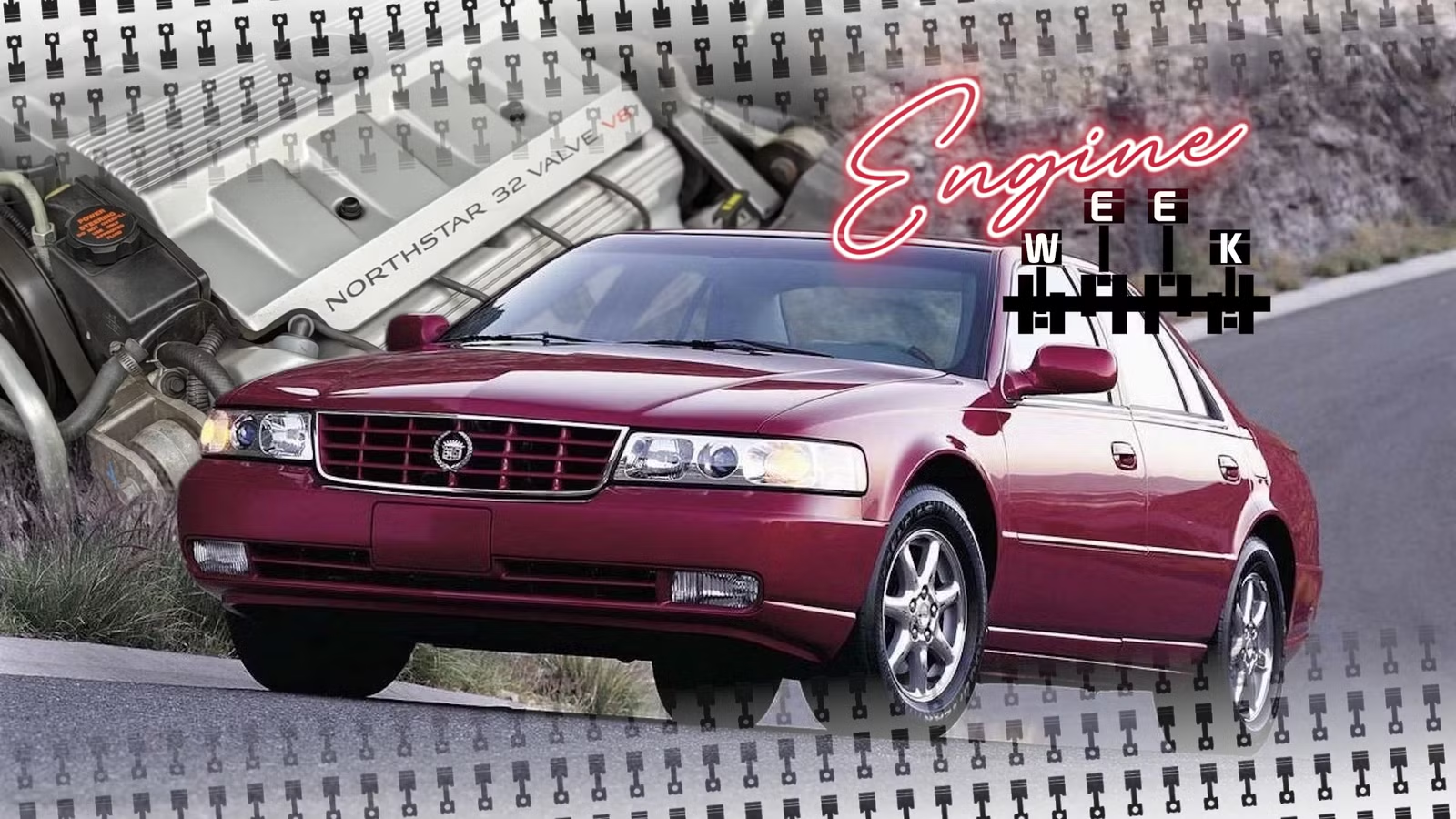
It’s really a darn shame about the 1990s version of the Cadillac Northstar V8. This was a power plant that had the makings of an all-time great, a two-time Wards 10 Best Engines winner, a 300-horsepower monster, back when 190 hp was more than enough to qualify as a performance model. Unfortunately, a handful of fatal flaws made total engine failure almost inevitable.
It wasn’t machining debris in the main bearings or anything like that. The problem with the Northstar V8s produced from 1993 to 1999 came down to fundamental flaws in the design and production of the power plant. Had General Motors sorted these issues in the research and development stage, instead of seven years in, these would be among the most sought-after engines on the market. But things went in a different direction.
It’s Engine Week at CarBuzz, which means we’re looking into great engines, weak engines, weird engines, or downright charming engines all week long. Join us as we look at some of the biggest hits and misses of the internal combustion engine.
Early Northstar V8s Were Built With A Fatal Flaw
cadillac northstar v8Wikimedia Commons: VX1NG
1993 L37 Northstar 4.6-Liter V8 Engine Specs
Displacement
4,565 cc NA 8-Cylinder
Power
295 hp
Bore x Stroke
3.66 x 3.31 Inches
Compression Ratio
10.3:1
Check the specs, and you can see that the original Northstar V8, the L37, was a pretty exciting engine for the time, transforming luxurious Cadillacs into real, honest-to-goodness muscle cars.
The first run of L37s were introduced in 1992 for the Cadillac Allanté, a mostly-forgotten luxury roadster, built in collaboration between Cadillac and Pininfarina from the 1987 to 1993 model years. The 1993 Allanté would prove to be its final model year, with the L37 migrating to the Cadillac Eldorado, Seville, and DeVille by the mid-1990s.
Early Northstars, including, but not limited to, the L37, were built with torque-to-yield bolts in the head gasket. Torque-to-yield bolts are also known as stretch bolts. The name comes from the process by which the bolt is stretched beyond the point of elasticity, which causes deformation and permanent elongation.
The cool thing about this type of bolt is that you’ve got consistent clamping force, like when you give your tie-down straps a pull and say, “Yeah that ain’t goin’ anywhere.” It locks the fastener permanently into place. The downside should be easy to guess, namely, you can’t reuse them.
The Northstar’s Bolts Were Doomed From The Start
1997 Cadillac Seville STS close-up of engineBring A Trailer
In the early Northstar engines, the bolts were threaded very finely and tended to lose their grip under the constant stress and heat cycling of regular use. This was compounded by problems with the cooling system, with clogged purge lines and thermostat failures being fairly common, and by the use of aluminum engine blocks, which lacked the tensile strength to hold the bolts’ fine threads.
These early engines created a scenario where no amount of TLC could prevent the eventual thread-pull failure, wherein the bolts would simply slide right out of place.
Related
Cadillac’s Forgotten V Sedan Is The Supercharged V8 Bargain Of The Year
Looking for an affordable rear-wheel-drive sports sedan powered by a supercharged V8 engine? Set your sights on the Cadillac STS-V.
It wouldn’t be enough to simply replace the bolts, either. When this happened, you would need to replace the head gasket, a $3,000 fix in itself. Ignore the problem, and catastrophic engine failure is guaranteed. There’s no telling exactly how long these bolts can last, but it’s hard to find early Northstar engines with more than 80,000 miles on the odometer that still have the original head gasket in place.
The problematic years for the Northstar engine are 1993-1999, and the Allanté, the Eldorado, the DeVille Concourse, DTS, and the Seville STS are the cars to avoid from these model years.
GM Got It Under Control With Iterative Fixes
Bronze 1998 Cadillac DeVille front endCadillac
Cadillac’s fix was pretty simple. Starting in 2000, Cadillac started using longer, coarser-threaded bolts, with steel thread inserts embedded in the soft aluminum blocks. If you know the first thing about metallurgy, this is probably the first thing you would have suggested, but it took GM seven years to put the fix in place.
From 2005 forward, the bolts were even stronger. Early-2000s engines are a major improvement over the 1990s power plants, but the best version of this engine went into production in 2005.
Early Northstar engines are salvageable if you want to go to the trouble of tearing the engine down, drilling new holes, and installing head studs. You’ll probably be happier simply buying something from the 2000 model year or later, though.
A 2005 Cadillac DeVille DTS Is Easy To Recommend
2005 Cadillac DeVille side angle in silver while parkedBring A Trailer
Model
Power
Torque
Engine
2005 Cadillac DeVille DTS
290 hp
285 lb-ft
L37
2006 Cadillac DTS Performance
292 hp
285 lb-ft
L37
2008 Buick Lucerne Super
292 hp
288 lb-ft
L37
2005 Pontiac Bonneville GXP
275 hp
300 lb-ft
LDB
2005 Cadillac STS
320 hp
315 lb-ft
LH2
2006 Cadillac STS-V
469 hp
429 lb-ft
LC3
If you don’t mind putting in the extra elbow grease that comes with owning a quarter-century-old luxury car, we don’t have any problem recommending a 2005 Cadillac DeVille DTS, or any mid-2000s Cadillac with a Northstar engine, for that matter. To go over some of our favorites.
The Cadillac STS is really cool, and the STS-V is even cooler, running on a supercharged LC3, the most powerful factory version of the engine. It comes with some of its own maintenance issues, like coolant leaks and supercharger wear, but it’s fairly reliable for what is essentially a supercar-tier Caddie.
As far as bargain-hunting goes, it’s a real take-what-you-can-get market. It’s hard to find most of these cars on used-car websites, but they do pop up at auction now and then. We were able to dig up the following recent sales.
- A 34,000-mile 2005 DeVille sold for $8,100 in May.
- A 40,000-mile 2005 DeVille sold for $11,000 in 2023.
- A 33,000-mile 2006 DTS Performance sold for $10,500 in 2024.
- A 28,000-mile 2006 STS-V sold for $23,500 in 2024.
These auctions should give you an idea of what’s out there, but we’re only reporting on listings that have already closed, so you need to do your own shopping to see what’s available.
At these prices, $10,000 could get you your new favorite car, and with low miles. But you’ll need to keep your ear to the ground, because they don’t hit the market all that often, and they usually disappear quickly when they do.
Our Advice: Avoid The 1990s Northstars Altogether
2005 Cadillac DeVille detail shot of the engine bayBring A Trailer
Red flags for crappy bolts include engine overheating, white smoke, and that sweet smell of burning coolant. But our advice is to avoid all 1990s Northstars to ensure you don’t have to deal with the thread pull-through problem in the first place. If you’re still shopping around, it’s not like you’re stuck trying to make the best of an unreliable engine. You can simply narrow your search down to more recent model years and sidestep the problem entirely.
Related
How Long Can A Used 7.0 V8 Chevrolet Corvette Z06 Last?
This race-bred 500-horsepower engine can achieve 100,000+ miles, but one potential issue has owners concerned.
That’s not to say that later engines don’t have their share of problems, but they’re not saddled with the guaranteed failure point that is the stretch bolt in an aluminum block.
Going to RepairPal to get an idea of maintenance issues in later Northstar-powered cars, we find that the most common and expensive problems in the 2006 Cadillac STS include the following.
- Radiator replacement – $1,237 – $1,391
- ABS control module replacement $1,111 – $1,185
- Active suspension system height sensor replacement $591 – $668
- Trans oil cooler line replacement $451 – $616
- Blower motor replacement $353 – $433
Nowhere on this list do you see blown head gaskets and stripped bolts. That reads like no news being good news in our book.
Sources: Cadillac, GM, RepairPal
