

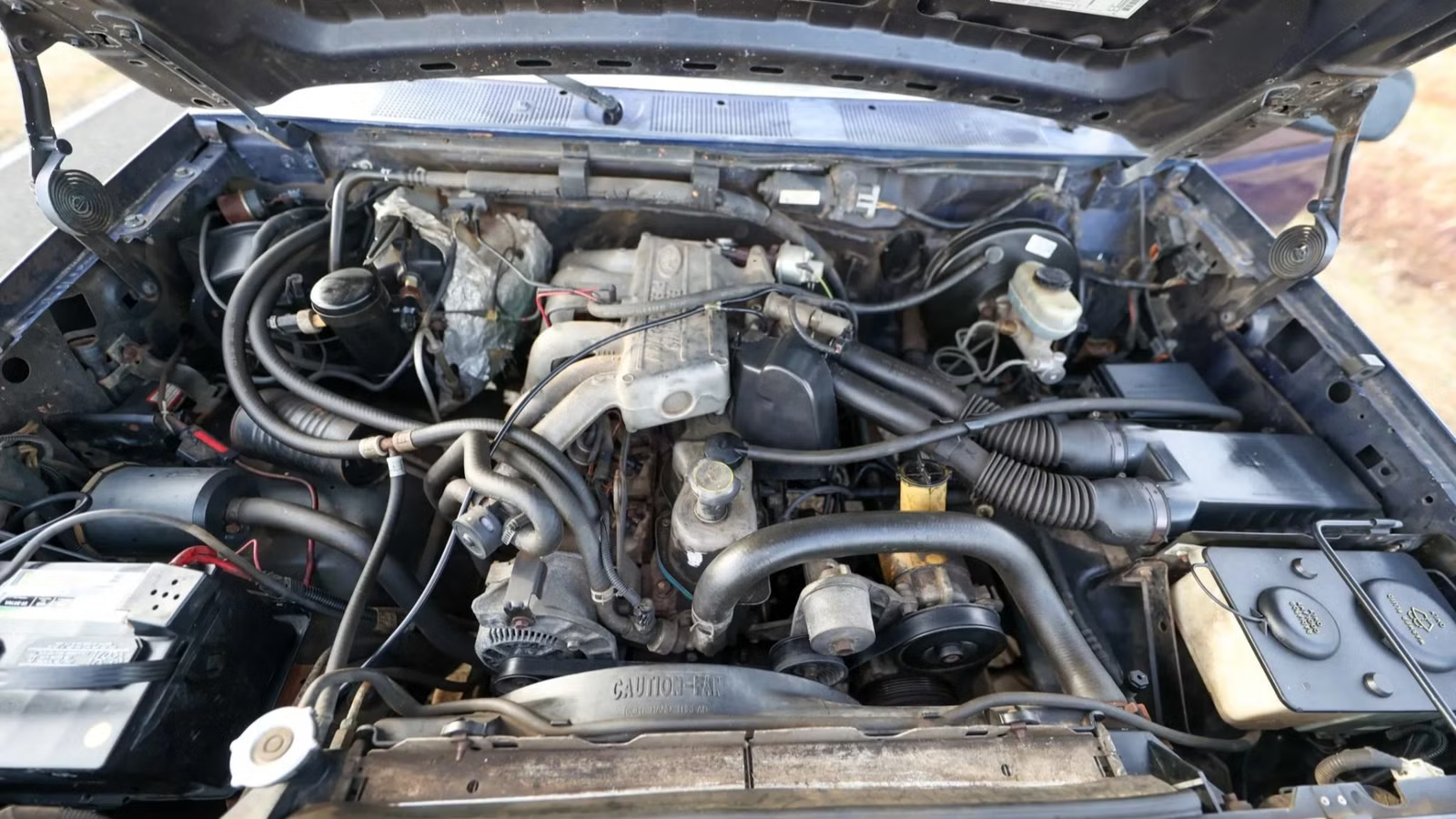
Most world-famous automakers have produced at least one extremely reliable engine that managed to earn itself a massive following. Most of us are familiar with engines like the Buick 3800 V6, an engine that was voted the second-best engine produced during the 20th century according to WardsAuto. Other engines that come to mind are examples like Toyota’s 1UZ-FE V8, and the Ford 4.6-liter Modular V8.
However, some exceedingly reliable engines flew right under the radar when it comes to the mass market. A great example of this phenomenon is Ford’s 300 CID straight-six. It stuck around for over three decades, and its penchant for share-tree reliability is, potentially, unsurpassed. It saw use across a swath of applications outside road-going pickup trucks, such as in generators, earth-moving equipment, and even irrigation equipment. An engine that’s trusted with heavy-duty work had better be reliable, and the 300 CID six is.
Ford
Founded
June 16, 1903
Founder
Henry Ford
Headquarters
Dearborn, Michigan, USA
Owned By
Publicly Traded
Current CEO
Jim Farley
What Makes It So Reliable
1982_ford_f-100_engine top viewBring A Trailer
It was no accident that the Ford 300 CID straight-six was so reliable. At its core, the mill boasted a crankshaft supported by seven main bearings. Most inline-six engines typically use four or five, but Ford seemed to know the engine was going to be tasked with some heavy work.
In addition, the mill’s block and cylinder head were both made from cast iron. When the engine was first introduced in the mid 1960s, cast iron engines were the norm. But, near the end of the engine’s life, most automakers were producing engines with aluminum blocks and heads, but Ford stayed the course with its cast iron construction.
Related
Most Reliable Engines: 10 Motors That Refuse To Die
They’re not all Toyota motors, either.
The reliability train doesn’t stop there, either. Its timing system didn’t use a chain or belt. Instead, a gear-driven system was implemented, eliminating the “middle man”, so to speak, that a timing chain or belt creates. By using a timing gear setup, the engine’s valvetrain was near-bulletproof. Adding to the mix is an extremely low-rev maximum which, in most applications, hovers between 3,500 and 4,000 rpm. Those with a mechanical inclination will know that the slower an engine has to spin, the less likely it will experience a catastrophic failure.
1982_ford_f-100_engine1 diagonal viewBring A Trailer
Ford 300 CID (4.9L) Inline-Six
Aspiration
Natural
Cylinder Bore
4.00 in
Piston Stroke
3.98 in
Compression Ratio
8.9:1 (1965–1972 MY)
Engine Weight
490 lbs (Dressed)
*Specs courtesy of F150 Hub
Topping things off was its “square” design. Now, the engine itself isn’t a literal square, but its bore/stroke setup is, as its cylinder bore and piston stroke are nearly identical in measurement. A square bore/stroke allows an engine to focus more on low-end torque at low rpm, meaning the engine produces most of its pulling power down in the rev range. This is an excellent attribute for heavy-duty towing applications, when you need the most amount of power when accelerating from a stop.
The 300 CID’s Timeline
1965_ford_f-100_front parkedBring A Trailer
The legendary engine first hit the market in 1965 as an enlarged version of the 240 CID six. At the time, Ford was interested in producing an all-new engine that could both handle the strain and demand of heavy-duty applications. But, the new motor also needed to offer the sort of fuel economy that couldn’t be replicated by Ford’s then-V8 engine options.
Its first application was the Ford F-Series pickup truck lineup, and boasted 170 ponies during its debut year. Its use quickly spread to heavy-duty vehicles, such as dump trucks, too. 300 CIDs that made it into the heavier-duty side of things were equipped with upgraded exhaust manifolds, a forged crankshaft, and forged pistons.
Related
This Famous V6 Is The Second-Best Engine Ever, And It’s Bolted In A Dirt Cheap Car
Want to own a piece of General Motors history? Luckily, you won’t need very deep pockets to do so with this model.
Over the years, the 300 CID remained largely unchanged. When SAE net horsepower measurements were mandated in 1972, replacing the older SAE gross method, the engine received a power output rating of 120–130 horsepower, depending on the advertisement or technical specification sheet referenced. It would also lose its “300” nomenclature in favor of “4.9L” in 1978 as Ford, along with most other domestic automakers, began advertising engines with metric displacement measurements.
1995_ford_f-150_front blueBring A Trailer
The one and only major change to the engine came about in 1987. That year, the old-school, single-barrel carburetor was ditched in favor of electronically controlled fuel injection. Its compression ratio was altered, too, and was now rated at 8.8:1. The introduction of fuel injection allowed the six to gain some power, with a new rating of 150 ponies. This would remain its power output until its final year of production. Only three road-going, civilian models actually employed the engine over the course of its life, those being the Ford F-Series, the E-Series, and the Bronco.
Related
Why Every Automaker Is Quietly Bringing Back The Inline-Six Engine
As the automotive industry evolves, one engine layout is making a surprising resurgence. But what benefits does this old-school design offer?
The 300 CID Straight-Six’s Predecessors
1965_ford_f-100_engine2 top viewBring A Trailer
Ford’s first foray into producing straight-six engines began all the way back to 1906. However, this pre-gen mill was only in production until 1908. It wouldn’t be until 1941 that Ford would get back into building six-pots in earnest, and the first modern(-ish) iteration of the engine emerged. Both a 226 CID and 254 CID version were produced in this first wave, the former of which was destined for use in passenger cars, and the latter in heavy-duty trucks and other industrial applications, such as generators and pumps, although this version wasn’t introduced until 1950.
The second-gen version of the modern Ford inline-six hit the market in 1952. A slew of upgrades was introduced, such as a revised cylinder head and a relocated distributor. It also shared numerous components and some of its design with the Ford Y-Block V8. Ford marketed this second-gen iteration as the Mileage Maker, or I-Block Mileage Maker, as it was one of the more fuel-efficient engines on the American market at the time. It was in production until 1964, and had three different size variations ranging from 215 CID, 223 CID, and up to 262 CID.
1995_ford_f-150_engine1 side viewBring A Trailer
A third generation was slotted into the mix starting in 1960. This time, the Ford straight six came in five iterations, ranging from a 144, 170, a 187, an Argentina-only motor, a 200, and a 250 cubic-inch version. This new mill featured a cylinder head that was fused to an intake manifold, which made production easier, but repairs and modification were relatively difficult. All told, the third-gen was produced until 1980.
The Jack-Of-All-Trades Was A Straight-Six
1982_ford_f-100_front greenBring A Trailer
It was never intended to be a speciality engine, and Ford knew that. The 300 CID entered the market to try and fill a gap left between inline-four engines that couldn’t cut it in heavy-duty applications, and V8s that some folks deemed too thirsty. Its penchant for reliability was quickly made apparent, and its rise to fame reached its peak in 1975, when it was crowned the standard engine for the Ford F-Series.
However, its use in several other applications, ranging from dump trucks, irrigation equipment, ski lifts, wood chippers, and tractors, means it’s been everywhere, seen everything, and afraid of nothing. While it’s not totally immune to issues – as it does have a tendency to leak oil from its rear main seal once it reaches old age – it’s certainly able to take aging in its stride. Many old-school Ford trucks that boast the engine still run, even after sitting for decades or with extremely high mileages. In addition, many of these still-running examples never experienced the luxury of regular maintenance, but the engine kept humming away happily, unbothered.
1995_ford_f-150_full_frontal blueBring A Trailer
These days, you’d be hard-pressed to find an engine that could be oil-starved, left to rot, or just beat up, and would still run like a top no matter what. If you spend some time in some Ford forums, you can see just how revered these engines actually are. It’s no wonder it was around for over three decades.
Sources: F150 Hub, Grassroots Motorsports, Ford F150 Forum, F150Online.com
