

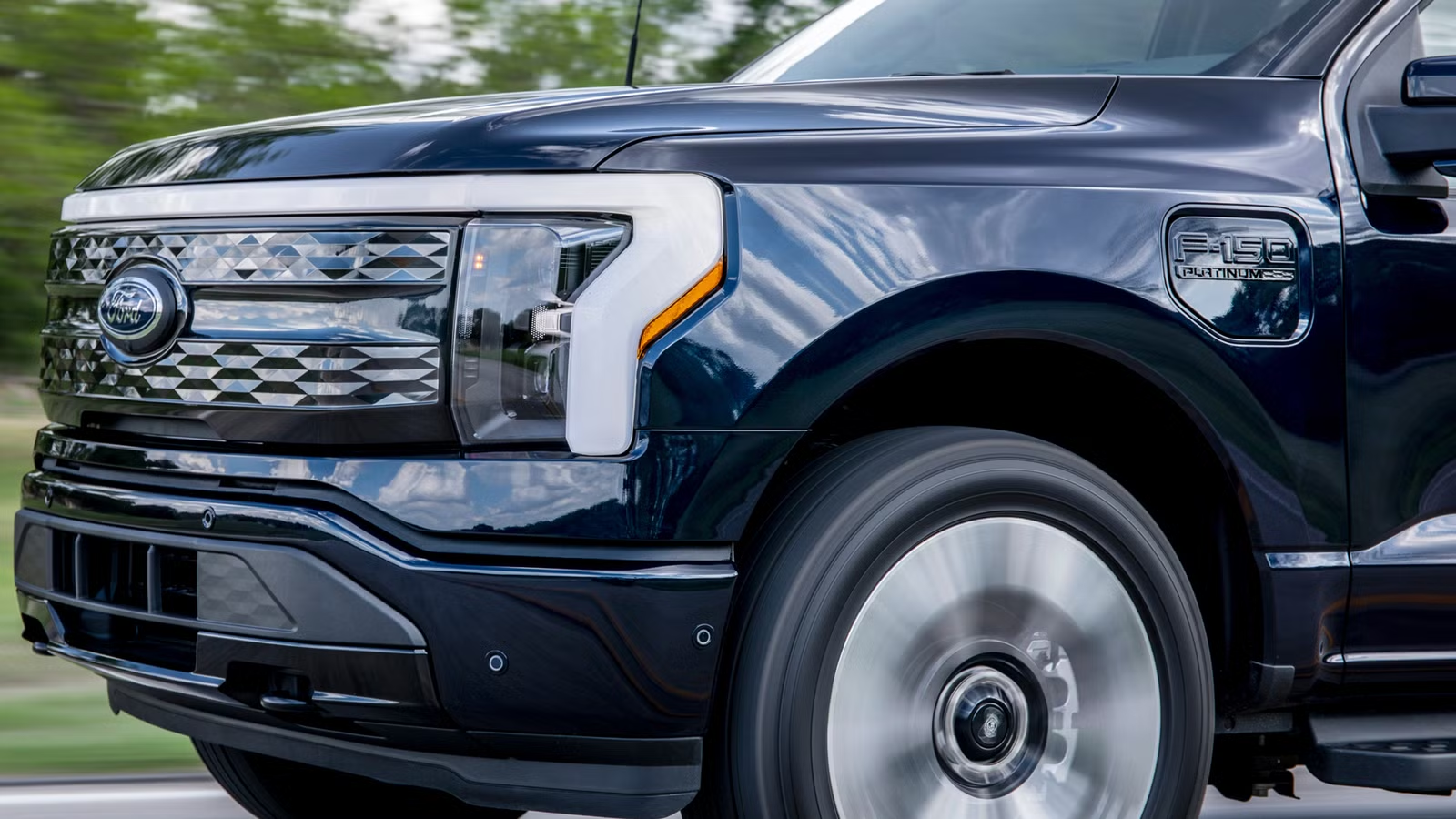
You would think that having the top-selling electric truck in the country would be awesome, right? Ford sold 27,037 examples of the F-150 Lightning last year, outselling the Tesla Cybertruck by more than 7,000 units, and more than doubling the sales numbers of the Chevy Silverado EV. While 27,037 units is nothing to sneeze at, what if you were expecting to sell 150,000 units every year? As it turns out, developing and producing a new vehicle is actually quite expensive!
Building the Rouge Electric Vehicle Center in Dearborn, Michigan, was a project that alone cost Ford close to a billion dollars before even considering research, development, design, testing, and manufacturing costs. All told, the F-150 Lightning’s failure to reach critical mass has the automaker losing around $44,000 on every unit sold. The only word for that is oof. No wonder they canned it. We have to ask, though: is this just a matter of Ford being overly optimistic about EVs, or are there other factors at play?
Ford Claimed A $19.5 Billion Write-Down While Canceling The Lightning
2025 Ford F-150 Lightning side angle in gray while driving on a dirt roadFord
Without taking a firsthand look at Ford’s account books, we can’t say for certain what it cost the brand to develop and manufacture the F-150 Lightning, in monetary terms, but we know that Ford reported a $19.5 billion write-down after canceling the truck after just a few years on the market.
If you’re wondering what the heck a write-down is, it means that you’re reducing the value of an asset without totally writing it off. So, however you split it, Ford is claiming a $19.5 billion loss related to the cancellation of the Ford F-150 Lightning.
We know that the initial investment in the Rouge EV Center involved $700 million just to construct the building. Then, the brand spent another $250 million to expand the site and get it ready for production. With powertrain and tech development costs included, we’ve seen estimates ranging from $10 billion to $11 billion in total.
The $19.5 billion write-down has been attributed to three factors.
- $8.5 billion for canceled EV projects.
- $6 billion for a dissolved battery venture.
- $5 billion for program-related expenses, which basically means this is what it costs just to switch a company from EVs to hybrids. Hiring, training, rebranding, etc. It’s like the readjustment period when your office switches from Windows to Mac, but across a $56 billion multinational automotive empire.
In 2024 alone, Ford claimed it was losing $5 billion on its EV venture, which amounted to a per-vehicle loss of $44,000 for every Lightning sold in the second quarter that year.
If we divide the total $19.5 billion write-down by roughly 100,000 units sold, the final number might come out to something like $195,000 just to build a single F-150 Lightning. But, again, we’d need a closer look at Ford’s books to make anything but a guesstimate.
The Lightning Market Has Effectively Bottomed Out
2025 Ford F-150 Lightning Red Front 3/4 Angle While Sand DrivingFord
According to Yahoo, Ford EV sales plunged from the first quarter of 2025 to the first quarter of 2026 by about 70%, from 7,187 units to 2,060. At this point, it seems that most people who want an F-150 Lightning already have one.
I, for one, am thankful Ford took billions in losses to develop the Lightning, because it’s the best truck I’ve ever owned.
Maybe one of the most surprising aspects of the F-150 Lightning story is that drivers love it. The truck is reliable, capable, low-maintenance, and tows up to five tons. Plus, a person couldn’t ask for a better pickup when gas prices are through the roof. But the devotion of around 100,000 buyers doesn’t make up for nearly $20 billion in development and manufacturing costs. A rabid cult following is great for a touring rock band, but it’s cold comfort for one of the world’s biggest automakers.
It’s Not Just About EVs
2025 Ford F-150 Lightning Interior view of the dashboard and steering wheelFord
One of the key takeaways from the story of the Ford F-150 Lightning has been that Ford is losing faith in electric vehicles and is pivoting to hybrids. That’s an important point, but there’s a broader story going on here.
A 2026 Ford F-150 Lightning Platinum starts at $84,995. Add taxes, financing, and various titling and registration fees, and you’re easily spending more than $100,000.
Related
Why You Should And Shouldn’t Buy An Early Ford F-150 Lightning
Is This The Upscale F-150 Experience You’ve Been Looking For?
Trucks Have Gotten Too Darn Expensive
2024 Ford F-150 Lightning front 3/4 angle in red while towing a boatFord
It wasn’t just unchecked optimism about EVs that led Ford to build the F-150 Lightning. Ford seems to have operated under the assumption that the six-figure pickup era would never end and that pandemic-era price spikes would continue. In an F-150 Lightning, a standard-range battery alone can cost more than $30,000. You simply can’t build a full-size EV for cheap.
Case in point, Ford’s not totally giving up on EVs. The automaker is working with former Tesla engineer Alan Clarke to develop a Universal EV Platform that will serve as the foundation for a smaller, more affordable mid-size pickup. The brand will build this smaller pickup for the 2027 model year alongside a full-size EREV (extended-range EV, basically an EV with an onboard combustion engine to serve as a generator) to replace the Lightning.
In short, the plan was unwieldy even when we had the EV credits on the table. Without five times as many buyers willing to spend six figures on a pickup, the F-150 Lightning would simply not have been economically viable.
Related
You Can Get 25 MPG From Your New Ford F-150 For Under $55k
Looking for the lowest cost 2026 F-150 Hybrid? We reveal the most cost-effective trim that balances power and efficiency without breaking $55k.
Hybridization Is Almost Certainly The Way Forward
Ford sold 84,934 hybrid F-150s last year, representing a 15% increase from 2024, while the broader F-150 nameplate only saw an 8.3% increase in sales. The brand moved around 81,000 Ford Maverick hybrids in 2025, making up more than half of the 155,051 total sales. All told, Ford reported 21.7% growth in hybrid sales, including plug-ins, to 228,072 in total, accounting for more than one in 10 of the brand’s 2.2 million sales for 2025.
It doesn’t take a fortune-teller to suggest that hybrids are the way forward for the pickup segment. We don’t think it takes a master’s degree in economics to suggest that the more accessible pricing has something to do with this.
Related
Ford F-150 Generations Ranked By Reliability
The F-150 has dominated sales in America, but which generation is the most reliable?
Hybrids Just Make More Economic Sense
2022 – 2025 Ford Maverick exteriorFord
The cheapest F-150 hybrid available is a SuperCrew STX with a 3.5-liter PowerBoost V6 under the hood for an estimated MSRP of $55,505. The cheapest F-150 Lightning starts at $54,780 for a Pro work truck, while the daily-driver-oriented XLT starts at $63,345. Essentially, the same sticker price buys you a fleet model EV, or a mid-range hybrid. That’s not a hard call to make.
You could spend six figures to upgrade your Lightning to a top-of-the-line model and tell yourself that you might make up the difference on fuel expenses, but FuelEconomy.gov estimates that you’d be spending around $2,600 a year in the Ford F-150 hybrid, or $1,100 in the EV, assuming 15,000 miles driven every year, split 45/55 between highway and city miles.
If you’re only saving $1,500 a year, but you’re spending tens of thousands of dollars more for a comparable driving experience, it could take decades to see any real savings. All of this is not to knock the Ford F-150 Lightning. It’s a fantastic truck, and people who’ve actually driven it have nothing but positive things to say. But, from a business perspective, it’s no wonder Ford had to scrap the truck.
Sources: Ford, FuelEconomy.gov, Hagerty.
