

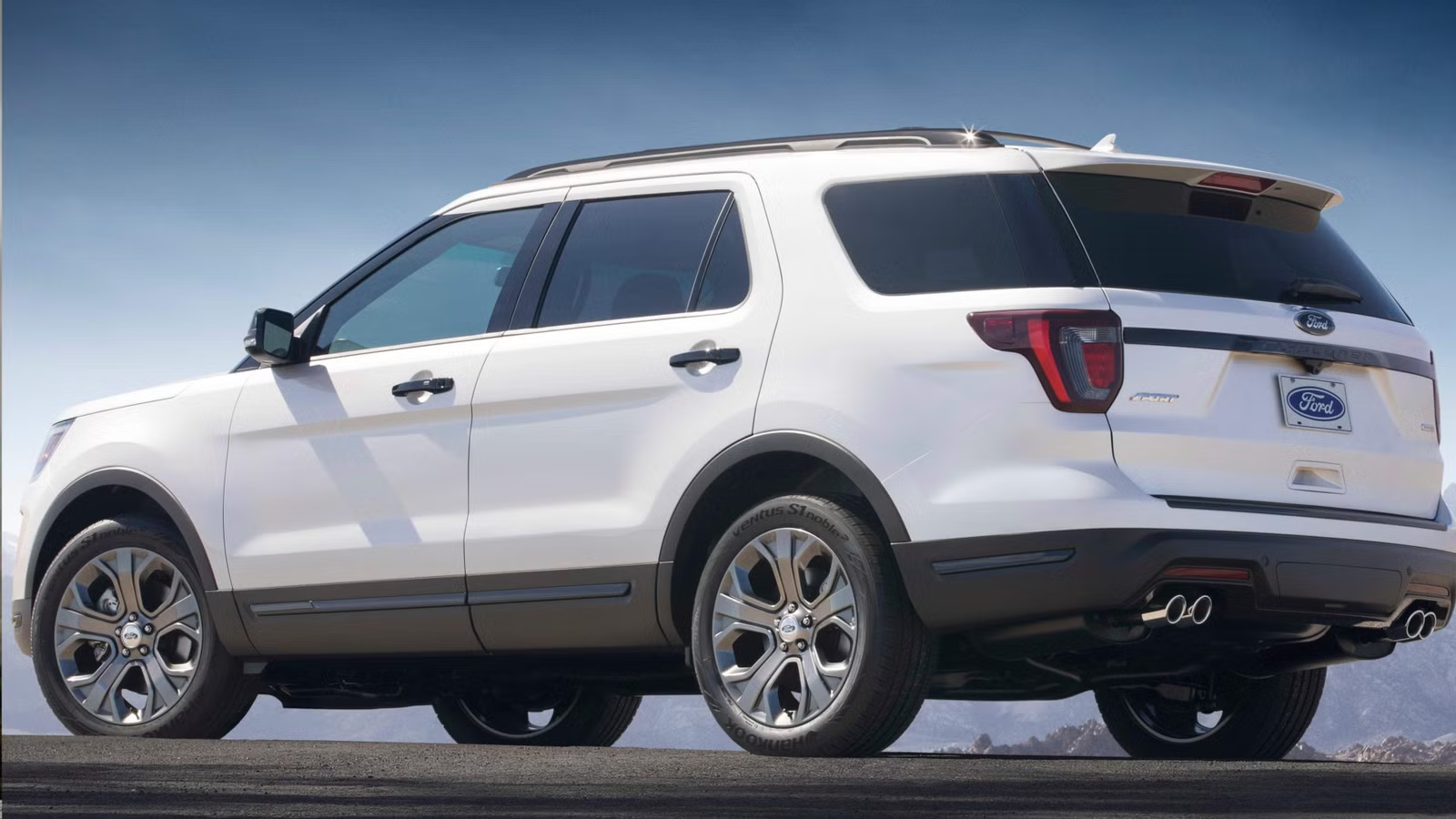
The latest batch of recalls issued by Ford this month isn’t for a new problem. It was actually to solve an issue the company thought it fixed back in 2021. Examples of the Explorer produced between September 2014 and March 2019 were previously recalled for potentially defective roof rails that could detach at high speeds, creating a road hazard for other drivers.
The number of Explorers recalled under Ford’s 26S54 recall was just a fraction of the nearly 2 million vehicles Ford has recalled this month alone, with some Explorers included in the original 2021 recall for the same issue now back on the list of affected vehicles.
What To Know About Ford’s Roof Rail Recall
Press image of the 2016 Ford Explorer SUVFord
Ford plans to issue recall notices to owners by mail between August 24–28. Owners can check whether their Explorer is part of the recall on the National Highway Traffic Safety Administration (NHTSA) website by entering the VIN or license plate number. Vehicles that have already been recalled for the same issue might still be affected by the current recall caused by the epoxy used to secure the roof rails to the body.
JAC Products, a Tier 1 automotive supplier that provides Ford with roof rail components, manufactured the parts used on the Explorers in question. Failures not caused by the factory might have resulted from repairs made during the prior recall. The NHTSA report noted instances in which technicians may have applied less epoxy than needed or failed to replace broken clips that hold the roof rails to the body. It also stated that roof rails with plated covers, which may have been exposed to hot and cold climates over the years, may have aged and weakened, potentially causing parts to fail.
The report also stated a rattle or squeak at highway speeds might indicate a failed roof rail, as well as a visible gap between the cover and the roofline. Either could develop as a result of failed clips or adhesive used during manufacturing or repair of the roof rail. As of now, neither Ford nor the NHTSA has received any reports of injuries or deaths resulting from the failed components in question, though one accident was allegedly caused by this failure.
The Blue Oval Is Leading The Recall Charts For 2026
Ford Bronco ProductionFord
Ford is not happy about leading the auto industry in recalls. Earlier this year, the company had brought 4.3 million vehicles into question with its 26C10 electrical system recall, as fast-paced product development took precedence over quality control.
Sometimes, recalls for new cars can be fixed by updating a few lines of code. Manufacturers can issue software patches or programming changes over-the-air to connected vehicles, eliminating the need for owners to take their vehicles to a Ford dealer for repairs.
When components fail, a few keystrokes and a Wi-Fi connection will not fix the problem. Earlier this month, Ford recalled nearly half a million Broncos due to a failing wiring harness that poses a risk ofvehicle fires. Along with fiery Broncos, close to 400,000 Explorers and Lincoln Aviators were recalled for issues with their second-row seats. If that wasn’t enough, the Mustang Mach-E was part of a recall for its rear differential pinion. Meanwhile, the Mustang suffered from issues with windshield wipers and washer systems on all models (including the GTD).
For updated information on Ford recalls, owners should visit the company’s recall information webpage or contact their dealer for further instructions. CarBuzz also tracks recalls from each major brand so that owners can stay up to date on all information issued by the NHTSA and automakers.
Ford’s Commitment To High Quality
Ford CEO Jim Farley. KentuckyFord
Ford has moved its standing in JD Power’s Initial Quality Survey from mid-pack in recent years tonear the top in 2026. Granted, recalls and initial quality are two unrelated entities, but the Blue Oval is appearing in headlines regarding each, which makes for a confusing time to be a Ford owner.
Company CEO Jim Farley remarked about the automaker’s move up the charts to third overall in initial quality, making it first among mainstream brands, as “a proud day for everyone at Ford, and the result of years of intensive work across our company.” The two areas where Ford excelled were infotainment systems and powertrain reliability. The work Ford puts into developing the latest models shows, but the progress doesn’t fix the work that is already complete.
Another one of JD Power’s surveys monitored vehicle quality over 3 years. Results from over 33,000 owners of 2023 model-year vehicles let the analytics company assess each brand’s quality based on problems per 100 vehicles. The industry average was 204 problems per 100 vehicles. Ford tallied 228 problems per 100 vehicles, and Lincoln had 217.
Ford still swears by its campaign to improve overall quality despite all the recalls the automaker issued this year. “During Q4 earnings, we reported a $500 million reduction in warranty costs in 2025 compared to 2024, which is a reflection of our team’s collective focus on getting the fundamentals right,” company spokesperson Mike Levine previously told CarBuzz. At face value, that’s quite impressive, but Ford’s warranty costs still totaled $5.2 billion for 2025.
The Nature Of Recalls In The Auto Industry
BMW OTA connectBMW
Resolving a car’s faults in the modern age is light-years ahead of the situation from just twenty years ago. When OBD-II gave owners and mechanics the ability to diagnose engine issues with a scan tool, we, as a people, were gob smacked by the capabilities of modern engineering. With connected vehicles, the manufacturer can tap into the car to monitor conditions and send out updates. This process is reducing the cost of solving some vehicle issues for companies.
For example, when Tesla gave the first Model S cars to journalists, some recounted minor issues they reported to Tesla, which were resolved within minutes of being reported, thanks to OTA updates. Vehicle connectivity opens the door to new ways of solving problems owners might have, but the other side of this argument is that the connected components themselves can develop issues.
So many cars share basic underpinnings with a slew of models, sometimes spanning a few nameplates under the same automaker. Components built for these vehicles are produced in massive quantities and, should they fail, can cause major problems for automakers with less-diverse product lineups. Those issues are usually solved through complex and/or time-consuming repairs, unlike when an engine has a part failure, which most mechanics can resolve easily.
When newer vehicles fail, the issue affects the owner first. Depending on how the dealer solves the problem, it can influence a consumer’s perceptions of the brands. Many interactions like this are necessary before the leaders at an automaker can even understand there’s a serious problem with how folks perceive the brand’s dependability.
The work may be covered under warranty, in which case neither the customer nor the dealership is footing the bill, but it still costs the dealership money by not performing a service for a paying customer. This causes issues with service departments over the long term, which anyone who has worked in a dealership can attest to as not a fun time to be in the service manager’s office. Ford’s roof rail recalls are at least a simple fix, or so it thought the first time it recalled them.
Sources: Ford, NHTSA, Detroit Free Press
