

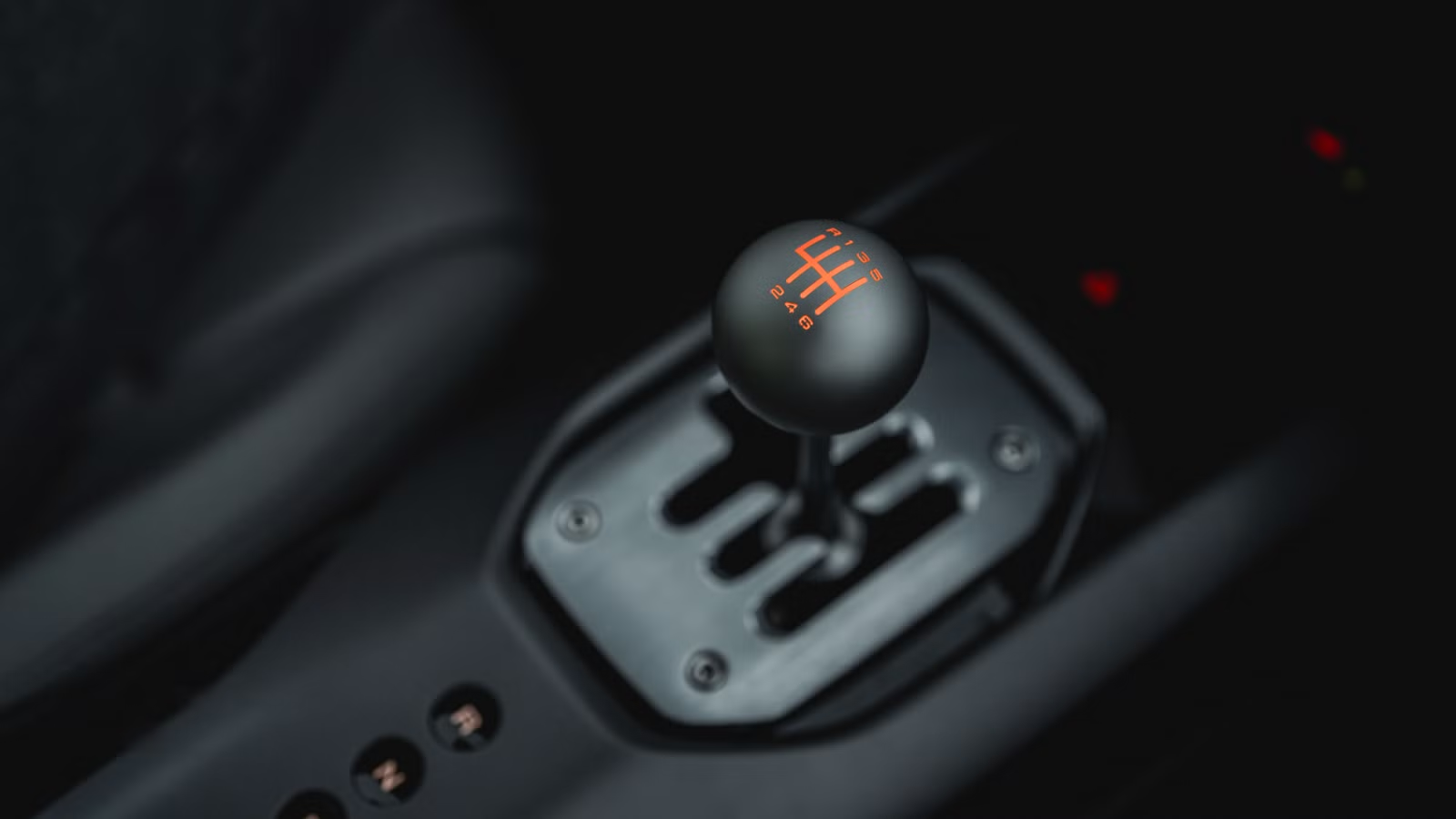
Many driving purists hate the demise of the stick shift and at Ferrari level that disappearance feels almost sacrilegious. Buyers had already come to terms with the fact that Maranello was abandoning the traditional manual until Ferrari suddenly put a gated shifter and clutch pedal back into a V12 grand tourer.
This limited-production model, the 12Cilindri Manuale, costs a great deal more than the regular coupe, but the catch is that it still doesn’t have a conventional manual transmission. Instead, it features an elaborately engineered six-speed interface that fits over the car’s existing eight-speed dual-clutch transmission.
Ferrari Customers Wanted A Manual But Ferrari Had Moved On
Ferrari 12Cilindri ManualeFerrari
Reports suggest that the 12Cilindri Manuale costs approximately $675,000, which is roughly a $217,000 premium over the regular coupe. The vehicle features a signature gear lever and clutch pedal that don’t actually connect to the gearbox at all, even though they feel mechanical to the driver. Instead, sensors interpret the driver’s movements, before software and actuators deal with the dual-clutch transmission underneath.
At the engine level, the V12 represents a deliberate celebration of traditional Ferrari hardware. It’s a 6.5-liter naturally aspirated V12, turning out 819 hp and 500 lb-ft of torque, and the engine can spin up to 9,500 rpm. It doesn’t need a turbocharger or fancy hybrid motor to help it move along, and it represents a continuation of the company’s front-mid-engine V12 lineage. However, the eight-speed dual-clutch transmission (DCT) definitely belongs in the modern era.
This DCT can change ratios far more quickly than a driver can when using a clutch pedal and conventional gear lever. It also supports the launch, emissions, stability, and powertrain management strategies that buyers have come to expect from a modern-day Ferrari. The company’s chief product development officer, Gianmaria Fulgenzi, felt that you couldn’t beat the combination of both hands on the steering wheel and paddle shifting, but customers were still begging for a manual anyway.
In the end, Ferrari listened to the purists, but instead of retrieving an old six-speed transmission or working on a stronger replacement, it took an entirely new and innovative approach. This resulted in the Manuale By-Wire system, which reproduces the physical rituals of a gated Ferrari while still using the DCT transmission as an integral part of the car. The company re-created the driver-facing mechanics of manuals by studying older manual models (like the 599 GTB Fiorano), even though the powertrain-facing mechanics were still those of a DCT.
The Clutch And Shifter Are Mechanical Until The Signals Leave Them
Ferrari 12Cilindri ManualeFerrari
At the center of this trick technology is a polished metal H-pattern gate that has six forward ratios and one reverse. It has a lever featuring a machined steel fulcrum, while a spring and roller bearing arrangement deals with every movement. Ferrari has even been able to reproduce the metallic sound of the lever striking the gate to make the entire combination feel as analog as possible. The clutch pedal features about 4.3 in. of travel with a biting point simulation around halfway through the movement. The operating effort ranges between 22 and 33 lbs. of force, which is similar to the weight of the clutch in the old manual 599 GTB.
What happens beneath the surface is more remarkable though, as once the driver’s movements are out of the way, position sensors take over. These report the driver’s input, and the control system translates these inputs into commands for the eight-speed DCT. When the driver presses the clutch below 62 mph, this switches the car into manual mode. This illuminates the gear position markings while changing the instrument graphics.
Notably, Ferrari has intentionally programmed imperfections into the system as well. This allows a driver to perform heel-and-toe downshifts and rev the V12 engine before releasing the clutch if they want to. A badly coordinated start generates a jerky launch or can even stall the engine, but software will intervene if poor driving etiquette could become expensive.
The system will not allow a driver to request a ratio that would overstress the engine, as they won’t be able to actually push the lever into that errant position. And the end result is a heavy mixture of both theater and substance. The driver can act as if the car had a conventional stick shift setup and the system will generate those familiar sensations. However, there’s no conventional pedal-controlled single clutch, and no mechanical linkage to connect the H-pattern lever to the transmission.
A 500 Lb-Ft Ferrari Manual Would Have Been Physically Difficult, But Not Impossible
Ferrari 12Cilindri Manuale exterior – side viewFerrari
Many may wonder why Ferrari did not simply work on a conventional six-speed for this car. Apparently, the company reckons that such a setup wouldn’t be able to deal with the V12’s combination of 819 hp and 500 lb-ft of torque. However, other cars may contradict that finding, and transmission manufacturer Tremec does have versions of its TR-6060 family rated as much as 650 lb-ft.
Production cars like the Dodge Viper seem to combine manual gearboxes with torque outputs north of that 500 lb-ft figure as well, so torque capacity alone doesn’t necessarily rule out a suitable manual transmission. Still, Ferrari did have a broader challenge to consider. It needed a transmission that could deal with a front-mid-engine, rear-mounted transaxle setup. The end solution also had to meet the company’s standards for shift quality while operating reliably behind an engine that could turn to 9,500 rpm.
In addition, a conventional six-speed manual setup might well have demanded changes to the floor pan and surrounding vehicle structure. All things considered, Ferrari probably didn’t think that a clean-sheet manual approach would be an appropriate engineering investment for just 1,499 cars. With the Manual By-Wire system, designers could keep an already-validated DCT and still give customers some of the controls that they craved.
Six Manual Ratios Can’t Completely Match The High-Speed Automatic Ones
Ferrari 12Cilindri ManualeFerrari
Push the manual all the way to its limits and drivers may find that there are still limitations, as those controls will only affect the first six ratios of the eight-speed DCT. The first six ratios suit the V12’s high-revving character and can reportedly help the car to reach 186 mph. But if drivers want to see what happens with seventh and eighth gear, they’ll need to select automatic mode. They can either choose to operate six ratios through the gate or flick the appropriate switch and let the transmission control all eight.
As far as acceleration goes, the V12 features the same impressive headline performance figures as the standard car, with 0-62 mph in 2.9 seconds and 0-124 mph in less than 7.9 seconds. However, the company doesn’t show separate acceleration times for a driver who is shifting through the gate.
Meanwhile, the underlying DCT works closely with the electronic character of the V12. The company has installed its Aspirated Torque Shaping System that modifies the torque curve in third and fourth gears to give the perception of progressive acceleration. It’s all part of Ferrari’s approach to modern performance through coordinated software systems.
The Price Buys Exclusivity As Much As A Simulated Gear Shift
Ferrari 12Cilindri Manuale Fender BadgeFerrari
It seems hard to justify the approximately $217,000 cost of this gated system, especially when that’s virtually the cost of an entire Porsche 911 GT3. When you remember that the Porsche still offers an actual six-speed manual transmission for those who want it, the comparison makes the Ferrari’s value proposition look quite absurd.
Apparently the 12-cylinder manual is only 11 lbs. heavier than the standard car, at a minimum dry weight of 3,450 lbs. And some would interpret that as a significant six-figure investment for what is essentially a shifter, a third pedal, some sensors, and sophisticated software. But Ferrari is presenting the Manuale as a limited-production special. The company will only produce 1,499 examples, with each car passing through the company’s tailor-made personalization program. Each one will have dedicated badging, forged wheel choices, exclusive finishes, and special trim possibilities and this level of exclusivity may help to explain its cost.
Certainly, the interface is the car’s defining feature. But buyers will also be paying for scarcity, development costs, customization, and access to a special series and that means that the car is almost sure to attain collectible status.
In the end, the Ferrari 12Cilindri Manuale is not a conventional manual, but it doesn’t represent a cheap simulation either. The Manuale By-Wire system is expensive and carefully engineered, and it does restore a significant part of the physical involvement without destroying any modern electronic architecture. While paying more than a $200K premium for such a system may seem hard to justify, Ferrari is unlikely to have much difficulty in finding its buyers. Don’t be surprised if they are lining up to pay mad money for such rarity, personalization, and a very new kind of driving theater.
Sources: Ferrari, Tremec.
