

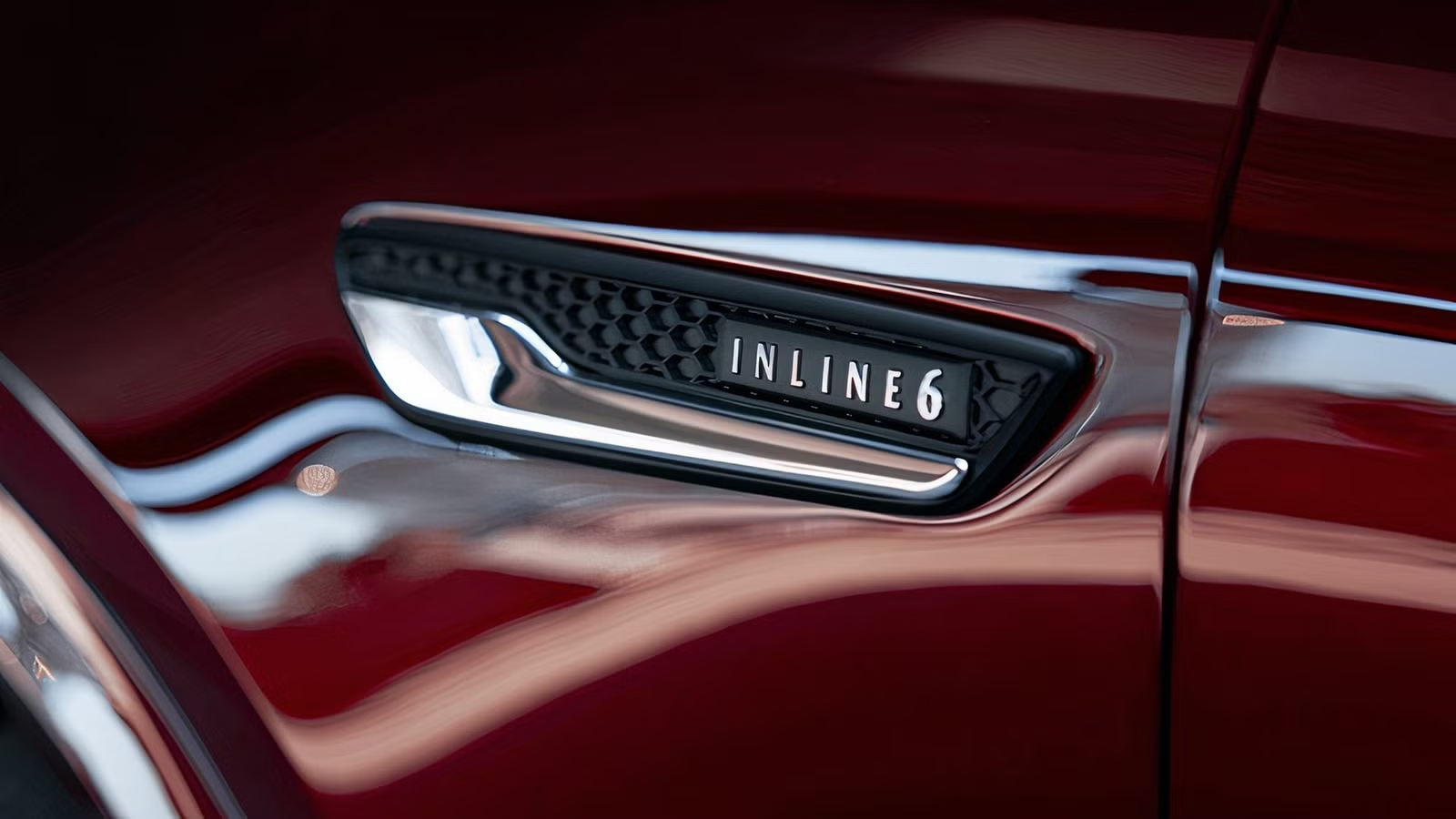
The Mazda CX-90 was a big deal for the Japanese automaker when it launched, and not just because of the SUV’s physical size. Mazda gave it the brand’s first new rear-drive platform since the fourth-generation MX-5 Miata launched. Mazda also gave it an inline-six, an engine mostly associated with luxury brands. In the United States, this six-cylinder runs on gas, but it has a cousin overseas that burns diesel. Let’s see how they stack up, and whether America is missing out.
What SUVs Have These Engines
2025 Mazda CX-70 Black Front Angled View DrivingMazda
Mazda only sells the gas-powered version of the straight-six in North America and Australia. At the moment, it only comes in two models, the CX-90 and the CX-70. They’re the largest models on Mazda’s modern rear-drive platform, and are nearly identical. The only major difference between them is that the CX-90 has three rows of seats, while the CX-70 has just two. Also, the CX-70 has slightly different bumper cover designs.
The diesel version of the engine is found in the CX-60 and the CX-80. These models are available in various markets outside the US, including Japan and Europe. It also appears in the CX-70 and CX-90 in Australia. The CX-60 is the smallest of the group with the shortest length and wheelbase. It was actually the very first model to use the shared platform and engines. Later, Mazda introduced the CX-80, which is larger than the CX-60, but not as big as the CX-90. Mazda did manage to squeeze in a third row of seats, so it fills the CX-90’s role for the rest of the world. In both of these SUVs, the diesel is the only six-cylinder option.
What The Engines Have In Common
Mazda CX-60 from the sideMazda
The basics of both six-cylinder engines are shockingly similar. The displacement of each is identical at 3,283 cc, or 3.3 liters. Mazda reached that displacement with the same bore and stroke, too, with an 86-mm bore and a 94.2-mm stroke. The cylinder head and block on each are made of aluminum, with the head featuring twin camshafts. Each has a single turbocharger hanging off the exhaust side, and they both are available with a small electric assist motor bolted to the back. That single motor makes 16.6 horsepower at 900 rpm, and 113 pound-feet of torque at 200 rpm.
The Diesel Details
Mazda CX-80 from the front three-quarter angleMazda
If you’re like most of our readers, you’re probably in the US, or at least North America, and you’re probably less familiar with Mazda’s diesel, so let’s start with what makes it unique. Although it has the same displacement, Mazda gave the diesel a higher compression ratio of 15.2:1. It doesn’t rev as high, either, with a redline of 5,000 rpm. These details are also the same across the three versions, two of which have the hybrid motor, and the other doesn’t.
The base version of the engine is the low-output hybrid offered in Europe. It makes just 197 hp and 332 lb-ft of torque across wide portions of the power band. The horsepower tops out from 3,600 rpm to 4,200 rpm, and the torque from 1,400 to 3,000 rpm. Additionally, the CX-60 with this engine is rated for an impressive 46 miles per gallon in combined driving according to the European NEDC test cycle.
Mazda Skyactiv-D diesel six-cylinder in a studioMazda
Surprisingly, the non-hybrid diesel, which is the base engine for the Japanese CX-60 and CX-80, falls between the two hybrid versions. Peak power is 228 hp, and it’s made over a slightly smaller part of the rev band, from 4,000 to 4,200 rpm. Torque covers nearly the same rpm spread from 1,500 to 3,000, but it’s turned up to 369 lb-ft. On the WLTP test cycle, this diesel is rated for 38 mpg in the city and 52 mpg on the highway with rear-wheel drive. All-wheel drive drops those numbers to 36 mpg in the city and 48 mpg on the highway.
Finally, we come to the high-output hybrid diesel. It’s the only diesel offered in the European CX-80, and it’s an option on the CX-60 and Japanese CX-80. It also appears in the Australian-market CX-70 and CX-90. It makes 251 hp, though just at 3,750 rpm. Torque breaks the 400 lb-ft mark at 406, and the engine makes it from 1,500 to 2,400 rpm. It does take a slight hit in fuel economy. The CX-60 on the NEDC cycle gets between 44 and 45 mpg combined. The CX-80 gets between 41 and 42 mpg combined.
The Goods On The Gas Engine
2024 Mazda CX-90 Maroon Front Angle Driving on HighwayMazda
Since the gas-powered version of Mazda’s straight-six doesn’t have to rely on compression to ignite its fuel, it has a notably lower compression ratio of 12:1. It’s higher revving, too, with the gas engine’s redline at 6,500 rpm. Those specifications are the same between the standard- and high-output variants.
One other specification shared between the two engines is, bizarrely, the fuel economy. All CX-90s and CX-70s return 25 mpg combined. Most get 23 mpg in the city and 28 mpg on the highway, but the CX-70 somehow manages 24 mpg in the city. While these numbers are on par with other similar-sized gas-powered SUVs in America, they’re far less efficient than the diesels.
Cutaway image of the Mazda Skyactiv-G gas straight-sixMazda
Getting into the differences, we start with the standard-output engine, which makes 280 hp and is only offered in North America. That’s more than any of the diesel engines, though it also makes that power much higher in the rev band from 5,000 to 6,000 rpm. Torque also matches that of the low-output hybrid diesel at 332 lb-ft. The peak spans a fairly wide and low section of the rev band from 2,000 to 3,500 rpm.
The high-output gas engine is the output champ of all of these. It makes 340 hp at the same 5,000 to 6,000 rpm range as the low-output engine. It’s the most-powerful engine ever put into a production, road-going Mazda. Torque is up, too, though not by as much at 369 lb-ft. It makes that for much more of the rev band, though, from 2,000 to 4,500 rpm. The engine only makes these exact numbers when running on premium fuel (91 octane or higher). It will run on regular 87-octane gas, but horsepower drops to 319 hp from 5,500 to 6,000 rpm. Peak torque remains the same, but it’s only made from 2,000 to 3,500 rpm.
If You Want The Best Of Both Worlds, You Need Fewer Cylinders
2024 Mazda CX-90 PHEV 2.5L NA PY-VPH I4 EngineCarbuzz
While we sometimes complain about the US not getting the best engine options, that’s not necessarily the case when it comes to these straight-six engines. The gas versions are dramatically more powerful than their diesel counterparts, and they provide just as much torque. When judged solely on performance, the American gas engines are clearly superior. Of course, if you want efficiency, it’s impossible to argue the diesels overseas are better by bounds, and still provide plenty of grunt.
The most fascinating part of all of this, though, is that there is a powertrain option that, on paper, provides the best aspects of each of these engines, and actually outperforms them. It’s the plug-in hybrid, naturally-aspirated four-cylinder, which is available on every vehicle we’ve mentioned. The 2.5-liter engine itself isn’t hugely powerful, making 189 hp and 192 lb-ft of torque on premium fuel, or 185 hp and 184 lb-ft on regular fuel. However, it’s paired with an electric motor that has a similar output at 173 hp and 199 lb-ft of torque. Together, the powertrain makes 323 hp and 369 lb-ft of torque on premium fuel (319 hp on regular fuel). The numbers make it the second-most powerful option, with just as much torque as the top-spec six-cylinder engines.
However, the electric motor isn’t there just for performance, but also for economy. While both the CX-90 and CX-70 have the same battery capacity at 0.33 kWh, the former has a fully electric range of 27 miles, and the latter has a range of 32 miles. With a fully charged battery, the CX-90 is rated for 56 mpg-e in combined driving, and the CX-70 manages 61. Both of those numbers handily outperform those from the diesels, and none of the diesels can go short distances with no fuel use. Of course, the hybrid benefits only come into play if the owner plugs in to charge the battery. On a drained battery, each only gets 26 mpg in combined driving, an improvement of just 1 mpg over the six-cylinder engines.
Source: Mazda
