

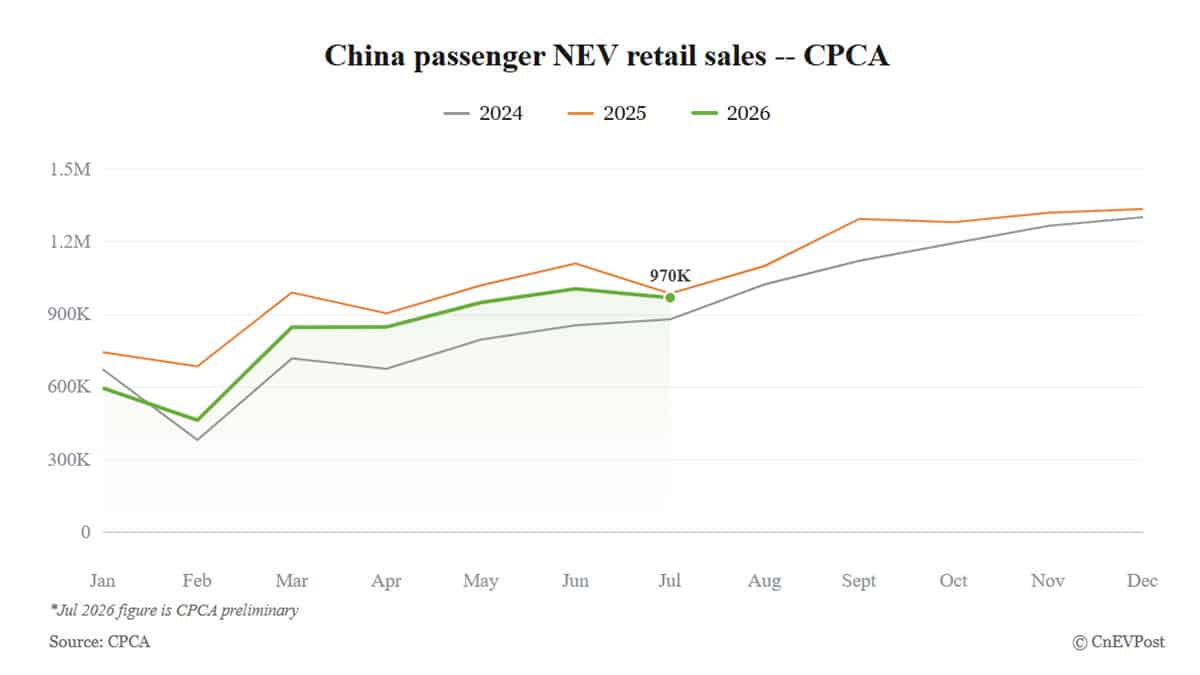
China NEV Monthly Sales (CPCA) 2024-2026
Month
2024
2025
2026
January
673,536
744,052
596,000
February
381,626
686,000
464,000
March
718,498
991,000
848,000
April
675,484
905,000
849,000
May
796,811
1,021,000
950,000
June
856,354
1,111,000
1,007,000
July
881,021
987,000
970,000
August
1,024,848
1,101,000
September
1,122,467
1,296,000
October
1,195,018
1,282,000
November
1,266,990
1,321,000
December
1,302,599
1,337,000
China passenger NEV retail sales — CPCA
2024
2025
2026
*Jul 2026 figure is CPCA preliminary
Source: CPCA
© CnEVPost
- NEV retail penetration rose to a record high of 64.4% as sales decline narrows.
- Overall passenger vehicle retail sales fell 18%, as demand for gasoline vehicles continued to collapse.
Retail sales of passenger new energy vehicles (NEVs) in China totaled 970,000 units in July, down 2% year-on-year and down 4% from June, according to preliminary data released Wednesday by the China Passenger Car Association (CPCA).
It marked the seventh consecutive month of year-on-year declines, though the contraction was significantly smaller than the 9.4% drop recorded in June.
China’s cumulative NEV retail sales reached 5.675 million units in the first 7 months of the year, down 12% year-on-year.
Wholesale sales of NEVs by Chinese automakers totaled 1.463 million units in July, up 24% year-on-year but down 1% from June. Cumulative wholesale sales reached 8.251 million units in the first 7 months, an increase of 8%.
Penetration reached another record high. The preliminary data indicate that NEVs accounted for 64.4% of China’s passenger vehicle retail sales in July, up from 62.8% in June and above the previous record of 62.9% set in May. NEV wholesale penetration stood at 65.3%.
Conventional gasoline vehicles continued to decline sharply. China produced 422,000 gasoline-powered light vehicles in July, down 54% year-on-year and down 13% from the same period in June.
China’s total passenger-vehicle retail sales stood at 1.506 million units in July, down 18% year-on-year and 6% from June. Cumulative retail sales reached 10.207 million units in the first 7 months, a decline of 20%.
During the first week of July, from July 1 to July 5, average daily passenger-vehicle retail sales in China were 33,894 units, down 15% year-on-year but up 4% from the same period in June.
In the second week, from July 6 to July 12, average daily retail sales were 39,045 units, down 16% year-on-year and 4% from the same period in June.
In the third week, from July 13 to July 19, average daily retail sales were 46,719 units, down 18% year-on-year and 9% from the same period in June.
In the fourth week, from July 20 to July 26, average daily retail sales were 50,454 units, down 23% year-on-year and 28% from the same period in June.
In the fifth week, from July 27 to July 31, average daily retail sales were 76,565 units, down 15% year-on-year and flat from the same period in June.
Passenger vehicle wholesale sales totaled 2.241 million units in July, up 1% year-on-year but down 5% from June. Cumulative wholesale sales reached 14.788 million units in the first 7 months, down 5%.
From July 1 to July 5, average daily passenger vehicle wholesale sales were 25,238 units, down 35% year-on-year and 13% from the same period in June.
From July 6 to July 12, average daily wholesale sales were 36,035 units, down 20% year-on-year and 19% from the same period in June.
From July 13 to July 19, average daily wholesale sales were 52,539 units, down 6% year-on-year and 12% from the same period in June.
From July 20 to July 26, average daily wholesale sales were 60,703 units, down 19% year-on-year and 52% from the same period in June.
From July 27 to July 31, average daily wholesale sales were 213,955 units, up 35% year-on-year and 42% from the same period in June.
July is traditionally a slow season for the auto market, with overall consumer demand remaining weak, the CPCA said. The World Cup and midsummer heat sharply reduced showroom traffic, while the absence of holiday-related spending provided little support.
The price war in the first half of the year also brought forward some demand. Consumers became increasingly inclined to postpone purchases, further suppressing retail transactions, the CPCA said.
Weak retail demand spread to dealership channels. Slower inventory turnover increased pressure on dealers, prompting them to reduce vehicle orders from automakers.
NEVs showed significantly greater resilience than gasoline vehicles in July, supported by product upgrades, policy incentives and stronger value for money, with the slowdown in their growth less pronounced than in June, the CPCA said.
Exports remained robust and continued to provide important support for wholesale volumes, according to the association.
CPCA estimates China’s July NEV wholesales at about 1.47 million units, with year-on-year growth hitting its highest level so far in 2026.
