

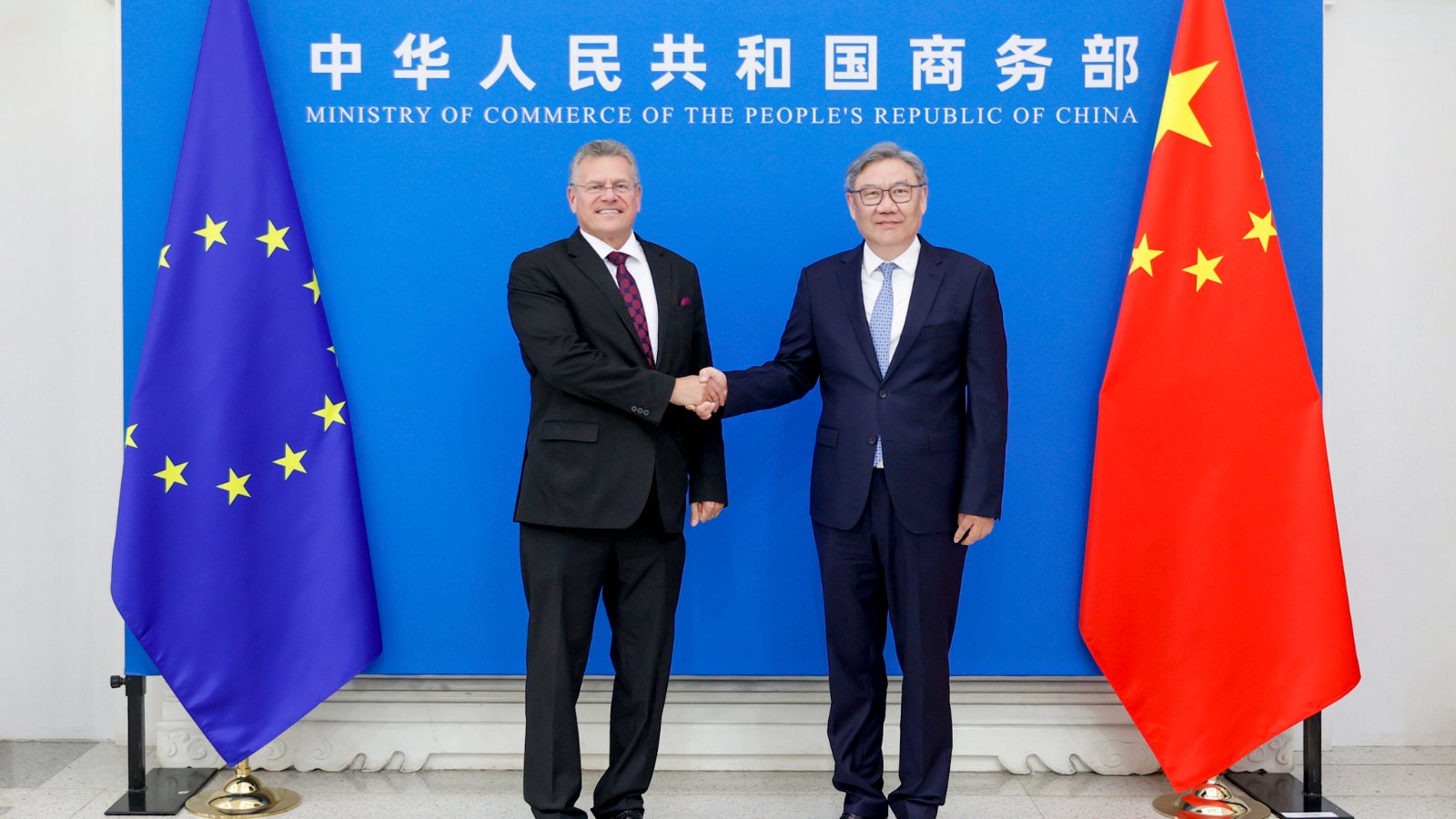
EU Trade and Economic Security Commissioner Maros Sefcovic, left, and Chinese Commerce Minister Wang Wentao co-chair the second meeting of the China-EU trade and investment consultation mechanism in Beijing. Credit: China’s Ministry of Commerce.
- China said the understanding complies with WTO rules; the EU trade commissioner said it includes halving hybrid vehicle exports to the bloc.
- Both sides will continue procedures for company price undertakings and reviews in the EU’s anti-subsidy case involving Chinese EVs.
China and the European Union reached an understanding on hybrid vehicle trade, marking progress in negotiations as the bloc seeks to curb imports, though details of how it will be implemented remain unclear.
The understanding followed intensive consultations and complies with World Trade Organization (WTO) rules, China’s Ministry of Commerce said in a statement released on Friday, without disclosing specific terms.
Chinese Commerce Minister Wang Wentao and EU Trade and Economic Security Commissioner Maros Sefcovic held 2 days of talks in Beijing on October 8 and 9.
Chinese and EU officials attend the second meeting of the China-EU trade and investment consultation mechanism in Beijing, held on October 8-9, 2026. Credit: China’s Ministry of Commerce.
Sefcovic said on social media platform X on Friday that the shared understanding includes halving China’s exports of hybrid electric vehicles (HEVs) and plug-in hybrid electric vehicles (PHEVs) to the EU.
He also cited improved access to China’s market for EU companies and further easing of rare earth export licensing, describing the progress as a “first step.”
However, the post did not specify a baseline, implementation timetable or mechanism for halving exports. The statement released by China did not mention the scale of the reduction.
EU-CN trade needs real rebalancing. With Minister Wang Wentao we’ve reached a shared understanding to:
🔹halve HEV, PHEV exports
🔹improve access to China’s market
🔹further ease rare earths export licensing.
A first step. I welcome the genuine engagement. We reconvene by Jan. https://t.co/SiKiZYLC8N
— Maroš Šefčovič🇪🇺 (@MarosSefcovic) October 9, 2026
Before the understanding was reached, the EU had been considering using hybrid vehicles as a starting point for addressing its trade imbalance with China, raising the risk of a broader automotive trade dispute.
The Financial Times reported on September 17 that the EU was asking China to voluntarily limit hybrid vehicle exports to its market or potentially face higher tariffs.
China’s commerce ministry responded on September 18 that so-called voluntary export restraints seriously violate WTO rules, and that any solution between China and the EU must comply with those rules and their respective domestic laws.
On October 7, Bloomberg reported, citing people familiar with the matter, that the European Commission was preparing safeguard measures targeting Chinese hybrid vehicles, potentially using tariff-rate quotas to limit imports.
Hybrids have become a new focus of the automotive trade dispute. The EU imposed definitive countervailing duties on China-made battery electric vehicles (BEVs) in October 2024, while hybrids were excluded from the measures.
The additional duties set at the time ranged from 7.8% to 35.3%. Combined with the existing 10% standard import tariff, the maximum total rate reached 45.3%.
EU imports of hybrid vehicles from China rose from 3,800 units in October 2024 to 50,000 in July 2026, while average prices declined over the same period, according to the Financial Times’ September report.
The talks also left room for further negotiations over the BEV trade dispute. Both sides will continue procedures related to company price undertakings and reviews in the EV anti-subsidy case, according to the statement released by China.
They will also explore the possibility of lowering tariffs on certain goods within the WTO framework, though the statement did not identify the products or the size of any potential reductions.
On export controls affecting automotive supply chains, China said it was willing to continue facilitating export license approvals for rare earths and permanent magnets destined for the EU through a “green channel” mechanism.
Both sides plan to hold a ministerial video conference in January 2027, followed by the third meeting of the China-EU trade and investment consultation mechanism in March to advance follow-up work.
The EU links treatment of British goods to closer trade policy alignment and suggests London join its customs union.
