

Cadillac is one of the oldest and most famous automotive brands in the United States. A part of General Motors, this marque has a history that spans over a century and has produced countless models, including some that became iconic over the decades. The Eldorado, for example, became a symbol of mid-century America thanks to its instantly recognizable silhouette with huge rear fender fins.
Cadillac’s golden age, however, eventually fizzled out and gave way to a more difficult period for the brand. In the late 1980s, one of the company’s attempts at picking itself back up involved collaborating with Italian designers. However, the project produced an unsuccessful model, which was discontinued a few years later. We’re talking about the Allante, a luxury convertible grand tourer that drew inspiration from European cars of the era. Let’s take a look back at this obscure Cadillac and its fascinating history.
The Cadillac Allante: A Stylish But Unlucky Pininfarina Creation
1993 Cadillac Allante Top Down Beige Front Angled ViewBring A Trailer/AarieVann
1987 Cadillac Allante
Engine
4.1-liter V8
Horsepower
170 hp
Torque
235 lb-ft
0-60
~10 seconds
Top Speed
124 mph
The Cadillac Allante is a model from a curious chapter in the brand’s history. Only on the market for seven years, it launched for the 1987 model year. Despite wearing a Cadillac badge, it was actually designed by legendary Italian firm Pininfarina. On paper, this stylish grand tourer should have been a successful combination of Italian style and American luxury.
In real life, however, things played out quite differently. The model had a very small production run of just over 21,000 units, and was quietly killed off after 1993. Today, average folks are unlikely to have heard of it, much less have seen one in person.
Pininfarina’s input gave a distinctly European character to the Allante, a luxury convertible with an angular but elegant silhouette. All early models came with a removable aluminum hardtop panel that allowed for extended closed-roof driving, in addition to the fabric, folding top. Later in the production run, the hardtop became an optional add-on.
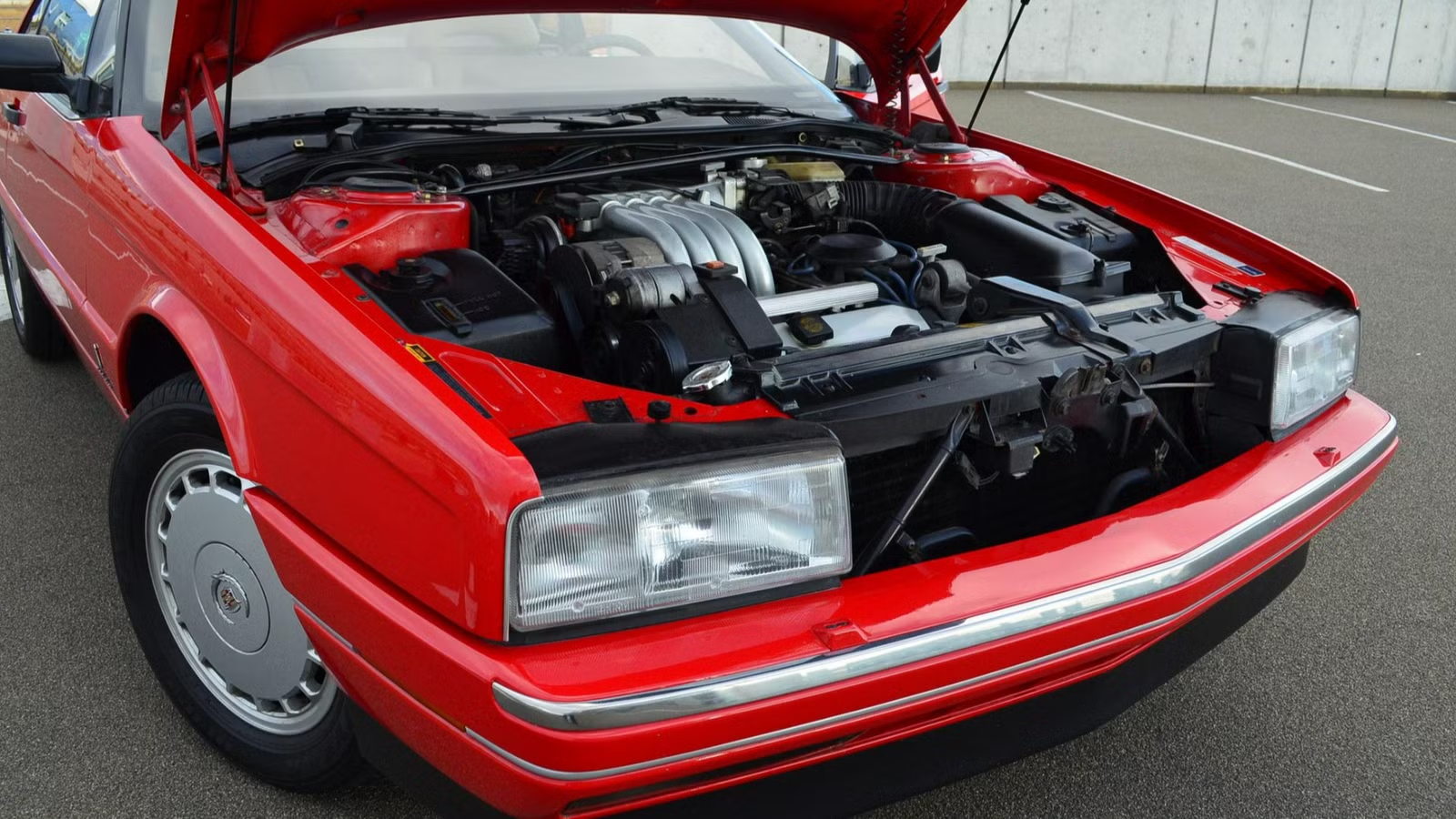
Under the hood, the Allante was very American. Three engine options were offered throughout the model’s lifespan, all of them V8s. At launch, there was a 4.1-liter unit that produced 170 horsepower and 235 pound-feet of torque. In 1989, a 4.5-liter V8 making 200 hp and 270 lb-ft replaced the earlier unit. Then, during the Allante’s final model year, 1993, it received the 4.6-liter Northstar V8 with 295 hp and 290 lb-ft.
In terms of transmission, the Allante was equipped with two different four-speed automatic units over the course of its life.
1993 Cadillac Allante RearBring A Trailer/AarieVann
The interior was extremely high-end for its time, with heaps of tech on board that drew inspiration from fighter jets. The model was equipped with a digital dashboard and a built-in computer with a diagnostic system. The layout of the cabin resembled that of a cockpit, with the center stack oriented towards the driver. The car had powered leather seats, powered windows and locks, a premium sound system developed with input from Bose, and an AM/FM/car phone antenna.
The Allante’s Origins And Unique Manufacturing Process
Bring A Trailer
The Allante traces its origins back to the evolution of the American automotive market throughout the 1970s. Cars became smaller in the wake of the 1973 oil crisis, and European brands increasingly encroached on the territory of well-established American marques, such as Cadillac. Rather than fighting consumers’ growing interest in European models, Cadillac adopted the “if you can’t beat them, join them” philosophy, striking a deal with Pininfarina to collaborate.
The Italian coachbuilder had a strong reputation for creating visually appealing models that were quintessentially European in appearance. The idea was to create a European-style grand tourer with a dash of Cadillac luxury, a car that would appeal to American drivers’ evolving tastes.
19989 Cadillac Allante finished in black and whiteCadillac
The launch of the project did not come without backlash. Cadillac’s own designers were unhappy at the prospect of Pininfarina taking over their duties; the idea of a car built without their input being sold under the Cadillac name caused a stir. However, General Manager Bob Burger settled employee unrest by stating that although the new car would be branded as a Cadillac, it would be purely a matter of marketing, with the Cadillac name used to give consumers a familiar, trusted logo.
By the mid-1980s, work had begun on what would become the Allante. In a rather futuristic move for the time, the new model’s Italy-evoking name was chosen from among 1,700 other options by a computer program. The manufacturing process was similarly space-age. The body of the Allante, along with a few components, underwent the first part of its assembly at Pininfarina’s own facilities in Italy. Then a fleet of Boeing 747s, fitted with custom mounts that securely held unfinished bodies, transported the partially assembled cars to Detroit, where Cadillac completed the process.
Unfortunately, the complex production routine made the Allante extremely expensive. When launched, it was the most expensive model in the company’s lineup. An Allante cost around $54,000, or around $158,000 today. The second most expensive Cadillac, the Fleetwood 75 Limousine, was nearly $20,000 cheaper. Along with the Allante’s unusual character as a vehicle, the massive price tag put off would-be buyers and helped accelerate the model’s demise.
Related
The Cheap Turbocharged Five-Cylinder Sports Car You Can Legally Import To The USA
The story of a sleek, little-known Fiat sports car, the Coupe.
The Allante’s Evolution Across Its Production Run
1993 Cadillac Allante EngineBring A Trailer/AarieVann
Despite not being on sale for very long, the Allante still underwent several changes throughout its time on the market. Although a digital instrument cluster, fairly ahead of its time, was the default option, in 1988 customers were also given the choice of analog instruments. The following year, GM added an anti-theft system dubbed the Pass Key, which device automatically made the starter and fuel system inoperable if someone attempted to use the wrong ignition key.
In 1990, there were minor changes to the interior layout, and an airbag was added on the driver’s side. The following year, the Bose sound system was upgraded, and a power-latching mechanism for the convertible top was introduced.
1990 Cadillac Allante finished in red with tan interiorCars & Bids
Despite being the model’s last year, 1993 brought about a major change in the form of the Northstar V8, the third and last engine to power the Allante. This year also saw the end of the Bose sound system and cheaper seats, in a doomed effort to bring the car’s price down and make it more appealing to consumers.
Related
What Does ‘Grand Touring’ Actually Look Like In 2026?
Just because a car calls itself a GT does that make it a grand tourer?
The Decline Of The Grand Tourer In America And Beyond
Front quarter shot of a Cadillac AllantéBring A Trailer
As the 1980s rolled into the ’90s, Cadillac began planning a second generation of the Allante. After a short while, however, these plans were abandoned when the model was discontinued. The chief reason was poor sales: although Cadillac had originally envisioned a production run of around 6,000 to 8,000 units a year, a total of just 21,430 Allantes were built over the model’s entire seven-year lifespan.
Today, the Allante has not become a sought-after rarity with the passage of time, but has instead faded into obscurity. Despite there being so few around, you can buy one for as little as $15,000, with the upper end of the price range hovering around $30,000.
The Allante’s demise came about as part of a wider decline in popularity for the grand tourer. Once popular during the mid-century period, this type of luxury cruiser has since become much rarer, confined to a few models within the realm of high-end cars. This is especially true in North America, where grand tourers occupy a fraction of their former place on the market.
1990 Cadillac Allante finished in red with tan interiorCars & Bids
Consumers’ quest for practicality pushed them away from two-door cars and, eventually, from cars altogether as SUVs and crossovers became more popular. While grand tourers had once been popular among celebrities and the wealthy, even that cohort drifted away from them. Today, you are far more likely to see an actor or a footballer driving a high-performance SUV than a grand tourer. Luxury SUVs now offer many of the features people once looked for in grand tourers: the combination of sports car-like performance and practicality.
The popularity of grand tourers in America was a fairly brief blip, and even in Europe, where they lasted a little longer, they have become a rare sight today. The Allante was an attempt to capture an automotive phenomenon that was already beginning to fade at the time. Today, this rare model remains a testament to a unique collaboration across the Atlantic.
Sources: Cadillac, Hemmings, Car And Classic
