

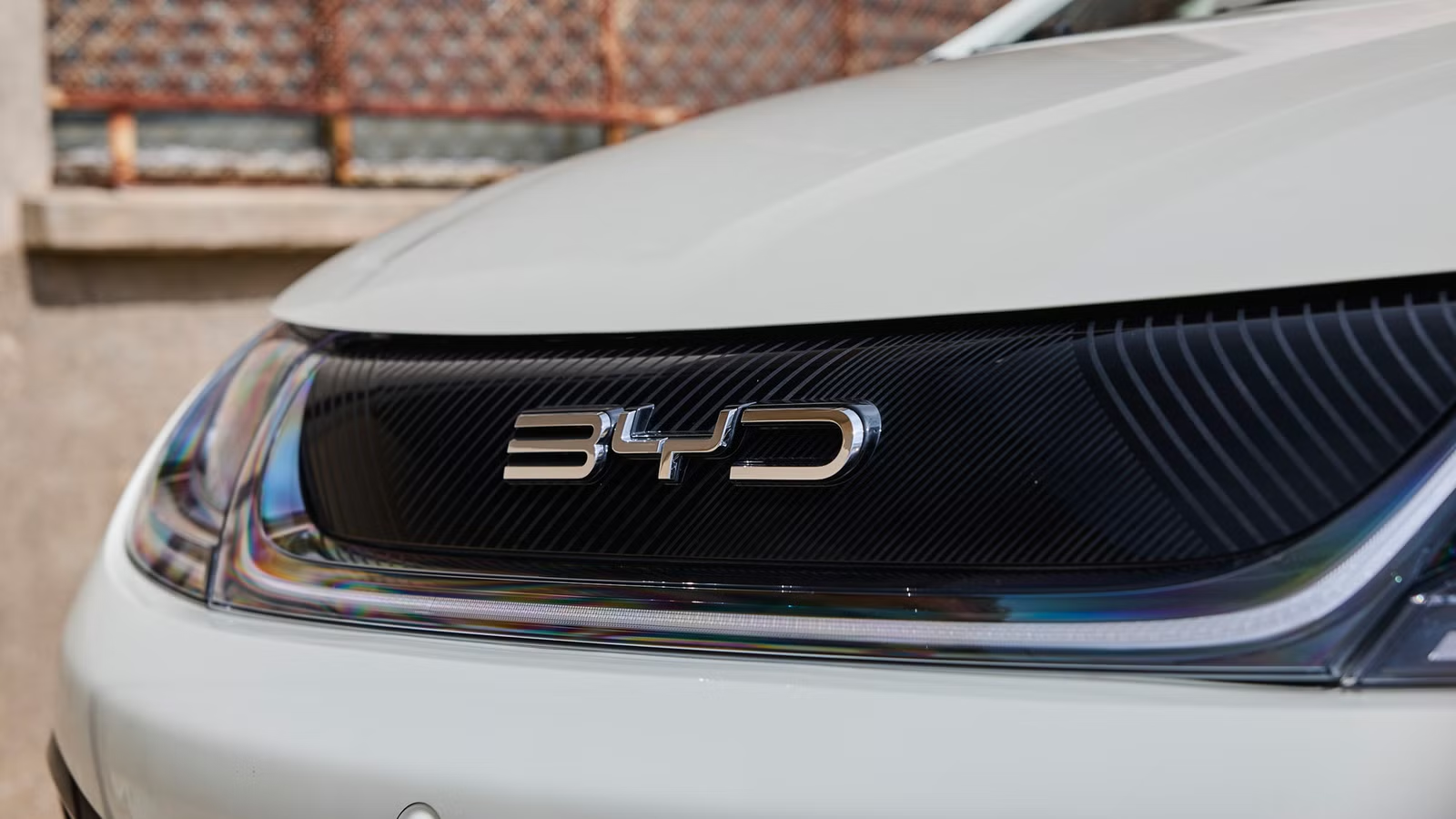
American administrations are intent on keeping the Chinese auto industry at arm’s length. Politicians impose punitive tariffs and other rules to prevent companies like BYD from setting up US showrooms and offering $20,000 electric hatchbacks with warranties and finance deals. But BYD is still pressing around the edges of the North American market through Mexican plant plans and commercial activity in Canada.
It has an overseas manufacturing playbook partly designed to soften the impact of tariffs, and its clear goal is continued international expansion. US automakers currently have tariff protection and can lean on dealer networks and established brand loyalty, but the pressure is building. And what the US auto industry may not have on its side is an unlimited amount of time.
Detroit May Be Watching The Wrong Starting Line
2026 Ford Mustang Mach-E California SpecialFord
Across much of the US auto industry, the EV fight involves familiar opponents. Legacy rivals are trying to make their electric vehicles profitable while worrying about union labor costs or battery supplies. And they’re clearly fighting with sector-leading Tesla, which has become the benchmark for charging, software, pricing, and public perception.
But a larger enemy may be emerging outside America, and the Chinese auto industry has come on in leaps and bounds to reach the forefront of technology. Chinese OEMs produce vehicles to much higher levels of quality these days, leading even the CEO of Ford, Jim Farley, to describe the achievements of Chinese automakers as “the most humbling thing I’ve ever seen.”
Ford itself has shown a significant decrease in the number of vehicles it sells worldwide. In 2016, its wholesale number was about 6.65 million, but by 2025 it had shrunk to 4.40 million. While Ford may have been purposefully focusing on North America as part of that international retreat, the reduction in Detroit’s global footprint isn’t timely. It comes at the same time as Chinese OEMs become more ambitious abroad.
In 2025, BYD sold more than 4.5 million passenger vehicles and as it grows, its impact may start to shape the broader picture. And BYD’s bolder decisions could eventually reshape prices, supply chains, and consumer expectations within America.
The Mexican Fortress Is Real, But A New Plant May Be A Work In Progress
2026 BYD Dolphin Mini EVBYD
2026 BYD Dolphin Mini EV (Mexican market)
Motor
Front-mounted electric motor
Transmission
Single-speed EV reduction gear
Drivetrain
Front-wheel drive
Power
74 hp
Torque
100 lb-ft
In 2024, BYD executives confirmed the company was looking for a Mexican production site, potentially in the center of the country. If this came to fruition, BYD would focus on an initial capacity of around 150,000 vehicles per year, with a possible second phase of another 150,000. Still, there has been controversy around these plans, with one report suggesting that Mexican federal officials backed off on incentives under pressure from Washington. If the brand-new plant does not come to fruition, BYD may have another option. It’s reportedly one of the finalists to buy the Nissan Mercedes-Benz Compas plant in Aguascalientes, Mexico.
New plant or not, BYD already sells vehicles like the Dolphin Mini EV, the Song Pro DM-i, the Sealion 7 EV, the Atto 8, and the Shark DMO plug-in hybrid pickup in Mexico. The latter vehicle was especially symbolic for BYD because it showed the company’s confidence in introducing a product with obvious appeal in truck-friendly markets. So, BYD may not actually need a US presence to start showing North American buyers, regulators, dealers, and competitors what it could hypothetically offer.
Canada Shows How Quickly A Wall Can Become A Door
2026 BYD Seagull MiniBYD
Canada represents the second piece of the North American pressure map. Here, BYD opened a 45,000 sq ft electric bus assembly facility in Newmarket, Ontario, to provide electric buses for major city transit operators, including Toronto. While that’s clearly different from selling Dolphins or Atto 3s to private Canadians, the facility still represented a physical industrial footprint in North America.
Meanwhile, the Canadian government has been making its own efforts to keep Chinese-built EVs in check, imposing a 100% surtax in 2024. But Ottawa announced an import quota that would allow 49,000 EVs to come in from China per year at a 6.1% most-favored-nation tariff rate. Some people think that represents the beginning of a dam break, but it remains to be seen how common BYD vehicles become on Canadian roads. However, crucially, BYD can now see that tariff policies may be flexible, and that should represent a warning for Detroit.
100% US Tariffs Buy Time, Not Safety
BYD Han all-electric sedan.BYD
The American administration’s Section 301 tariff increase pushed the US duty on Chinese EVs up to 100% before any ordinary tariff treatment comes into the picture. Even for a company as efficient and ambitious as BYD, that makes its Chinese-built passenger vehicles deeply uncompetitive. But is such tariff protection just protecting an inefficient US industrial base?
Those tariffs can surely prevent a low-cost rival from breaking into the market, but tariffs can’t make that local market more efficient or cost-effective. Tariffs can’t lower a domestic automaker’s bill of materials, fix software execution, or speed up vehicle development and, importantly, those tariffs do nothing to make a $45,000 EV feel affordable in a tight nationwide market.
Other rules make the situation more complex, such as the US-Mexico-Canada Agreement. Vehicles that a company assembles in Mexico may receive favorable treatment in the US so long as they meet demanding labor value and regional content rules. But those rules may have a high bar, and even established North American automakers can sometimes struggle to meet relevant thresholds.
Another law covers the issue of “substantial transformation,” where if a company assembles a vehicle in one country, that can sometimes change the official origin of the product. In this light, Washington officials are keeping a close eye on BYD’s potential Mexican investment. The US government could yet modify the rules to try to ensure that Mexico does not, in essence, become a backdoor for Chinese brands to avoid tariffs. In the meantime, BYD continues to explore its options, working out how to localize assembly, route around trade frictions and use nearby markets to build regional familiarity in the US marketplace.
The Segments Detroit Can Least Afford To Expose
2024 – 2026 Chevrolet Equinox EV 1st Gen SUV rear 3/4 angle in blueChevrolet
If BYD were to ever try and reach US consumers directly, it would probably start at the lower end of the market. The company seems astute at creating affordable EV hatchbacks, budget sedans, and compact crossovers, to potentially compete in the entry-level family transportation market for sub-$30,000 cars. Take BYD’s Mexican range as an example – the company launched its Dolphin Mini in Mexico at the equivalent of about $21,000, and it also offered an EV city car package around its e-platform 3.0 and Blade battery. That gives an indication of what could happen should the company ever break into the US.
Related
This Could Be How North America Gets Budget Chinese EVs
Canada may be ready to lift tariffs on Chinese-made EVs as China’s retaliatory measures begin to bite.
Across Mexico’s northern border, the affordable EV landscape remains quite thin. Buyers can choose a 2026 Nissan Leaf from $29,990 before destination, the returning Chevrolet Bolt from $27,600, or the Equinox EV at $34,995. Those vehicles represent the affordable EV field in the US, while Detroit’s most visible EV programs seem to lean more heavily towards trucks, larger SUVs, or premium crossovers. Those are the vehicle types that can more easily absorb battery and broader development costs.
Meanwhile, BYD comes at the problem from a different direction, as it’s not trying to make a high-margin electric pickup work first before focusing on cheaper vehicles. Instead, it appears to know how to build affordable battery-electric and plug-in hybrid vehicles at a huge scale. And if it is somehow able to break through those tariff pressures, Detroit’s softest segment could become BYD’s easiest opening.
Detroit’s Countermeasures Still Miss the Mark
BYD facility and signBYD
Detroit may have some weapons in its arsenal should a BYD threat materialize. It could roll out incentives, offer lease deals, strip out trims, or make more software promises, but such reactions may not solve the underlying problem. BYD appears to have an advantage that goes far beyond low market prices. It is adept at producing vehicles at scale with strong manufacturing discipline and a clever product cadence. It has also proved that it can adequately serve the low-cost end of the market with its serious engineering approach.
The US has had to deal with overseas automotive invaders before, but those challenges felt different. Korean and Japanese automakers broke into the US by proving quality, value, and durability over a lengthy period, and in an era where tariffs were not anywhere near as stringent. Today, BYD may apply pressure indirectly, especially as a much stronger presence in Mexico could change regional expectations.
Related
Tariffs Could Bring Tesla’s Biggest Rival To America’s Doorstep
While the tariffs are supposed to protect American interests, they could give the Chinese an entry into North America.
A more open Canada should now give Chinese EV-makers the ability to test their case on the North American continent. And such aggressive growth patterns give BYD more scale as it breaks into new markets, learns how to adapt to local rules, and further improves its capabilities.
The most dangerous version of a potential US arrival for BYD may not be some kind of dramatic launch event. Instead, it could be a gradual squeeze where the company builds familiarity in Mexico and takes advantage of a controlled import pathway into Canada. It may be able to reduce exposure with overseas production facilities while quietly educating US buyers about what really affordable, high-quality EVs should be.
Certainly, Detroit has time on its side, but it needs to use that time shrewdly. There’s nothing to say that tariff policies will convert from a temporary shield into a permanent advantage, and US automakers should act now. They need to focus on genuinely affordable EVs and hybrids through shorter development cycles while crafting cleaner software and making supply chains more efficient. After all, the real threat is not that BYD is somehow here, but that it’s close enough to make persistent inefficiencies feel very expensive indeed.
Sources: BYD, Ford, Nissan, Chevrolet, Canadian government, US trade representative.
