

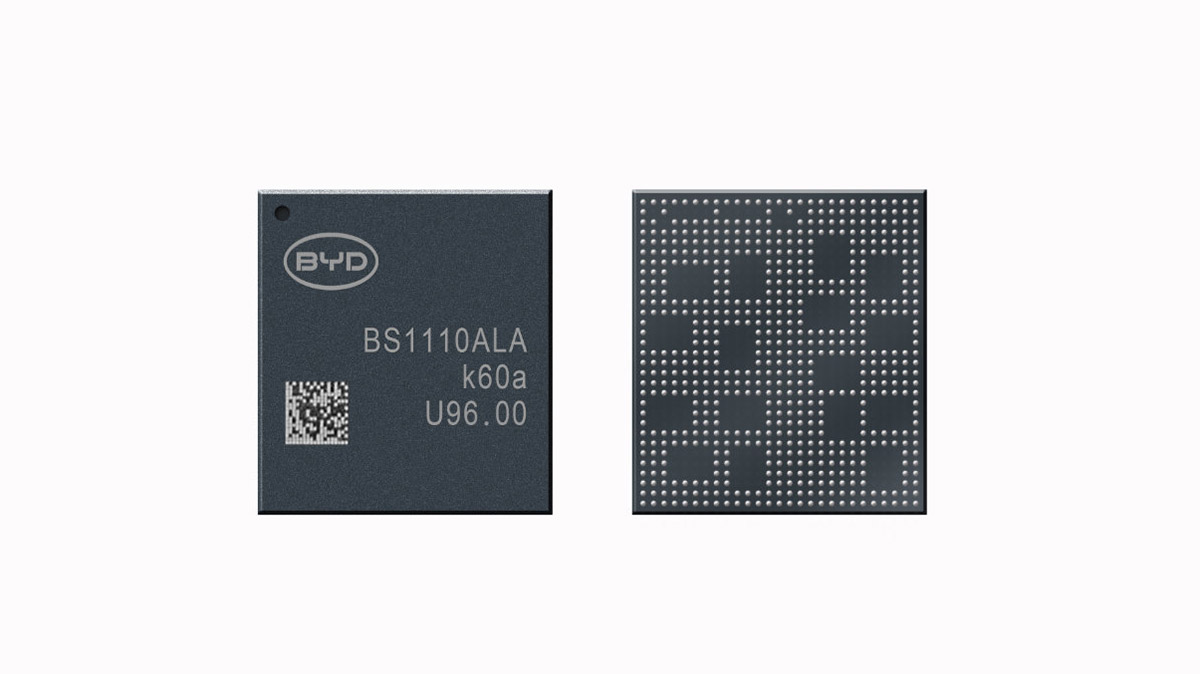
BYD’s next-generation 4D millimeter-wave radar chip, which has entered mass production. Credit: BYD
- The chip uses BYD’s Xuanji A3 smart-driving chip as its computing hub and can support Level 2 through Level 4 driving systems.
- BYD said the 4D millimeter-wave radar chip has a detection range of more than 400 meters.
BYD Semiconductor, a unit of BYD (HKEX: 1211), has begun mass production of its next-generation 4D millimeter-wave radar chip, further deepening the automaker’s vertical integration in smart driving.
The chip uses a satellite architecture centered on BYD’s in-house developed Xuanji A3 smart-driving chip, BYD Semiconductor said on Tuesday.
Conventional millimeter-wave radar lacks elevation-angle data, limiting its ability to handle complex urban road conditions and creating a perception bottleneck for advanced driving systems, according to the company.
The new chip is built on a 28-nanometer automotive-grade process and designed for high-resolution radar systems. It features a high-speed MIPI CSI-2 interface and supports several mainstream serializers/deserializers (SerDes), allowing it to connect with widely used smart-driving chip platforms.
BYD Semiconductor said the chip has completed integration and tuning with the Xuanji A3 and meets the detection-performance requirements of Tier 1 module suppliers.
Solutions built around the chip can support Level 2 through Level 4 smart driving applications, including highway navigation assistance, urban driving, automated parking and blind-spot monitoring, the company said.
The chip enables stable detection at distances of more than 400 meters, horizontal angular resolution of 0.8 degrees and parking-grade range resolution of 0.05 meters, according to BYD Semiconductor.
The single-chip solution integrates 8 transmit channels and 8 receive channels. It is designed to meet the ISO 26262 ASIL B functional-safety standard and AEC-Q100 automotive reliability requirements.
Its operating junction-temperature range spans minus 40 to 150 degrees Celsius, which BYD Semiconductor said is the widest in the industry.
The Xuanji A3, unveiled in May, is China’s first smart-driving chip built on a 4-nanometer process and supports Level 3 and Level 4 autonomous driving.
A single Xuanji A3 delivers more than 700 TOPS of computing power, while 3 working together provide more than 2,100 TOPS, BYD said in May.
Chinese media outlet LatePost previously reported that BYD plans to debut the Xuanji A3 in a mass-produced Denza model in 2027.
BYD’s cumulative research and development investment in semiconductors has exceeded 100 billion yuan ($14.73 billion). The company said in May that its chip research and development team had more than 7,000 members, supported by 4 research and development bases and 5 wafer fabs.
In-house developed chips are becoming a key strategy for Chinese EV makers seeking to build competitive moats in the AI era. Nio Inc (NYSE: NIO), Xpeng (NYSE: XPEV) and Li Auto (NASDAQ: LI) have all deployed their own smart-driving chips in production vehicles.
BYD plans to debut its in-house developed Xuanji A3 chip in a new production vehicle under the Denza brand in 2027.
($1 = 6.7889 yuan)
