

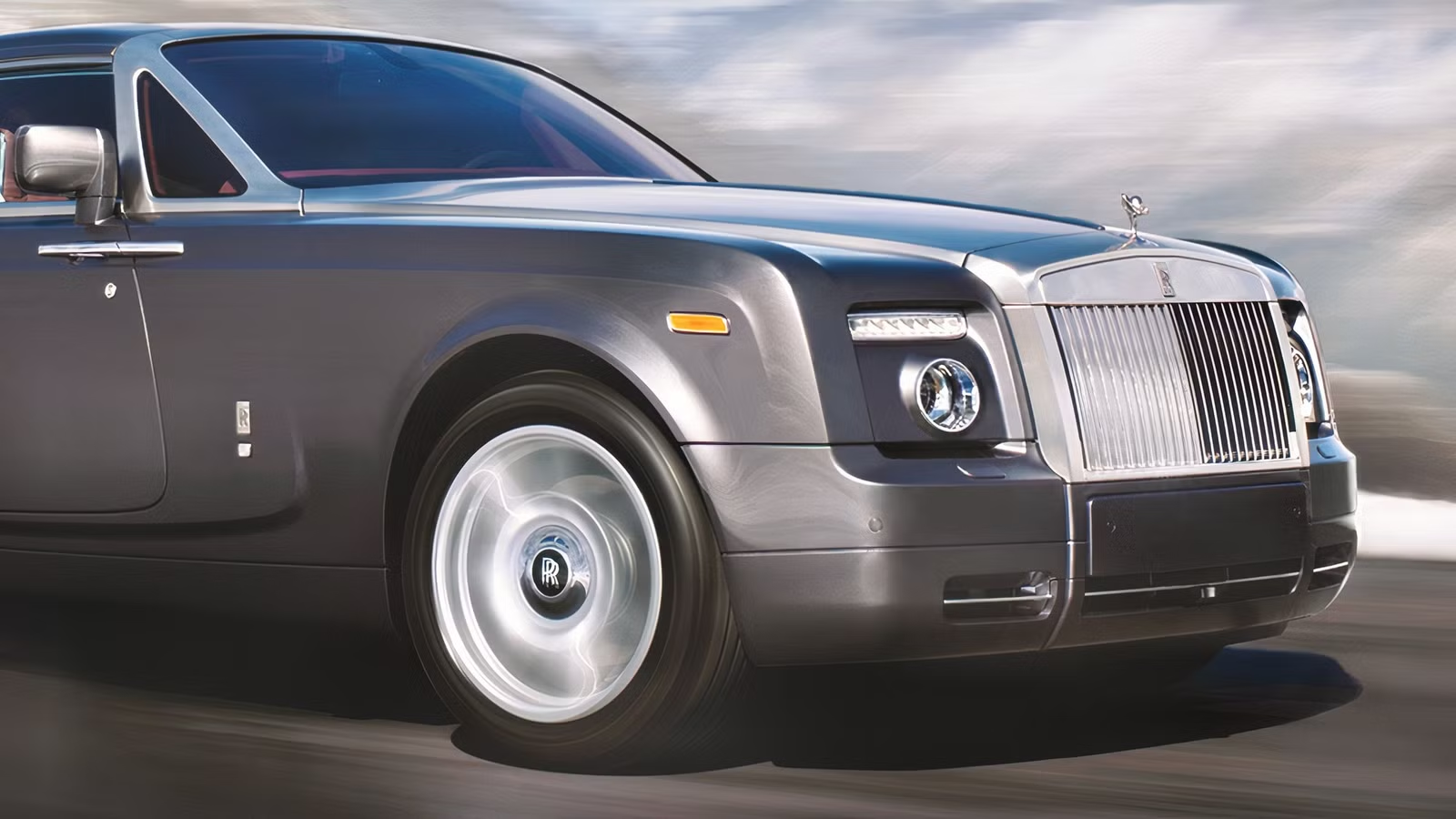
Rolls-Royce is an automaker like no other, and for the most part, it really doesn’t have many direct rivals in the marketplace. Bentley tries, but disperses of a little opulence in favor of some sporting pedigree, and Cadillac’s giving it a go with the Celestiq, but while still focusing primarily on mainstream models with middling degrees of luxury.
While immaculately trimmed cabins and effortless V12 engines deliver much of the appeal in Rolls-Royce models, it’s equally the small details that deliver the expected theater and sense of occasion often demanded by its customers. Details like floating center caps.
A Closer Look At Rolls-Royce’s Floating Center Caps
2004 Rolls-Royce Phantom floating center capRolls-Royce
Rolls-Royce does luxury in every way possible. That means small ways, in addition to big ways. So yes, while the company is famed for producing totally bespoke $30-million-plus builds, it is equally known for ensuring every little detail is finished to the highest of standards. Arguably one of the more iconic displays of subtle luxury associated with the brand is its floating or self-leveling center caps.
These do exactly what the name suggests; they self-level as the car drives, giving the appearance of floating. So, while your chauffeur wafts you from meeting to meeting, and from important dinners to private flights and casino parties, that all-important R-R logo stays upright and legible. It doesn’t improve the ride, performance, or anything tangible like that. It simply looks nice, and shows the engineers at Goodwood haven’t simply finished the wheel as per any other automaker, but that they’ve applied a bit of thought and somehow improved the most basic of details.
It’s that level of detail which separates Rolls-Royce from other premium brands, drawing a clear line in the sand between luxury and ultra-luxury.
A Small Detail That Ushered In The Goodwood Era
2004 Rolls-Royce PhantomRolls-Royce
When Rolls-Royce debuted its floating center cap design, it was a big moment, and not just because the British brand had a shiny new wheel cap to debut. Rather, the moment was important as the year was 2003, and Rolls-Royce was launching its first ever Goodwood-era model, the Phantom VII.
Gone were the staid designs of the 80s and 90s, and ushered in was an imposing, almost brutalist new design which just oozed excellence, and indeed, money. The Phantom wasn’t simply just another new model to thicken the pages of Rolls-Royce’s back-catalog, it signified a completely new era, that of BMW ownership.
2004 Rolls-Royce PhantomRolls-Royce
Since the Phantom VII launched, awfully close to 25 years ago now, every Rolls-Royce model since has proudly worn the self-leveling center caps. It’s a small detail which would likely go unnoticed by so many, but it separates the earlier models from the Goodwood-era cars, the first of which was a Phantom VII delivered at exactly one minute past midnight on January 1st, 2003.
These “new” cars boasted entirely new platforms to their predecessors, and entirely new pricetags too; price tags which would reflect the heightened level of execution. The final sedan model sold prior to the BMW and Goodwood era was the Silver Seraph, a model that boasted a $229,900 MSRP for its final 2002 model year. The Phantom swooped in with a baseline price almost exactly $90,000 higher; a significant increase over what was already a momentously expensive car.
Fast-forward to today, and the Phantom VII is still a decidedly modern and well-equipped car, despite not sporting all the electronic wizardry and fancy technology we think we need to get about, like Apple CarPlay and Android Auto, or cinema-spec touchscreens. It’s also still really quite expensive, considering it is essentially “just” a really posh 7 Series with fancy wheel caps. Expect to pay upwards of $70,000 for a smart, well-maintained example.
The Engineering Behind Self-Levelling Center Caps
2004 Rolls-Royce PhantomRolls-Royce
There is only so much technology that can be squeezed behind a two-inch center cap, so the science behind Rolls-Royce’s floating logos can’t be all that complicated, surely? Correct, it’s really not. Essentially, there is a weighted mechanism that sits within the cap itself, and the cap is mounted in such a way so that it can rotate independently of the wheel. A counterweight then uses gravity to keep the cap in position, thus enabling the Rolls-Royce logo to stay upright while you waft around the more salubrious parts of town.
Not magic, not wizardry, and not a six-figure slice of awesome innovation; just a clever idea, marketed and executed well.
Save $500,000 And Do It Yourself
2004 Rolls-Royce PhantomRolls-Royce
Now that we’ve covered how simple the science behind Rolls-Royce’s floating center caps is, it probably won’t come as a surprise to learn that numerous DIYers have been out and replicated the results on their own rides. In fact, the internet is littered with how-to guides demonstrating how feasible it is to add the feature to a wide range of wheels from a litany of makes and models, and usually, the DIY cost for doing so is in the region of $25.
Other automakers to offer floating wheel caps from the factory include natural and time-tested rival of Rolls-Royce, Bentley, who market them as self-leveling wheel badges. BMW also sells OEM kits, which are at least guaranteed to fit and to be of a consistent quality, but aftermarket sets are plentiful and often far cheaper, too.
Other Details Which Separate Rolls-Royce From The Crowd
2004 Rolls-Royce PhantomRolls-Royce
The floating center caps are a neat feature, no doubt, but other automakers offer them, and enthusiasts have pointed out that the effect can be replicated for less than a round of drinks. Therefore, it’s hardly enough of a spectacle on its own to sell Rolls-Royce cars, and that’s a fact that was true on $320,000 2004 models, let alone today’s $550,000 Phantom VIIIs.
Thankfully, in addition to housing technically brilliant powertrains and sumptuously comfortable interiors, Rolls-Royce cars also play host to other wonderful spectacles. Here are five other ways in which the storied British brand inserts theater and occasion into every model:
Electrically Retracting Spirit Of Ecstasy Hood Emblem
2010 Rolls-Royce GhostRolls-Royce
Rolls-Royce has been protecting its iconic Spirit Of Ecstasy hood emblems for decades now, with spring-loaded retractable emblems first appearing with the Silver Spirit model in the very early 1980s. The electrically retracting emblem arrived alongside the aforementioned fancy center caps on the Phantom VII in 2003, and has been a staple offering on all models ever since.
Integrated Door Umbrella
2010 Rolls-Royce GhostRolls-Royce
Here’s another first for the Phantom VII, and here’s a little spoiler alert for you, we’re not done with Phantom-firsts at the umbrella. While successful in many markets across the globe, Rolls-Royce is first and foremost a British brand, and in Britain, it rains, a lot. No self-respecting Phantom-owner should be caught out in the rain, and neither should they have an old umbrella rolling around in the trunk either.
Thankfully, Rolls-Royce engineered a solution for the forgetful rain-dodging Phantom owner, and worked one into the door shuts of Phantom VII models. Subsequent models have boasted the same feature since, it now having developed into yet another hallmark offering from the brand.
Rear-Hinged Coach Doors
2010 Rolls-Royce GhostRolls-Royce
So far, it might sound as if Rolls-Royce were building nothing special prior to the Phantom VII’s arrival, but that’s far from the case. Rear-hinged coach doors, also popularly known as suicide doors, featured on Rolls-Royce models as far back as 1906. Back then, models such as the Silver Ghost were sold primarily as a rolling chassis, and then buyers would instruct the coachbuilder of their choosing to craft and affix the body.
For decades, rear-hinged coach doors were a popular choice of customers, although the design did fade out of relevancy for quite some time. The model which is largely thanked for repopularizing the feature on modern models was, of course, the Phantom VII.
Starlight Headliner
2009 Rolls-Royce Phantom CoupeRolls-Royce
No prizes for correctly guessing the first Rolls-Royce to boast this glitzy feature from the factory. Interestingly, the history of the starlight headliner begins in 2006, with a customer requesting something bespoke to naturally elevate light levels within the cabin. Such was the response from other owners, that it was soon offered as a factory option.
The constellation of each Starlight Headliner is completely unique to the owner. Typically, it takes nine hours to craft, but a personalized pattern needs its own template, which can take as long as a week to complete. Two Rolls-Royce craftspeople marry their skills to create this extraordinary feature. It’s the perfect alliance of traditional craftsmanship and contemporary technology. – Rolls-Royce
Other automakers and countless DIYers have sought to replicate the starry headliner over the years, to varying degrees of success, but really very few out there manage to execute it quite to the quality that Rolls-Royce manages.
Lambswool Over Rugs
2004 Rolls-Royce PhantomRolls-Royce
Sometimes, the most luxurious feature you can add isn’t an impressive feat of engineering, or a striking visual display. Instead, it might just be a cozy set of rugs. Deep-pile lambswool rugs have been protecting carpets and warming toes for decades in the footwells of Rolls-Royce models, and it still stands as a measure of understanding whether you’re riding in a luxury car, or an ultra-luxury car.
Sources: Rolls-Royce.
