

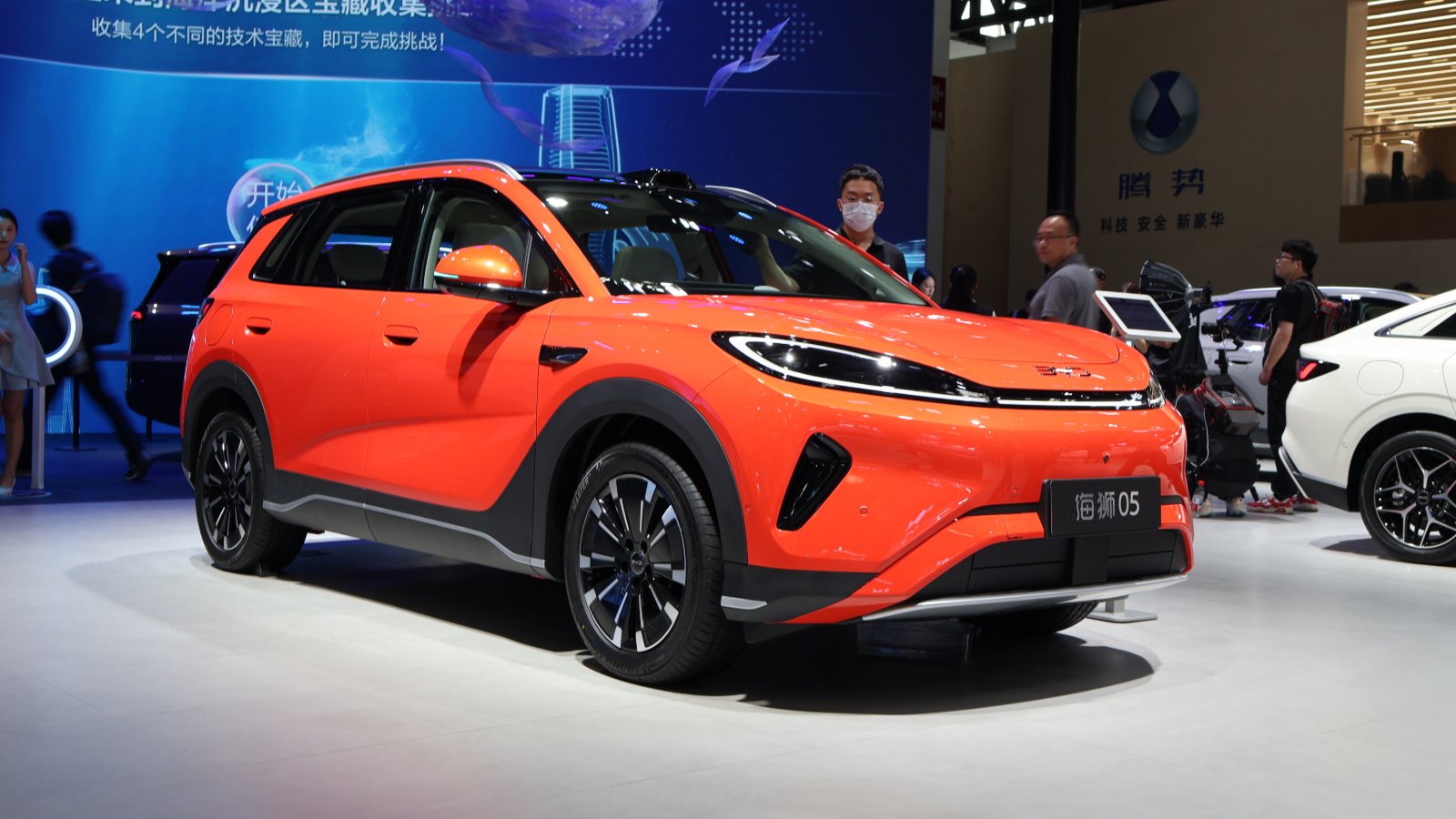
A BYD Sealion 05 on display at the Beijing Auto Show in April 2026. Credit: CnEVPost
- BYD will need 4 European plants over the long term to support its sales targets and comply with EU regulations, its regional adviser said.
- The second assembly site is expected to be chosen by year-end, with a preference for acquiring and refurbishing an existing facility. Spain and France are leading candidates.
BYD (HKEX: 1211) plans to establish 3 vehicle assembly plants and 1 battery factory in Europe over the long term to support local sales growth and meet EU manufacturing requirements.
Alfredo Altavilla, BYD’s European adviser and a former Fiat Chrysler executive, outlined the plans to reporters in Turin late on Wednesday, according to Bloomberg and Reuters.
The expansion will take time, but the factories will ultimately be needed to meet the company’s sales targets while complying with European regulations, Altavilla said.
BYD expects to decide on its second European assembly site by the end of this year, favoring the acquisition and refurbishment of an existing facility over building from scratch, Reuters reported.
Spain and France are among the preferred locations. BYD is also in talks with European automakers and governments about taking over underutilized car factories.
Italy remains a candidate, though it is less likely to be selected for BYD’s second European assembly plant, Altavilla said.
“Italy remains a plan B,” he said. The company is seeking the most competitive conditions, which he hopes to find in Italy but has yet to identify.
Local production is becoming central to BYD’s European expansion. It is starting production at its first European plant in Hungary.
The EU has imposed additional tariffs on China-made battery electric vehicles, while proposed “Made in Europe” rules could push the company to invest further in the region.
Meanwhile, the EU is seeking a negotiated limit on imports of China-made hybrid vehicles and could raise tariffs if no agreement is reached, the Financial Times reported earlier today.
That could extend the trade pressure facing Chinese automakers in Europe from battery electric vehicles to hybrids, underscoring the importance of expanding local manufacturing.
Overseas business is helping BYD offset sales pressure in China. Its overseas sales rose 85.72% year-on-year to 1,162,260 vehicles in the first 8 months of this year, according to data compiled by CnEVPost.
August overseas sales reached a record 189,466 vehicles, up 134.45% from a year earlier and accounting for 43.03% of the company’s monthly total. Those figures cover all overseas markets, rather than Europe alone.
BYD’s management raised its 2026 overseas sales guidance to between 1.9 million and 2 million vehicles and is targeting more than 2.5 million in 2027, Deutsche Bank said in a September 7 research note.
BYD’s overseas revenue exceeded domestic revenue for the first time in the first half of this year. The company is adding overseas production capacity and expanding its sales network to support that shift.
BYD is also bringing Denza to Europe’s luxury car market. Altavilla attended the opening of a Denza showroom in Turin, while the brand opened another in Paris on Wednesday.
BYD management raised this year’s overseas sales guidance to 1.9–2.0 million vehicles as the previously increased target comes within reach.
