

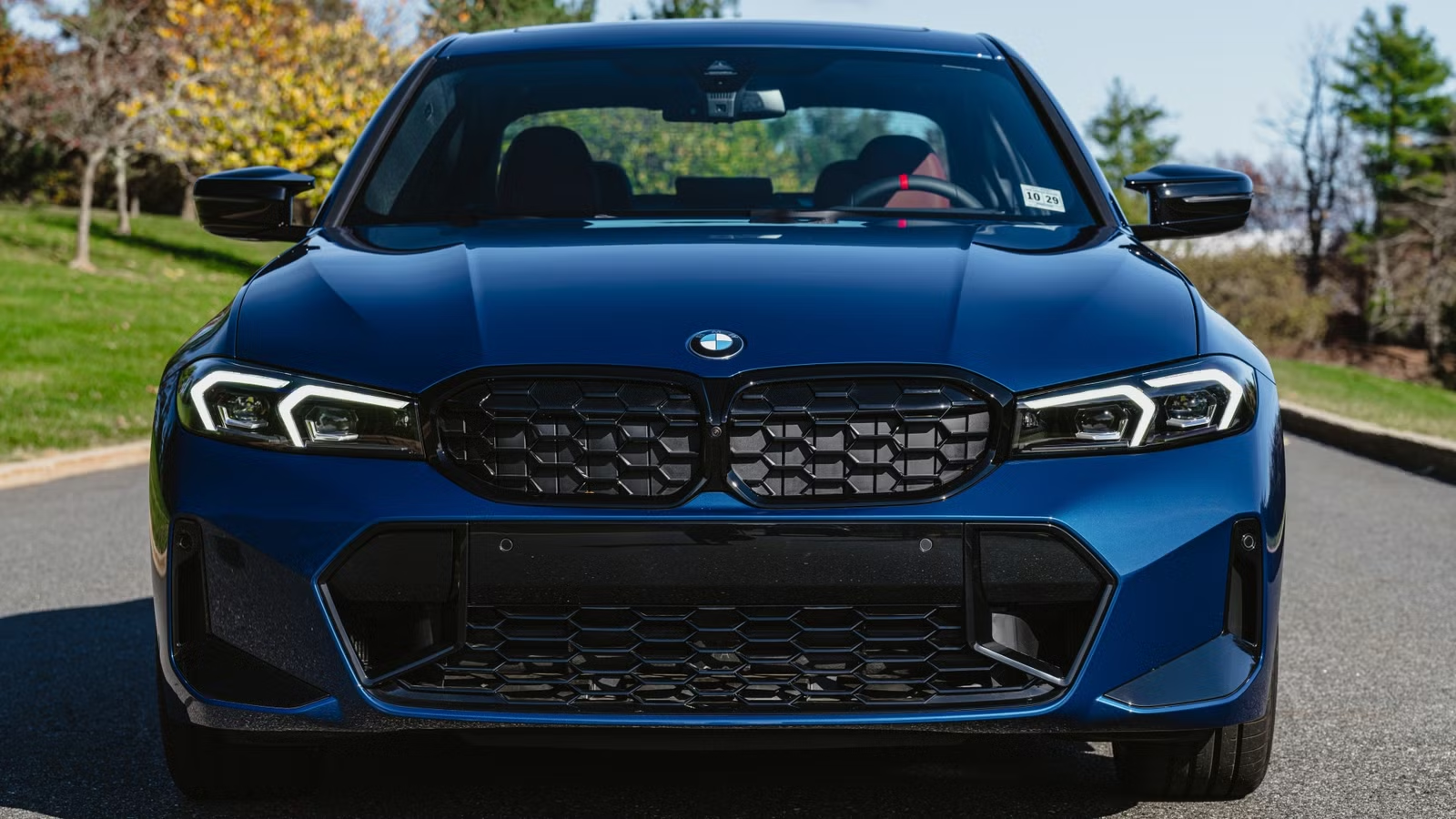
The BMW 3 Series has been the benchmark sporty sedan practically since its inception in 1975. It has dominated its class for decades, delivering a mix of speed, handling, and practicality that is hard to beat. The current M3 and M4 are quick enough to challenge today’s crop of junior supercars, but such is the march of progress that the mid-spec M340i sedan’s performance is now comparable to most supercars from the decade that majored on excess: the 1980s.
Base Trim Engine
2L I4 Hybrid
Base Trim Transmission
8-speed automatic
Base Trim Drivetrain
Rear-Wheel Drive
Base Trim Horsepower
255 HP @4700 RPM
Base Trim Torque
295 lb.-ft. @ 1600 RPM
Base Trim Fuel Economy (city/highway/combined)
28/35/31 MPG
Base Trim Battery Type
Lithium ion (Li-ion)
Infotainment & Features
8 /10
Find 2026 BMW 3 Series Sedan and more cars for sale on our Marketplace
Shop Now
We decided to compare a 2026 BMW M340i to a selection of the fastest and quickest supercars from that decadent decade to see how it measures up. And if you think that the result is an absolute hammering by the four-decade-younger 3 Series, then you may be in for a surprise.
All vehicle data is from reputable sources. Pricing excludes destination charges and tax unless otherwise specified. Most official manufacturer acceleration times for European models are 0–62 mph figures. For these, we have put the prefix “sub” in front of the 0-60 mph sections listed below. We focused solely on production models, so limited-run specials like the Vector W8 or tuner models like the Callaway Corvette were not included.
Your Family Sedan Versus 1980s Supercars
2026 BMW M340i xDrive 50 Jahre EditionBMW
BMW M340i
Engine
3.0-liter turbo inline-six
Power
386 hp
Torque
369 lb-ft
0-60 mph
4.4 seconds
Top Speed
155 mph (limited)
Model Years
2019-present
2026 BMW M340i xDrive 50 Jahre EditionBMW
The G20-generation BMW 3 Series has been around since 2019, yet models like the six-cylinder 340i are still at the top of their class. Producing 386 hp from a 3.0-liter turbocharged inline-six, the base M340i will launch to 60mph in a scant 4.4 seconds. Opt for the all-wheel drive xDrive model, and that figure drops to just 4.1 seconds. A quick-shifting eight-speed automatic transmission allied with standard launch control and explosive power delivery from one of the world’s finest six-cylinder engines allows this family sedan to toast some iconic 1980s supercars off the line.
2025 BMW M340i xDrive Grille TyreBMW
With a $62,300 MSRP, the M340i may not seem like it’s priced like an average family sedan, but that’s not far off the base 255-hp 330i, which starts at $50,000 (the current average price for new cars in the US), and in all-wheel drive form, is still capable of reeling off a 5.4-second 0-60 mph time. Check out the stats, and you’ll see that this puts the 330i very close to some iconic classic machinery. But for this exercise, we want to see how they stack up to the more potent M340i…
2025 BMW M340i xDrive I6 EngineVia: BMW
Ferrari Testarossa
Ferrari Testarossa
Engine
4.9-liter flat-12
Power
385 hp (Euro)
Torque
361 lb-ft
0-60 mph
Sub 5.8 seconds
Top Speed
180 mph
Model Years
1984–1996
Just looking at this side profile shot of the magical Ferrari Testarossa is enough to make you want one. Launched in 1984, it was the first of a new age of modern Ferrari supercars, and tucked in behind the driver was a 4.9-liter flat-12 engine that pushed out a serious 385 hp.
Ferrari TestarossaFerrari
Nothing else that was naturally aspirated (aside from a Lamborghini Countach) came close, and while the 0–62mph time was quoted at 5.8 seconds, some motoring publications managed to get that time down to 5.0 seconds flat. That is still well off the M340i, but still very impressive considering the slow and deliberate changes demanded of Ferrari’s manual shifters at the time.
Find 2024 Ferrari 812 GTS and more cars for sale on our Marketplace
Shop Now
Lamborghini Countach
lamborghini countachlamborghini
Lamborghini Countach QV
Engine
5.2-liter V12
Power
455 hp (Euro)
Torque
369 lb-ft
0-60 mph
Sub 4.8 seconds
Top Speed
185 mph
Model Years
1974-1990
The Lamborghini Countach was often compared to the Testarossa back in the day, but these two cars were not really competing in the same segment. The Testarossa was a luxurious grand tourer with space for your luggage, while the Countach was a much sportier and harder-edged car designed for one thing: speed. It was also released a decade before the Testarossa, which would have made it an unfair comparison had Lamborghini not continuously updated the basic design.
1985 Lamborghini Countach QuattroValvole Exterior Driving On Highway At Dusk Dynamic PhotoLamborghini
By the mid 1980s, the Countach had evolved into a bewinged, 455-hp monster, capable of beating the Testarossa to 60mph by over a second, and topping out at a mad 185 mph. Yet, despite the Lambo’s roaring 5.2-liter V12, the M340i is still quicker, but it’s limited to 155 mph in stock form, so it will eventually have to watch the Countach disappear into the distance.
Porsche 911 Turbo 3.3
Porsche 911 T 3.3
Engine
3.3-liter turbo flat-six
Power
296 hp
Torque
304 lb-ft
0-60 mph
Sub 5.4 seconds
Top Speed
161 mph
Model Years
1975-1989 (incl 930)
Every modern Porsche 911 – aside from the GT3 models – is now turbocharged, but back in the 1980s, only one regular-production model had a turbo: the type 930. Introduced in 1975, the 930 Turbo was renowned for its Ferrari-beating acceleration, as well as a tendency to slide backwards off the road at the slightest provocation. This was because the suspension design stemmed from the 1960s, and early turbocharger technology meant that you had an all-or-nothing power delivery.
1989 Porsche 911 (930) Turbo LECollecting Cars
A move to a larger 3.3-liter engine, the addition of an intercooler, and other detail changes made the updated 911 Turbo 3.3 a more capable machine, but it was still a handful for the uninitiated. Subsequent turbo models were even more powerful, and the introduction of all-wheel drive for the 993-generation Turbo made it even quicker and much safer.
Find 2026 Porsche 911 Turbo and more cars for sale on our Marketplace
Shop Now
Corvette ZR1
Corvette ZR1
Engine
5.7-liter V8
Power
375-405 hp
Torque
370–385 lb-ft
0-60 mph
4.3–4.9 seconds
Top Speed
175 mph
Model Years
1990-1995
American-built supercars weren’t really a thing in the 1980s. We had cars that were supercar-quick, and cars that were supercar-powerful, but it wasn’t until the C4 Corvette ZR1 that we combined it all into something that also looked and handled like a supercar. In fairness, the C4 ZR1 was sold as a 1990 model year car, but it went on sale in 1989, so we have included it here.
1995 Chevrolet Corvette ZR1 finished in red with tan interiorBring A Trailer
The ZR1 was fitted with a 5.7-liter V8, which sounded very similar to what you got in other C4s, but this was no mildly pumped-up variant; rather, it was a completely re-engineered machine with engineering assistance from British automaker Lotus. It helped upgrade the brakes, suspension, and assisted GM in getting big power from the LT5 motor, thanks to mods like quad overhead cams and a multivalve cylinder head design. Official acceleration claims vary, but independent tests showed it could launch to 60mph in as little as 4.5 seconds, making it a very close match for a rear-wheel-drive M340i.
Related
Ranking Every Generation Chevrolet Corvette ZR1 By Top Speed
The ZR1 is the Corvette’s most powerful model, so let’s see how fast every generation can go.
What About The Overachievers?
2025 BMW M340i xDrive Front 3/4BMW
Okay, so in ideal conditions, even a rear-wheel-drive M340i will be at least as quick, if not quicker, than many of the 1980s’ most revered supercars. What about the two supercar overachievers that rewrote what fast meant in that same decade?
Ferrari F40
Ferrari F40
Engine
2.9-liter twin-turbo V8
Power
471 hp
Torque
426 lb-ft
0-60
Sub 4.1 seconds
Top Speed
201 mph
Model Years
1987–1992
The F40 was one of those rare cars that managed to strike the perfect balance between beauty and performance. Released to celebrate Ferrari’s 40th anniversary, it was a development of the 288 GTO, a car that had initially been developed to compete in the Group B racing series. The F40 not only had more power, but it was also even lighter thanks to a racecar-like interior and its Kevlar, aluminum, and carbon-fiber composite bodyshell.
1987 Ferrari F40 Red Front Angled ViewFerrari
Capable of over 200 mph — a first for a production road car — it was also a superb track weapon, capable of turning in lap times that are still impressive today. A well-driven M340i may keep one in its sights for the second or two it takes the F40’s turbos to spool up, but after that, it would be left choking on its tire smoke, wondering what just happened.
Related
Why The Porsche 959 Is One Of The Most Influential Sports Cars Ever
The Porsche 959 was practically a clean slate design, and it set the template for the future of the supercar.
Porsche 959
Porsche 959
Engine
2.85-liter twin-turbo flat-six
Power
444 hp
Torque
369 lb-ft
0-60
Sub 3.7 seconds
Top Speed
197 mph
Model Years
1986–1988
Porsche released the 959 a year before the F40, and for that short period, it claimed the title of the world’s fastest production car. But while the Ferrari F40 may have been a little bit faster, the 959 was in another league in terms of off-the-line acceleration. To achieve its lofty performance capabilities, Porsche chose to employ the latest tech available. The 959’s all-wheel-drive system, twin-turbo powerplant, and complex on-board electronics became the supercar roadmap for future 911s as well as rival manufacturers.
The Porsche 959 was designed to dominate the World Rally Championship’s Group B class, but ended up dominating the Dakar Rally. The road-legal version, launched in 1986, was the fastest production car at the time.Porsche
Also developed with an intention to compete in Group B, the 959 ended up becoming one of the most influential and impressive cars to come out of the 1980s. Not only would this 40-year-old supercar destroy an M340i, but it would take the likes of an M3 Competition xDrive to keep up with it in a straight line.
The Porsche 959 was designed to dominate the World Rally Championship’s Group B class, but ended up dominating the Dakar Rally. The road-legal version, launched in 1986, was the fastest production car at the time.Porsche
And that’s with a manual shifter and no launch control. In truth, this comparison is a compliment to both cars; one for still proving its relevance 40 years on, the other for offering us once unattainable supercar-levels of performance in a four-door family-friendly package.
Sources: BMW, GM, Ferrari, Lamborghini, Porsche
