

In the 1990s, Subaru and Mitsubishi engineers had a particularly challenging job ahead of them as each pressed for advancement after advancement in turbocharged engines for rally-racing performance. Many of those advances came from pushing small, turbocharged engines in cars like the WRX STI and Lancer Evolution harder than ever before, which was risky business.
Without the help of modern-day computing power and design, these highly boosted four-cylinders rode a fine line between maximum performance and fatal meltdown. The situation stems from turbocharged engines facing daunting thermal challenges, especially when owners crank up the boost.
Subaru and Mitsubishi’s presence in rally racing helped establish their brand identities, which helped sell a lot of cars. The period was a heyday of combustion-performance innovation. Companies were perfecting advanced multi-valve engines, turbocharging, all-wheel drive, and new handling technologies like four-wheel steering and adaptive suspension tech. Today, features like these are more common in numerous vehicle segments, though many automakers use motorsports to test and validate these ideas before making them available to mainstream customers.
Early Turbocharging Came With Some Serious Thermal Challenges
Colin McRae is probably best-remembered for his antics in the 555 Subaru Impreza WRX. 1993 Subaru Impreza WRX Rally Car Dirt RacingSubaru
On the surface, turbocharging seems simple enough. Exhaust gases drive a compressor that forces the engine to draw in more air, allowing it to perform like a larger-displacement powerplant. Under the surface, this approach to adding power results in a high-stakes battle against performance-robbing heat that can destroy hardware if left unchecked. Remember that naturally aspirated engines inhale air directly from the outside world at roughly ambient pressure and temperature (perhaps 70 degrees Fahrenheit), while turbocharged engines do not.
Turbochargers themselves are usually positioned in close proximity to the engine’s exhaust manifold (s), which is among the hottest parts of the powerplant. The exhaust gases may enter the turbine housing at 1,500 degrees Fahrenheit. Plus, compressing the fresh air inside a turbocharger heats it considerably, especially during extended runs at wide-open throttle. That’s perfect for warming up some chicken nuggets, but it’s bad news for engine performance, since engines run better when breathing cooler air.
Intercooling Stopped The High-Boost Performance Meltdown
The Mitsubishi Lancer IX Evolution MR is considered by many Evo fans as the greatest of the lot.Mitsubishi
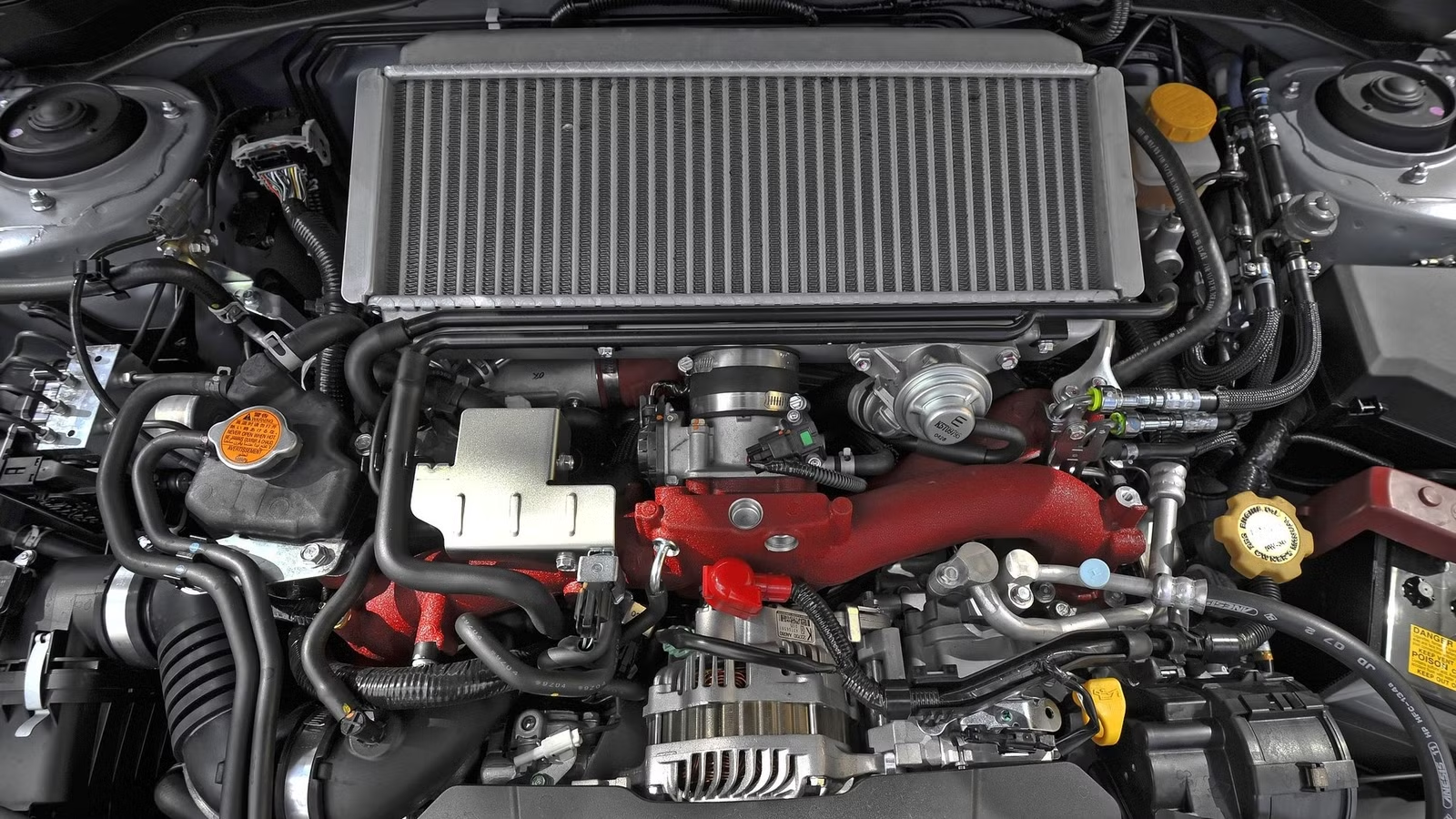
The solution to the temperature problem was to add an intercooler to the turbocharging hardware. Imagine a radiator, but instead of whisking heat away from engine coolant flowing through it, it pulls away heat from the incoming stream of compressed air from the turbo. Some cars have their intercooler in the bumper, like Mitsubishi, and others keep them under a duct mounted on the top of the hood, such as Subaru. In mid- or rear-engine applications like the Toyota MR2, Porsche Boxster, or Porsche 911, intercoolers could be concealed within integrated bodywork ducts, perhaps in the rear quarter panels or the bumper.
Wherever located, intercoolers work the same way. Outside air flows through the intercooler as the car is driving, drawing heat from the hot compressed air as it passes through a series of sealed passageways. This trip through the intercooler lowers the compressed air temperature back toward ambient.
For instance, on a 70-degree Fahrenheit day at wide-open throttle, hot, compressed air might exit the turbocharger and enter the intercooler at 300 degrees Fahrenheit. From there, it exits the intercooler into the engine’s intake manifold, at perhaps 120 degrees Fahrenheit instead.
Here’s the important part: the lower the temperature of the air exiting the intercooler, the harder the engine can be pushed before performance-robbing mitigations against engine knock are required. In simpler terms, if an engineer could get that 120-degree Fahrenheit figure down, even a little, additional performance bandwidth automatically opened up. Today, in 2026, numerous solutions have largely solved this problem, but in the 1990s, engineers had to get creative.
The Solution Was To Soak It
Mitsubishi Lancer Evo 2 Fast 2 Furious ZoomedBonhams
The solution was simple, reliable, and effective: spray the intercooler with water. Air flowing over an intercooler can absorb some heat, but air and water flowing over the intercooler surface can absorb even more. By hooking up a spray jet to an on-board water supply and giving drivers a simple switch to activate the pump, there was now a means of adding extra cooling power directly to the intercooler surface, thereby reducing that 120-degree Fahrenheit figure when things got hottest.
When Mitsubishi debuted the Lancer Evolution III in 1995, it had a 2.0-liter 4G63 turbocharged inline-four making 266 hp and 228 lb-ft of torque. A five-speed manual connected all four wheels. The new front bumper fascia was designed to maximize airflow to a larger front‑mounted intercooler, and the model continued Mitsubishi’s use of an intercooler water spray system to help manage boost temperatures.
Mitsubishi Lancer Evo VII WRC Red Front AngleMitsubishi
In early 2001, Mitsubishi announced the Japanese market launch of the 2001 Lancer Evolution VII, now with the 2.0-liter 4G63 making 276 hp (due to Japan’s gentleman’s agreement) and 282 lb-ft of torque. A five-speed manual and Active Center Differential AWD connected all four wheels. A platform shift and upgraded powerplant were along for the ride, complete with an upgraded intercooler and the latest three-nozzle version of the earlier intercooler spray system.
As boost levels climbed, Mitsubishi refined the system with updated spray hardware and control logic that could automatically activate the jets, allowing the driver to focus on the road.
Meanwhile, Subaru used a top-mounted intercooler for the WRX STi (and other models) that sat directly on top of a scorching hot boxer engine, reducing its ability to intercool in some situations. Specifically, when driving slowly or stopped, heat from the engine could cook the intercooler above, meaning it was piping hot or ‘heat soaked’ when boost arrived.
2011 Subaru Impreza WRX STI hatchback finished in blue white with black interiorSubaru
The Mitsubishi Lancer Evolution didn’t suffer the same problem because its intercooler was mounted low in the front bumper, away from the engine heat. For Subaru, the ability to spray the intercooler surface on demand was particularly beneficial in combating the performance-robbing heat-soak effect.
Subaru built a water-spray intercooler system into their rally racing program, too. In 2005, a press release from Subaru outlined how FIA Group N rules mandated production-class rally cars had to race virtually unmodified from showroom specifications. This was the part of the rally racing world where enthusiasts could watch the very cars they drove in real life compete on the world stage, but manufacturers couldn’t add aftermarket cooling hardware, larger heat exchangers, or intercooler spray systems unless those components were fitted to at least 1,000 street-legal copies.
In this case, the WRX STi Spec C ran the EJ207 2.0-liter turbocharged boxer-four with 276 hp, 311 lb-ft of torque, a 6-speed manual, and AWD. Subaru added a “large water reservoir for the intercooler water spray,” which equipped its Group N rally teams with a 12-liter water tank in the trunk. Now, drivers could spray their intercooler’s cooling fins for minutes on end, mitigating Mitsubishi’s thermal advantage with the front-mount intercooler setup.
Old Tricks For Modern Heat: Why (And How) Porsche And BMW Kept Spraying
2017 Porsche 911 GT2 RSPorsche
By the late 2000s, the intercooler spray era was winding down. In this period, engineers had access to higher-than-ever levels of computational horsepower during the engine design stage, more efficient intercoolers, and a wider rollout of new liquid-cooled intercooler systems that could extract more heat from the incoming hot boost stream. Add in the latest advancements in cylinder head, turbocharger, and exhaust manifold design, and (especially) the rollout of the latest engine management electronics and Gasoline Direct Injection (GDI) technology, and the next wave of turbo engines no longer needed intercooler water spray to manage excess heat.
The addition of GDI technology to modern engines was particularly important here. With it, fuel is sprayed at extreme pressure directly into the combustion chamber. The pressurized fuel expands rapidly, absorbing huge amounts of heat in the process. In this way, GDI engines automatically cooled down the hottest part of the engine, just upstream of the turbocharger, with every spray of fuel. None of this stopped the aftermarket from popularizing various intercooler spray solutions adopted by enthusiasts around the world, who continue to use such systems in a variety of applications to this day.
Even Porsche’s mighty 911 GT2 RS, launched in 2017 with a 700-horsepower 3.8-liter twin-turbo flat six, could soak its intercoolers with dedicated spray jets to keep boost temperatures in check during extended periods of full-throttle acceleration characteristic of motorsport driving.
2016 BMW M4 GTSBMW
Further, BMW adopted a different type of water-spray system for one of the hottest versions of its straight-six turbo engine back in 2016, with the M4 GTS. For this application, the 3.0L S55 twin-turbo inline-six used a special water-injection system to boost output to 493 hp and 442 lb-ft of torque.
It worked a little differently: here, water was sprayed not onto the intercooler but directly into the intake manifold as fine vapor. That water vapor mixed with hot boost, evaporated, and absorbed additional heat along the way. The emitted vapor would pass through the combustion process and exit the tailpipes harmlessly. This more direct means of reducing temperatures within the cylinder head allowed engineers to turn up the boost for more power while reducing thermal strain on the engine and turbocharger.
Whether drenching an aluminum heat exchanger on a dusty rally stage or atomizing water inside an intake manifold at 6,700 RPM, the clever use of plain old water can bridge the gap when air alone simply isn’t enough. Though we don’t see this approach used in the most modern cars on the road, it lives on as a legendary chapter in automotive engineering history, from an era when two rally-racing titans were pushing their engines to the limit. At the same time, an entire generation of customers watched.
Sources: The Ultimate Lancer Evolution Buyer’s Guide, Subaru, Mitsubishi, Calameo
