

Few engine layouts inspire the kind of devotion that the straight-six does. BMW never stopped believing in it, and today the format is enjoying a genuine renaissance — you’ll find inline-six power in everything from the RAM 1500 RHO to the Mazda CX-90 and the Land Rover Discovery. We recently covered the seven manufacturers still producing straight-six engines, but there’s an eighth name worth adding to that list — with one very important caveat. Read on.
The Alvis Car Company
The enthusiast driver’s love of the straight-six engine transcends generations. Below, we’re meeting a “supercar” engine from the 1930s that’s been un-retired after literally sitting in storage for decades. This particular inline-six love affair dates back 90 years to 1936, when the 4.3-liter unit was sold as a performance powerhouse with military durability and incredible smoothness. The powerplant propelled some of the fastest and most innovative British cars of the day.
The Alvis brand ceased operations in 1967, but not before earning a reputation as a design and innovation powerhouse that once marketed cars with slogans like “Ten Years Ahead Of Its Time.” By the time the company closed, it had ignited an early passion for straight-six power among enthusiast drivers, developed many innovations we take for granted today, and even indirectly influenced the original Mini Cooper. Today, the Alvis Continuation models are carrying the brand’s history forward, and a legendary straight-six is the star of the show.
Meet The 4.3-liter Straight Six From 1936
The Alvis Car Company
The Alvis Car Company’s technological achievements in the 1920s and ’30s eventually culminated in a new platform powered by what amounted to a supercar engine by period standards. A massive 4.3-liter straight-six producing 137 hp sat up front, bolted to the world’s only all-synchromesh four-speed manual driving the rear wheels. This rear-drive platform with independent front suspension underpinned some of the fastest and most sophisticated cars of the era.
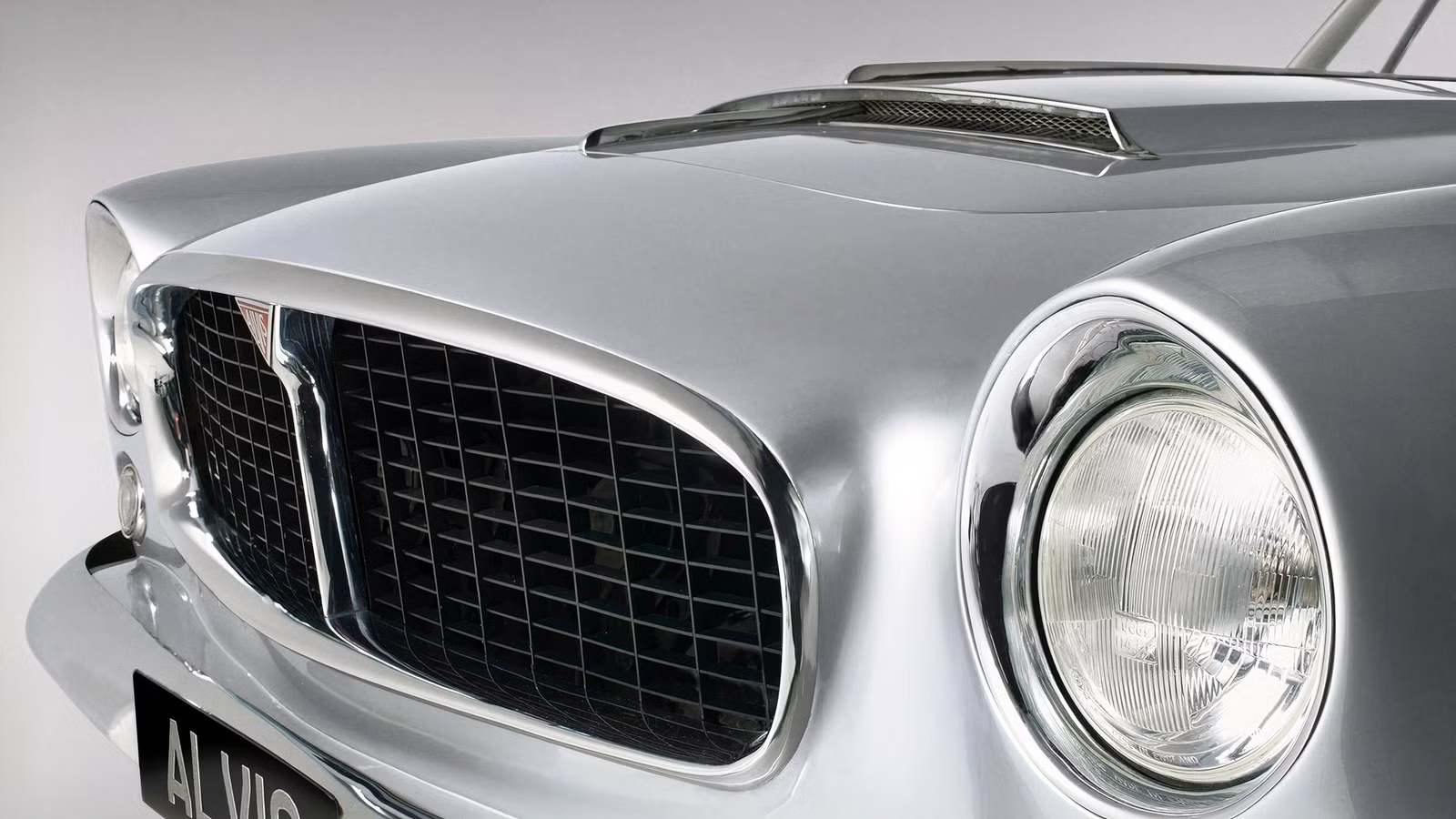
In 2021, the 4.3-liter straight-six was resurrected, along with a smaller 3.0-liter unit, as part of the Continuation Series from Alvis. Currently, the Alvis Graber (below) is the only continuation model to use the 3.0-liter engine. The remaining models — Vanden Plas, Bertelli, Lancefield, and Park Ward — all run the 4.3-liter unit.
Alvis Graber Coupe Continuation CarThe Alvis Car Company
Pickup up where the brand left off in the late 1960s, the Continuation Series cars brought the 4.3-liter straight-six back to life in a resurrection like no other. Rather than fitting a modern engine, the Alvis Continuation cars use original engine blocks and thousands of other parts that had been in storage since the brand’s final days.
Alvis engine blocks stored since the sixtiesThe Alvis Car Company
Before these castings are granted a new lease of life, each one undergoes thorough scrutiny: a visual inspection, crack and pressure testing for coolant integrity and precise dimensional examination. Other internals, such as conrods, camshafts, and pistons, also come from Alvis’ extensive inventory, which already supports a global network of over 4,500 Alvis cars still on the road. Some are original stock, while others have been remanufactured by reverse engineering existing parts, using an enormous archive of 25,000 drawings and diagrams.
An Emissions-Legal Resurrection
The Alvis Car Company
The first continuation cars sold with the 4.3-liter engine, like the Vanden Plas (above), were built using off-the-shelf original engine blocks. Today, the 4.3-liter block itself is custom-made for Alvis entirely to the original specifications and technical drawings. The original iron cylinder head has been replaced with an aluminum unit for better heat dissipation, and modern 20w50 multi-grade engine oil is the standard lubrication.
Alvis Straight Six
Engine
4.3-liter straight six-cylinder gas na
Injection
Alvis Fuel Injection
Power
170 hp @ 4,400 rpm
Transmission
4-speed manual, all-synchromesh
Top Speed
119 MPH (recorded 1936)
0-60
7.5-10 seconds
For emissions compliance, the continuation engines receive electronic fuel injection and improved compression ratios made possible by modern machining and manufacturing processes. These changes lift output from the original 137 hp to 170 hp in the continuation version.
The Alvis Car Company
While faithful to the originals, the modernized units deliver more refined performance and full emissions compliance. They are designed to fire up instantly at the touch of a button. The powerplant’s internals include a one-piece, seven-bearing forged crankshaft designed specifically for the engine and produced in the UK, along with roller rocker valve gear and forged pistons.
Alvis Lancefield Continuation SeriesThe Alvis Car Company
Interestingly, Alvis says the continuation engines weren’t designed with increased power as the primary goal. Rather, the adoption of closed-loop fuel injection, tighter machining tolerances, and the precise air/fuel mix control required for emissions compliance naturally improved refinement, power, driveability, and fuel economy. The result is a more polished version of a period-correct engine.
The transmission has also been updated, with the early all-synchromesh four-speed box replaced by a five-speed Tremec in the 3.0-liter chassis and a six-speed Tremec in the 4.3-liter cars. Power steering is fitted as well.
Continuation Series Graber EngineThe Alvis Car Company
Owning a modern Alvis isn’t cheap. The cost of this straight-six journey starts at around $437,000 for the Alvis Vanden Plas, including a three-year warranty on the hand-built engine.
Buying An Original
The Alvis Car Company
With starting costs of the remastered models perilously close to half a million dollars, fans of the innovative automaker may instead wish to seek out an original example of the marque. The good news is that plenty are still available, and thanks to a loyal and enthusiastic ownership community, many survive in excellent condition — with a wealth of knowledge ready to be tapped by newcomers to the brand.
Here’s what buyers in 2026 can expect to pay for these popular Alvis models:
- Alvis TE21 Sedan: a solid ’60s entry-point to the brand, with prices generally sitting between $20,000 and $50,000
- Alvis TD21 Drophead: a convertible from the same era, which fetches between $30,000 and $100,000
- Alvis 4.3-Litre: a late ’30s luxury tourer which, in the right configuration, can command upwards of $250,000
- Alvis Silver Eagle: a family of cars from the ’30s which all boasted inline-six engines. Sedans will be more affordable, whereas open-bodied cars command more — think $50,000 and up for the latter
Clearly, buying an original Alvis is a more accessible route to ownership, but that doesn’t diminish the appeal of the continuation cars. They combine intricate craftsmanship with modern technology to produce something that manages to stand apart from the crowd, even among the plethora of restomods that have hit the scene in recent years.
A Brief History Of The Alvis Motor Company’s Innovations
4.3L Alvis Bertelli Continuation CarThe Alvis Car Company
The year is 1900. The honeycomb-style automotive radiator hit the scene for the first time after its introduction by Wilhelm Maybach. This world’s first high-performance engine cooling system quickly helped automakers unlock the potential of the combustion engine, making cars faster and more practical. By 1912, electric engine starters had begun to appear. By 1920, the industry had endured a world war, and the transfer of knowledge from wartime production saw automakers applying new technologies, materials, and approaches to building modern cars.
Advances abounded in lightweight engineering and materials science. Manufacturing became smarter and more flexible. The closed-body car was growing in popularity, and four-wheel hydraulic brakes were hitting the scene. It was early days, but cars were now on a rapid path toward becoming faster and more luxurious than ever — and there was a growing market of drivers eager to get out and push them.
The Alvis Car Company
Amidst all of this, Thomas George John founded the Alvis Car Company in 1919. In 1920, the company began manufacturing its first car in Coventry, England. It was called the 10/30 and produced 30 horsepower. A 2-3-seat model with a rumble seat cost £561 (including tax). According to the Bank of England’s inflation calculator, that price equates to roughly £21,871.50, or approximately $29,390 in today’s money.
Alvis focused on design, engineering, and hardware, as well as manufacturing the rolling chassis of each vehicle. Coachwork bodies were supplied by the top manufacturers of the day, allowing Alvis to concentrate more intently on engineering and technology. In this era, cars like these were for the wealthy, who would often purchase the rolling chassis from a company like Alvis and then pay separately to have the coachwork installed elsewhere. As with the Bertelli (pictured below), the body is built to the customer’s exact specifications.
4.3L Alvis Bertelli Continuation CarThe Alvis Car Company
In 1923, Alvis signaled the “Dawn of a New Motoring Era” with the launch of the 12/50, a 50-hp two-seat sports model. That same year, Alvis won the 200-mile race at Brooklands, kicking off a run of competitive successes and earning a prominent place in the performance car spotlight of the day.
By 1925, Alvis was designing and manufacturing everything in-house, operating a design office, foundry, pattern shop, machining shop, and rolling chassis assembly facility, in addition to marketing and sales. Also that year, Alvis became the first automaker in the world to design and race a front-wheel-drive car, marketing the technology toward drivers keen on participating in the emerging pastime of motorsport.
The Alvis Car Company
In 1926, Alvis introduced the 12/80 — an 80-horsepower supercharged sports car with front-wheel drive and a polished aluminum body. Alvis literature of the day claimed that the modern “speedy driver” knew the benefits of front-wheel drive all too well, and that the 12/80 lived up to the brand’s motto of being “Ten Years Ahead Of Its Time.”
Before long, Alvis successfully combined experimental supercharged straight-eight engines with its front-drive technology to finish first and third in class (6th and 9th overall) at the 1928 24 Hours of Le Mans. This achievement spurred further development of front-wheel-drive cars that would prove to be a pinnacle of the brand’s technological legacy.
The Alvis Car Company
By the time the 1930s arrived, Alvis was gaining even greater recognition for innovation. The Speed 20 launched in 1931 with a “genuine 100-mile-per-hour chassis.” In 1933, Alvis created the world’s first all-synchromesh gearbox, giving drivers a quieter, smoother shift to rival that of the world’s finest cars. The company then began work on the first independent front suspension — a technology that Bentley didn’t introduce for another six years.
The Alvis Car Company
Decades after Alvis’s early front-wheel-drive innovations, the famous automotive designer Alec Issigonis joined Alvis and took an interest in the FWD design. He was heading a project to develop a prototype 3.5-liter V8 and associated suspension for a front-drive platform that never made it to production. In 1959, Issigonis — known to be fascinated by front-drive cars — joined the British Motor Corporation and went on to produce the iconic BMC Mini.
Sources: The Alvis Car Company, Bank of England
