

From a purely practical, transportation-led point of view, it’s always been a bit of a stretch to justify a performance car. After all, buyers have to accept additional costs and complications right from the start. They’d need to deal with worse fuel economy, pricier consumables, more expensive tires, and the occasional repair bill that made a middling crossover look like the more sensible pick.
Insurance costs have always factored into the equation, but they are now starting to get out of hand for aspiring performance car owners. Insurers aren’t formally removing the likes of a Corvette Z06 or a Mustang GT from their rate sheets, but they’re increasingly looking at high-performance trims as a more concentrated risk.
The New Affordability Cliff Isn’t On The Window Sticker
2026 Ford Mustang Dark Horse SC frontFord
Across the US, automobile insurance costs have been rising steadily. Insurance data sets suggest that average full-coverage premiums now range from $2,300 to $2,500 annually. That’s starting to make buyers look more closely at performance cars, wary of those rising baselines and steeper premiums. Now the conversation extends beyond the vehicle’s purchase price and whether a particular buyer could justify the jump from a “sensible” 330i to an M3.
The spread between regions can also be quite stark. A buyer who lives in a low-cost state may be irritated by the premium quote but still find it manageable. But a similar buyer in places like New York, Washington, DC, Florida, or parts of California would likely see a quote that could change the entire purchase decision. They may feel that the sticker price is attainable on a target used car, especially if it’s depreciated enough to become tempting. However, a subsequent insurance quote may start to frame things rather differently.
Insurers Aren’t Leaving The Market, But They Are Repricing The Fun
BMW’s M3 V8 saloon… 420 hp of screaming V8 power in a four-door saloon.BMW
While some insurers may be starting to pull out of performance-car coverage altogether, others are instead completely repricing their operations. In doing so, they don’t even need to withdraw coverage when they effectively exclude a particular vehicle through unaffordable premiums. Those underwriters delve into their records and consider factors such as theft exposure, crash severity, repair costs, horsepower, location, driver age, prior claims, and overall experience with that model. And this significantly affects how performance trims fare when compared to standard versions of the same badge.
In the underwriting system, a Mustang GT is definitely different from a base Mustang, and an M3 isn’t just a 3 Series that has better seats and a bit more swagger. These cars tend to fall into categories where insurers expect some spirited driving and where replacement parts and labor can be more expensive than for a regular commuter car. Total loss payouts will probably be painful, and the quotes will absolutely reflect an underwriter’s angst.
These quotes now amount to an invisible performance tax, and enthusiasts may be in for a significant surprise after they’ve done all the hard work of negotiating a purchase price and checking the loan payment. Buyers may suddenly discover that the insurance quote is a dealbreaker, and this is especially brutal for younger buyers or those who live in apartments that don’t have a garage. Those living in theft-heavy ZIP codes may suffer too, and even a clean driving record can’t overcome some of these higher-risk points.
The Hellcat Is The Perfect Symbol Of The New Problem
Blue 2021 Dodge Challenger SRT Hellcat noseDodge
2023 Dodge Challenger SRT Hellcat Specifications
Engine
6.2-liter supercharged HEMI SRT V8
Transmission
Six-speed manual or eight-speed auto
Drivetrain
Rear-wheel drive
Power
From 757 hp
Torque
From 656 lb-ft
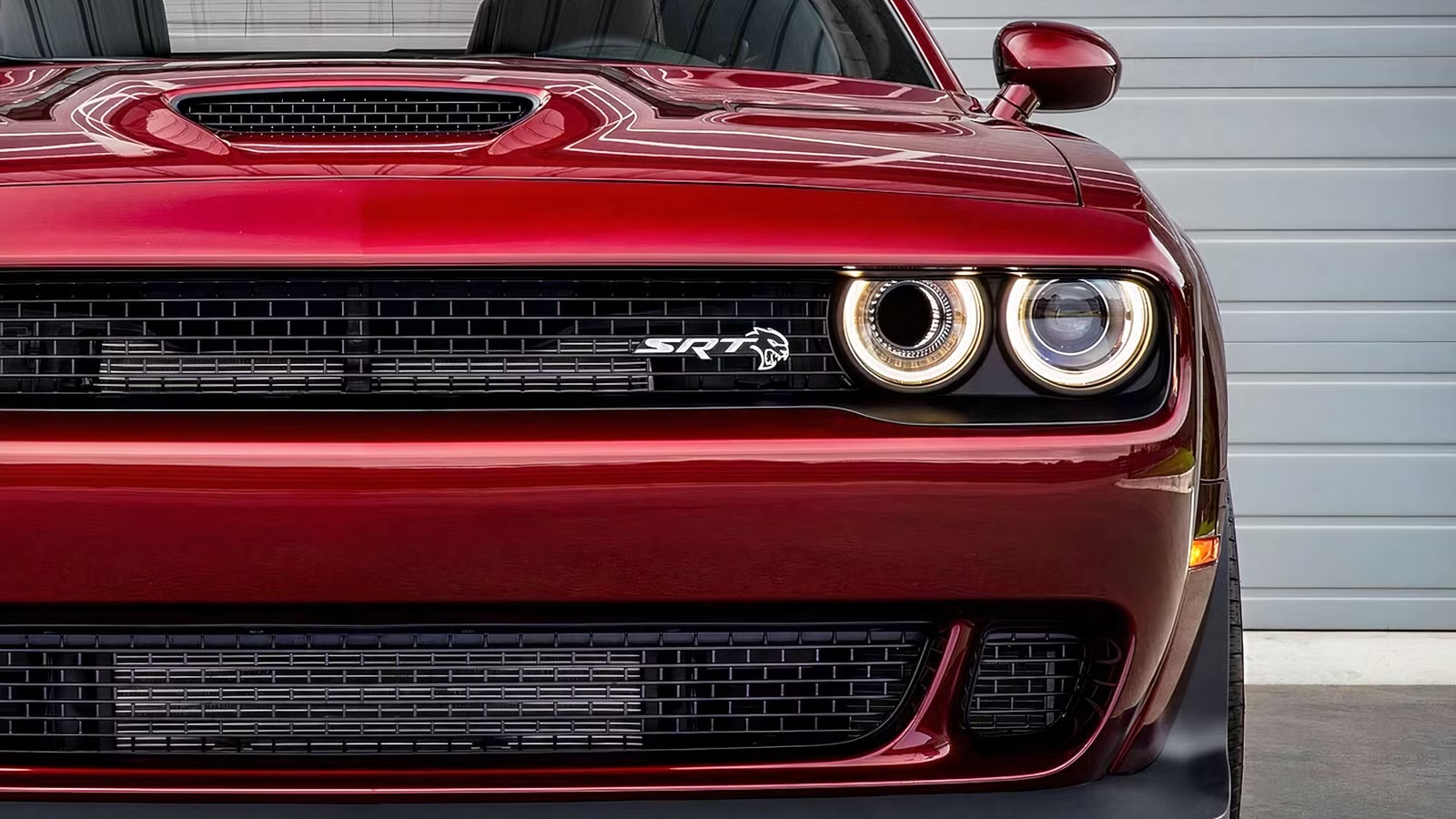
With its much-anticipated Challenger SRT Hellcat, Dodge gave buyers a menacing supercharged 6.2-liter Hemi V8. The unit produced 717 hp in standard Hellcat form, 797 hp in Redeye form, and up to 807 hp in an extreme variant. This was unashamed excess as Dodge tried to recreate an old muscle-car fantasy, and it certainly felt good to true enthusiasts at the time. Dodge would eventually end the Challenger era in 2023 with its last gas-powered version, which elevated the Hellcat to a desirable used-market item.
But when that happened, the Hellcat became an underwriting nightmare, and it started to spell trouble for enthusiasts looking for this discontinued muscle car. Many of those enthusiasts had been waiting around for the Hellcat to take its depreciation medicine and become more affordable, but while the sticker price may have been more appetizing, those premiums were under serious pressure.
Data from the Highway Loss Data Institute, a part of the Insurance Institute for Highway Safety, suggests that high-powered Dodge muscle models are magnets for car thieves, with 2020 to 2022 Charger SRT Hellcats coming in at 25 whole-vehicle theft claims per 1,000 insured vehicle years. And this suggests that both thieves and insurers now fully understand the broader high-horsepower Dodge muscle ecosystem.
Meanwhile, on forums, Hellcat and Challenger fans regularly trade eye-watering insurance quotes and wonder what to do. One particular thread from a Hellcat owner in Atlanta reported a quote ranging from $580 to $650 per month. Another lamented that they couldn’t afford to buy the SRT because the insurance added too much on top of their payments.
Mustang GT, M3, And Other Performance Buyers Are Caught In The Same Squeeze
2018 Ford Mustang GT finished in orange with black interiorFord
While the Hellcat has its own legion of fans and potential buyers, Ford’s Mustang GT is probably the greatest symbol of attainable American V8 performance. However, the insurance story is complicated here, as well. Some figures suggest that a Mustang GT premium costs around $2,500 annually, but there are significant variations. A costly ZIP code, a recent claim, a high-theft area, or a young driver can see that quote climb significantly.
The Camaro ZL1 is showing around $3,000 annually on average in some high-performance car data, with the Corvette Z06 higher still. The Highway Loss Data Institute discovered that the 2022-2024 Camaro ZL1 had a whole-vehicle theft rate that was 39 times the average for all vehicles, which doesn’t help its cause.
Related
You’re Not Imagining It, You’re Paying WAY More For Car Insurance Than Ever Before
Car insurance has gone up more in the last three years than ever before.
People looking for a BMW M3 may discover a different flavor of pressure. This one isn’t a traditional muscle car, of course, and more people are likely to buy an older version as a cheap used V8 toy. But it still comes with expensive parts, luxury repair costs, and high-performance risks, with a buyer profile that insurers fully understand. So, even though an enthusiast may just want a car like this that feels a bit special on the back roads but that can still commute well and carry passengers, insurers don’t care. Instead, they remind potential buyers that premium performance now translates to premium exposure and the likelihood of (you guessed it) premium rates.
Specialty Insurance Can Help, But It Changes The Ownership Contract
Front view of a 2018 Chevrolet Camaro ZL1 1LEChevrolet
In recent years, specialty insurers have been quite busy. Companies like Hagerty, one of the best-known names in collector and enthusiast coverage, have reported strong written premium growth in 2025, with record new member enrollments. This suggests that some Hellcat, ZL1, or Z06 buyers may be seeking solace in a specialty policy. The larger takeaway suggests that enthusiast-focused coverage is now a lot more relevant to average buyers, as traditional pricing becomes more painful.
But while specialty insurance may be a solution, it could also change the ownership contract. Some such insurers may insist that buyers keep their vehicle in secure storage or even limit its use. Those agents may look for another regular-use vehicle in the household and could frown if the coverage seeker wants a commuter.
Related
Challenger vs. Charger: Which Iconic Muscle Car Is Superior?
While they’re currently going through an electric transformation, let’s take a look at the history and compare each of these classic muscle cars.
Those restrictions may be okay for some owners who just want a low-mileage Hellcat that they’d use on weekends and keep in a garage. But for others who are looking for a daily driver or who may be forced to park on the street in a theft-heavy city, problems remain. Those consumers may just want to use a used M3 as a real form of transportation, and that may be the whole appeal of such a purchase. But insurers may be starting to move performance cars away from daily-driver culture and toward the realm of the selective collector. The cars are still around, but the accessible ownership model could be starting to shrink.
Driving enthusiasts can still buy performance cars, but before they decide, they are increasingly having to shop for insurance first. They may have to consider garaging arrangements, compare multiple insurance carriers, and even evaluate different deductibles. They may also need to consider a specialty policy to see if it fits their real use. So, while cars like the Mustang GT or Camaro ZL1 will always remain desirable, they may no longer be as attainable for the next generation of enthusiasts. In this case, those enthusiasts may not be priced out by the car itself, but by the insurance policy that increasingly dictates how they drive it.
Sources: IIHS, Stellantis, HLDI, Reddit, Insurify, Ford, Hagerty.
