

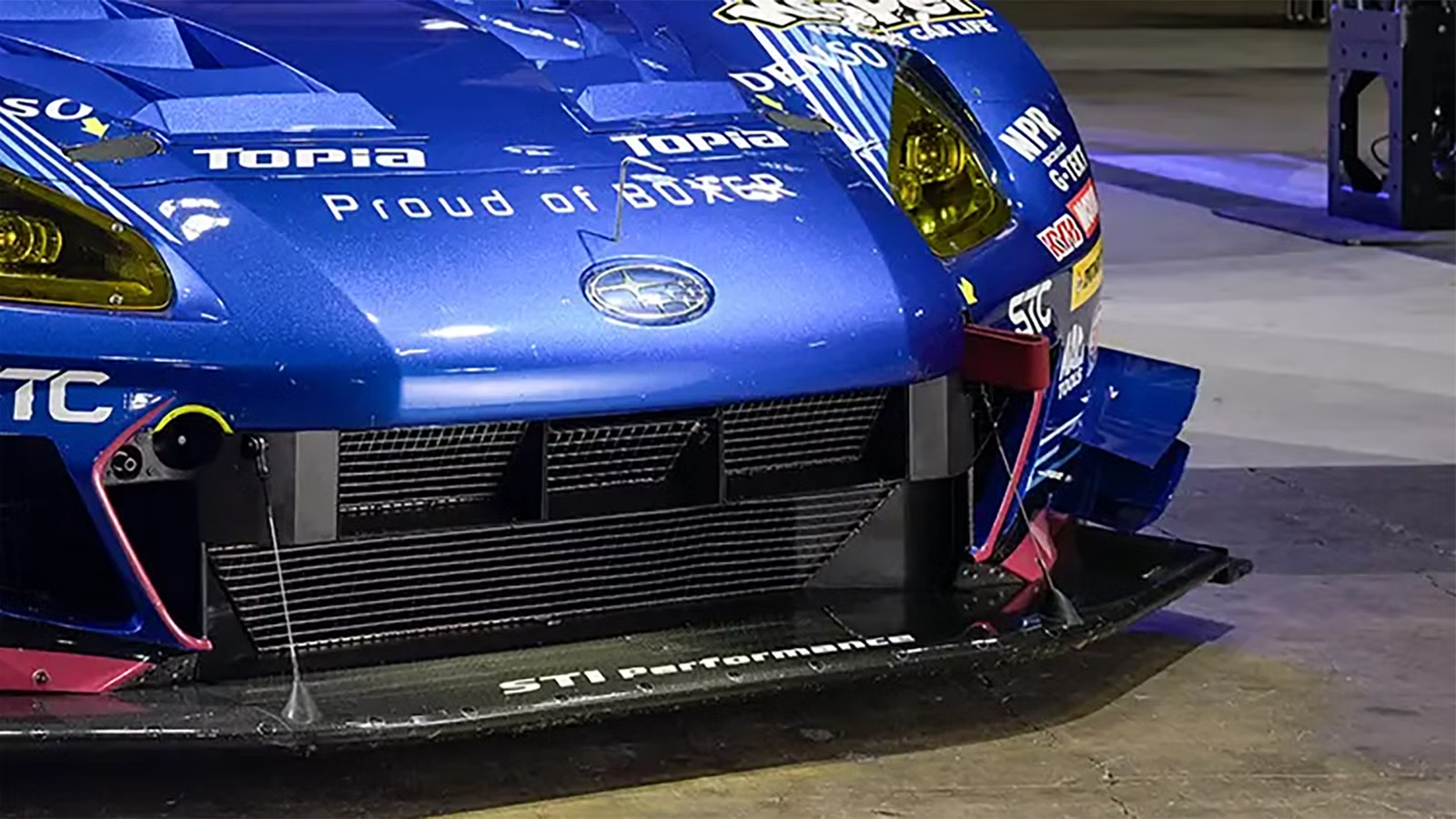
In the United States, the Subaru brand is best known for all-wheel drive, but the automaker also touts its horizontally opposed engines as a key benefit. All of its vehicles (except for the new EVs) are equipped with flat-fours, which have a lower center of gravity and better balance than the inline-fours that are far more common in its competitors. But the automaker has experimented with flat-six engines in the past as a means to improve power (and prestige) in its cars, most recently in the 2019 Subaru Outback 3.6R.
Subaru GT300 BRZSubaru
These days, flat-sixes are a thing of the past for the automaker, which uses turbocharging as its primary power-adder in cars like the Outback XT and Ascent. But earlier this year, Subaru introduced another flat-six, a twin-turbocharged 3.0-liter engine built for the Japanese Super GT racing series, debuting in the BRZ GT300. Although it seems like it was built on the cutting edge of internal combustion engineering, the impressive motor has much older roots – it’s derived from the one found in the 1992 Subaru SVX, dubbed Alcyone SVX in Japan.
What Is The Subaru Alcyone?
Subaru XTCars & Bids
Known as the Subaru XT in North America, the Alcyone was introduced in 1985 as a sophisticated, technologically advanced halo model for the brand. The wedge-shaped sports coupe featured several impressive advancements, including impossibly low bodywork (enabled by the flattened, compact engine design) and excellent aerodynamics. At the time of introduction, it was the slipperiest shape in the automotive world, with a drag coefficient of 0.29. It also became the first-ever six-cylinder automobile that Subaru offered in the US, incorporating a 2.7-liter flat-six in the 1988 XT6 (called the Alcyone VX in Japan).
By the end of the decade, the once-stylish origami design had grown a little dated. It was time for the brand to introduce a new flagship, and this time it would move upmarket to challenge the likes of Infiniti and Acura. The result was the 1992 Subaru SVX, which was longer, lower, and wider than its XT6 predecessor, with 1990s-chic, elegant contours replacing the knife-slash edges of the 1980s. Unlike the first-generation coupe, the Alcyone SVX – as it was known in Japan – came standard with a six-cylinder engine, the 3.3-liter EG33 that wasn’t used in any other Subaru model.
What Makes The Subaru SVX So Interesting?
Subaru SVXSubaru
As with the XT, aerodynamics were still a main focus of the sports coupe. Despite having a larger engine, its pancake-shaped profile allowed yet another low hoodline. The curved side glass sat flush with the roof and pillars. The SVX incorporated a stepped beltline into its design, with roll-down glass that stretched further into the doors than the fixed pillar glass. This novel window-within-a-window design became the SVX’s defining visual characteristic, with its futuristic look (and somewhat impractical shape for drive-thru–obsessed Americans) turning it into a love-hate thing for potential owners.
Although time has been more kind to the SVX, its exterior design was divisive. The narrow, full-width headlamp panel, high decklid, and fighter-jet greenhouse were perhaps a bit too avant-garde for a company that was better known at the time for decidedly homely, yet practical and responsible, sedans and wagons. Convincing consumers to spend genuine luxury money. Its 1992 base price of $24,445 split the difference between a BMW 318i and 325i of the same vintage on a vehicle that shared its badge with their eccentric neighbor’s BRAT was definitely a stretch.
1994 Subaru SVX Beige Interior Front CabinBring A Trailer
But its odd position in the market aside, the SVX was a solid luxury coupe. A contemporary Car and Driver review saw the 3,614-pound coupe hit 60 miles per hour in 7.6 seconds, a shade behind the Nissan 300ZX 2+2. All-wheel grip sat at 0.86 g, and it braked from 70 to 0 in a scant 172 feet.
Some other cars can match these capabilities, but few can do so while demanding so little of the driver. This isn’t to say that the SVX feels numb and disconnected. The speed-sensitive power steering, for example, is a model of response and accuracy. However, when even the windshield wipers are smart enough to automatically sweep faster at higher speeds, you know that the SVX is one of the more effortless high-performance GTs available.
– Rich Ceppos, Car and Driver
The publication even praised the mandatory four-speed automatic, a necessity because Subaru didn’t have a manual transmission that could cope with the 3.3-liter engine’s 224 pound-feet of torque – the most of any vehicle it had ever offered in the US. Still, C+D said that the electronically controlled slushbox might be better at selecting the right gear for the situation than any human would be, and that the variable torque-split all-wheel drive could apportion power almost instantly to the axle with the most grip. That’s high praise from the magazine that would spearhead the “Save the Manuals” movement two decades later.
Related
Subaru’s Forgotten WRX STI-Powered Wagon Is A Cheap Way To Own An Amateur Rally Car
This family wagon packs the same engine as the iconic WRX STI but costs a fraction of the price.
Why Did The SVX Fail In The Market?
Subaru SVXSubaru
Subaru had lofty expectations for its technologically advanced flagship coupe, with sales projections of 10,000 units a year in the US. But in 1992, the automaker sold only about 5,000 SVXs, with sales sliding each year after that. There are a few reasons for its failure in the American market, but the most obvious one isn’t the car’s fault at all.
The sub-$25,000 base sounds decent now, but it actually represents about $58,000 in modern money. Things got worse when you added options and accessories, since the SVX with the Touring package hit $28,000, or about $67,000 adjusted for inflation. Meanwhile, the flagship Legacy trim, the Sport, was $5,000 cheaper, while Subaru’s entry-level Justy was just $6,645 when new. The stylish, premium buyers Subaru hoped to court with the SVX wouldn’t have likely considered a model from such a humble brand – the Justy was a three-cylinder subcompact, for heaven’s sake — which is exactly why Honda, Nissan, and Toyota spun their luxury offerings into new nameplates.
1992 Subaru SVX Competitors
Subaru SVX
Acura Legend Coupe
Nissan 300ZX 2+2
Toyota Supra
Engine
3.3-liter flat-six
3.2-liter V6
3.0-liter V6
3.0-liter inline-six
Output
230 hp / 224 lb-ft
200 hp / 210 lb-ft
222 hp / 198 lb-ft
200 hp / 188 lb-ft
0-60
7.6 seconds
7.3 seconds (sedan)
6.7 seconds
7.9 seconds
Price
$24,445
$31,300
$33,090
$25,280
But if you ignored the automaker’s brand image, the SVX was actually in decent company. Many of its would-be rivals cost more and performed worse, while also lacking the individuality that defined the graceful Subaru coupe at the time. It’s just a shame that more consumers weren’t willing to take the chance on the airy, canopy-roof SVX when it was new.
What Does The SVX Have To Do With A Modern Race Car?
Subaru GT300 BRZSubaru
Despite its relative lack of success when it was new, the legacy (ahem) of the old Subaru coupe lives on with the automaker’s latest Super GT entry. As we reported in January, the BRZ GT300’s engine is a newly developed version of the old EG33 flat-six, although obviously, it’s been significantly redeveloped to handle forced induction and racing duty.
The automaker chose to retire the legendary EJ20 engine from its racer because it felt the engine had been stretched to its limit in terms of power and reliability. It anticipates the new 3.0-liter flat-six will be more competitive because each individual cylinder will have to cope with less boost and combustion pressure to produce the same amount of power.
Subaru GT300 BRZSubaru
If you want your own roadgoing Subaru six-cylinder sports car, don’t fret. These days, the SVX can be had in good condition for about $7,000, with absolutely pristine examples demanding $10,000 or $11,000. Better still, the aftermarket has discovered a workaround for the mandatory four-speed auto, with some companies offering retrofit kits for the five-speed stick found in the later-model Subaru WRX. We doubt a manual transmission would’ve saved the original SVX, but it certainly wouldn’t have hurt.
Now if you could find yourself a race-wrecked BRZ GT300 and swap that powertrain in, then you might have a real Supra killer on your hands…
Sources: Car and Driver, The New York Times
