

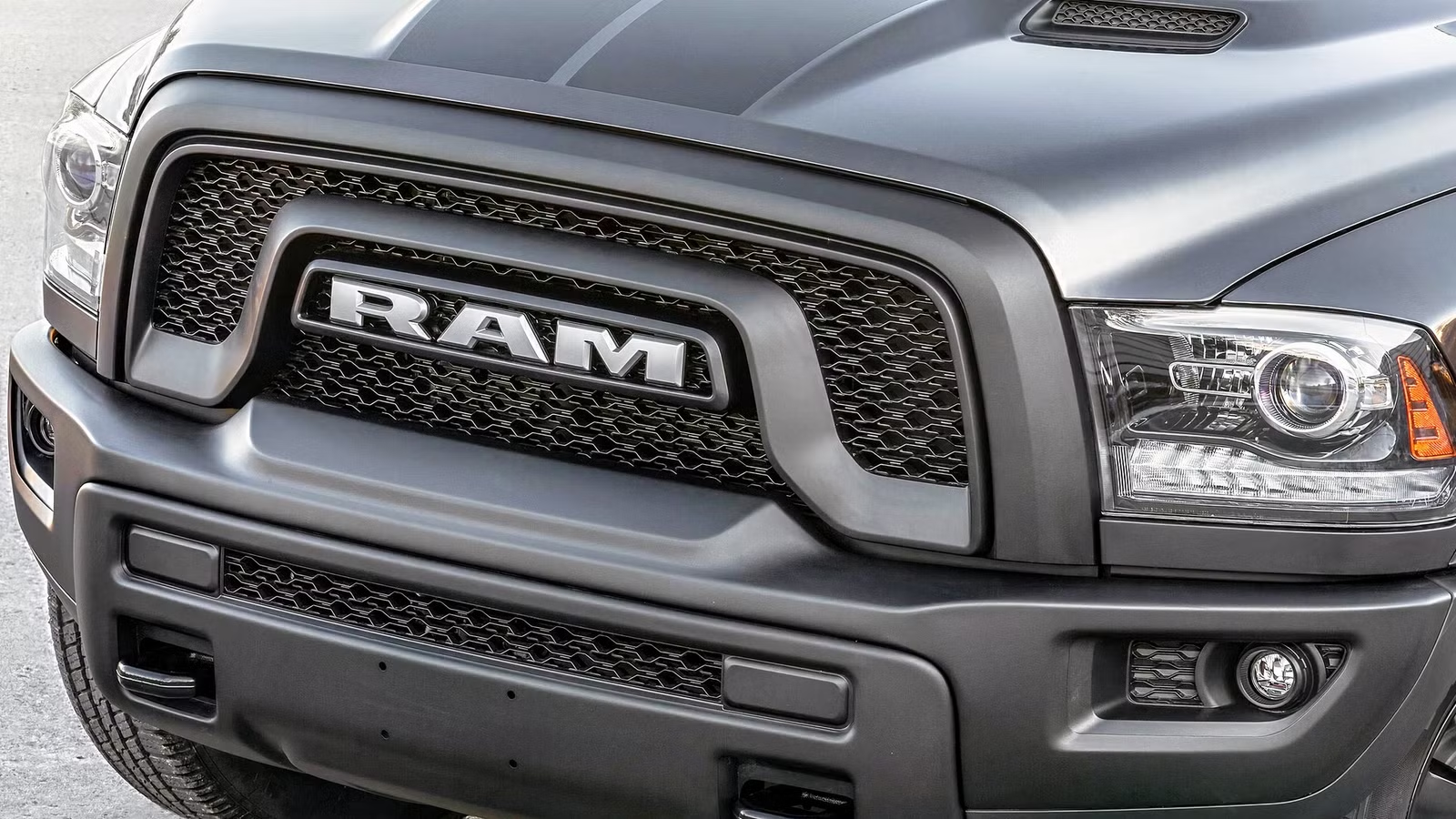
We wish more automakers would follow the example set by the Ram 1500 Classic, a continuation of the fourth-gen pickup, sold from 2019 to 2024, five years after the launch of the fifth generation. We get it, production space is a finite resource, and every vehicle would eventually fall behind emissions regulations, but would it really be so bad to keep the V6-powered Toyota Tacoma around for a few more years?
Of course, if you’re buying a fourth-gen Ram 1500 in 2026, they’re all outdated by now, but you’ve got 16 model years to pick from. As it turns out, taking 16 years to work out all the bugs results in a remarkably reliable pickup truck. The truck sold for less than an entry-level Ram 1500 on release, and continues to sell for a bit less than the newer pickup on the used market, making for a great deal on a dependable truck.
16 Years Of Refinement Produced An Excellent Pickup
2023 Ram 1500 HEMI E-TorqueRAM Trucks
The decision to keep the fourth-gen 1500 in production was sort of a “why not?” on the part of Stellantis. There was still demand for the older truck, and Ram had the means to keep up with that demand, so why leave money on the table?
Ram has not shared any breakdowns of exactly how many Classics the brand was selling for every fifth-gen Ram 1500 from the 2019 to 2024 model years. We’ve read guesstimates ranging from around 9% to 35%, but there are no verifiable numbers available to the public.
It’s Hard To Find Anything Wrong With A Ram 1500 Classic
2023 Ram 1500 HEMI E-TorqueRAM Trucks
We can’t verify sales figures for the 1500 Classic, but we do know that the 2023 model year doesn’t have a single engine recall on file with the National Highway Traffic Safety Administration. Checking the NHTSA page for the 2023 Classic shows a recall for fuel pump failure in the 3.0-liter diesel engine. But the 1500 Classic doesn’t have a diesel engine. This is a recall for the fifth-gen Ram 1500 that just happens to be listed on the Classic’s recall page.
It’s the same story if we look at the CarComplaints page for the 1500 Classic. The truck hasn’t generated a single complaint since the 2020 model year, when it produced three reports. The most worrying of them was a report of an intermittent battery drain at 14,000 miles. No cause or solution was listed for this problem.
Checking the J.D. Power Quality & Reliability scores for the 1500 Classic, the truck was reviewed just twice, for the 2021 and 2023 model years.
Model Year
Q&R Rating
2021
81/100
2023
88/100
Average
84.5/100
It’s worth noting how the truck’s Quality & Reliability rating improved by seven points over just two model years, which supports what we’ve been saying: the longer you keep a vehicle on the market, the more time you have to work out its kinks.
Related
Video: The Ram 1500 Classic Is Back With A New Name And New Ideas
The affordable full-size Ram pickup is back as the 1500 Express.
Simplicity Is Key To The Classic’s Dependability
2019 Ram 1500 ClassicRam
The fifth-gen Ram 1500 introduced a new eTorque system, standard on the Pentastar V6 and optional on the 5.7-liter V8 Hemi. This is a mild-hybrid system that replaces the alternator with a belt-driven generator. This is intended to improve performance and fuel economy, and the proof is in the pudding, as it were. To compare Hemi specs for both the eTorque-equipped 1500 and the 1500 Classic, for the 2019 model year.
2019 Ram 1500 w/eTorque
2019 Ram 1500 Classic
Power
395 hp
Fuel Economy (Combined)
19 mpg
17 mpg
Maximum Towing Capacity
12,750 lbs.
10,710 lbs.
When properly equipped, you’re looking at an extra ton of towing capacity and a couple more miles out of every gallon when you go with the eTorque system. On the other hand, you’re inviting a whole bunch of reliability issues you wouldn’t have to worry about in a Ram 1500 Classic. To round up some of the more worrying eTorque complaints from around the web.
- A 2021 Ram 1500 owner reports a grinding noise at just 8,000 miles on RAMForum.com.
- Another driver in this thread reports a squealing noise while idling and jerky downshifts.
- An owner in the r/ram_trucks subreddit reports premature bearing wear resulting in grinding and whining, and auto-stop/start not working, at just 75,760 miles. The owner reports the dealer initially denying their warranty before finally agreeing to do the work after a bit of back and forth.
- CarComplaints identifies battery drain as a common issue across many fifth-gen 1500s, associated with the eTorque system.
- One user reports to CarComplaints that their truck “won’t shut off,” forcing them to manually disconnect the battery at just 4,050 miles.
Note that for every comment we’ve found condemning the eTorque system as a piece of junk, we’ve found another comment from a driver who’s “never had any problems” with the system. We’re not saying that the eTorque system is a guaranteed failure point, only that if you want an incredibly low-maintenance pickup, you should err on the side of simplicity.
To put it another way, the only way to ensure you never have to deal with eTorque problems is to simply not buy a truck with an eTorque system in the first place.
Related
The Humble Dodge Ram 1500 Introduced A Feature We Now Take For Granted
Every full-size pickup is available with a roomy cab these days, but that wasn’t always the case.
A Five-Year-Old Ram 1500 Classic Is Priced Just Right
Ram 1500 ClassicRam
The Ram 1500 Classic hasn’t quite reached third-gen Tacoma status, where people are paying more for the old model than they are for the new ones. But prices are fairly stable, with an entry-level 2021 model currently selling for about two-thirds of its initial MSRP.
Checking out our own marketplace, we were able to turn up the following deals.
- The cheapest model we can find is a 174,579-mile 2019 SLT selling for $8,995 in Texas.
- A 99,753-mile 2021 Tradesman is selling for $18,659 in Oklahoma.
- An 88,139-mile 2020 Tradesman is selling for $18,895 in Maryland.
- A 73,950-mile 2020 Warlock is selling for $19,850 in Colorado.
- A 66,154-mile 2019 Big Horn is selling for $20,800 in Texas.
Based on these numbers, we’d say that you can just about have your pick of trims under 100,000 miles, with a budget of $20,000. Note that these listings are only provided as examples of what’s out there. There’s no telling what you’ll be able to find in your own area, and in your price range, when you’re ready to search for your own.
The Ram 1500 Classic Is An Easy Truck To Live With
2024 Ram 1500 Classic Front 3/4 ViewRam
RepairPal does not have a maintenance estimate for the Ram 1500 Classic in particular, but the 2018 Ram 1500, which was essentially the same thing as a Ram 1500 Classic, should have you spending around $539 a year on maintenance, with the following accounting for the most expensive common fixes.
- Timing chain tensioner replacement $1,479 – $1,922
- Active suspension system control module replacement $1,208 – $1,253
- Diesel injection pump replacement $1,024 – $1,183
- Backup warning system sensor replacement $610 – $644
- Windshield washer fluid reservoir replacement $334 – $403
Meanwhile, CarEdge estimates an annual insurance cost of around $2,388 for a Ram owner, assuming full coverage for a 40-year-old driver with good credit and a clean record. FuelEconomy.gov estimates fuel expenses of $3,100 to $4,200 per year, depending on your engine and drivetrain configuration. We can split the difference and say $3,650, or about $10 a day, assuming 15,000 miles a year, split 45/55 between highway and city driving.
Ram 1500 Classic Annual Ownership Costs
Maintenance
$539
Insurance
$2,388
Fuel
$3,650
Total
$6,577
Your mileage will certainly vary, but all told, a typical Ram 1500 Classic driver will probably spend around $548 a month to keep their car fueled, fixed, and street-legal. Not bad for a truck that can easily cross a quarter million miles without a hiccup.
Sources: Stellantis, Ram, RepairPal, CarComplaints, NHTSA, FuelEconomy.gov, RAMForum.com, r/ram_trucks.
